Days before he meets world leaders including Joe Biden at the G7 summit in Cornwall, Boris Johnson faces the humiliation of seeing his deep cuts to Britain’s international aid spending denounced in parliament by senior members of his own party.
Former prime minister Theresa May will be among a string of leading Conservatives to call on the prime minister to restore the commitment - enshrined in law by David Cameron and included in Mr Johnson’s general election manifesto - to meet the United Nations target of spending 0.7 per cent of national income on overseas development assistance.
The UK is the only member of the G7 group of leading world economies to be cutting its aid budgets during the coronavirus pandemic, and Mr Johnson’s critics have warned that Britain’s “credibility and voice” at the three-day summit in Cornwall will be undermined if he persists with plans to slash aid to 0.5 per cent of GDP at the potential cost of thousands of lives.
They hope Mr Biden will use a face-to-face meeting with the PM on Thursday to pile on pressure to reverse the cut.
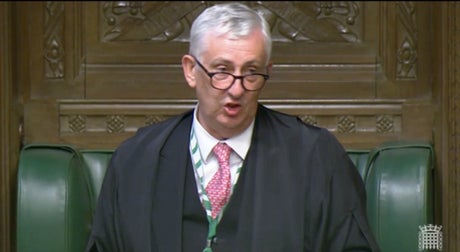
Mr Johnson escaped a likely defeat in the Commons on Monday evening, after Speaker Sir Lindsay Hoyle ruled a rebel attempt to force a vote out of order.
But in an unusually brutal slapdown for the PM, Sir Lindsay accused Mr Johnson of failing to show the Commons “the due respect which it deserves” and demanded an urgent and legally-binding vote on the cuts.
He gave the green light to an emergency three-hour debate on Tuesday, when Tory rebels will tear into the aid policy. But any vote following that debate will be purely symbolic and Downing Street sources indicated that Mr Johnson is resisting pressure to grant the “effective” vote demanded by Hoyle.
Former international development secretary Andrew Mitchell, who secured the emergency debate, said that Mr Johnson is facing a defeat by a margin of up to 20 if MPs are ever allowed to divide on the issue, suggesting a rebellion of as many as 50 Tories.
And he said the rebels are considering new procedural methods of forcing a vote onto the parliamentary timetable if the PM does not accede to the Speaker’s demand.
“The government needs to address the fact that the maths in the House of Commons is against them and isn’t going to go away,” Mr Mitchell told The Independent. “It’s important that we stand by our commitments and our promises and get the government into a better place.”
He added: “In the week of the British chairmanship of the G7, the government’s failure to address this issue will indisputably mean that hundreds of thousands of avoidable deaths will result. It is already attracting criticism from all round the other members of the G7.”
Former cabinet minister David Davis told The Independent that the government was acting “unlawfully” and would be challenged in the courts if it did not offer concessions now.
“With the economy recovering very sharply, the excuse for not standing by our promises is evaporating,” he said. “The government can and should now come back with a new and better thought-through strategy which enables them to retain the 0.7 per cent figure and deal with the real threat to people from starvation, unclean water and neo-natal deaths. There is an economic justification and a moral justification and now there is a parliamentary demand for it.”
Speaker Hoyle left no doubt that he will look sympathetically on any attempt to force ministers to allow MPs the deciding vote on the aid cut, if Mr Johnson will not do so voluntarily.
Telling MPs of his “frustration” at the government’s actions, he said: ”This House should not continue to be taken for granted.
“We are the elected members. This House should be taken seriously and the government should be accountable here.
“So I wish and hope, very quickly, that this is taken on board. I don’t want this to drag on. If not, we will then move to find other ways in which we can move forwards.”
Parliament’s longest-serving MP, father of the House Sir Peter Bottomley, said that a backbench business motion could be used to force a substantive motion requiring the government either to name a date for the restoration of the 0.7 per cent level or to bring forward a bill to change the UK’s commitments on aid, which he predicted would be defeated.
He told The Independent: “Those like me who want to retain the 0.7 per cent are not rebels, it is the government which is rebelling against the law and against what was in the manifesto of virtually every MP elected in 2019.”
The chair of the Commons Defence Committee, Tory former minister Tobias Ellwood said most Tory rebels would be ready to accept the compromise of Mr Johnson committing to return to spending 0.7 per cent after one year at the lower level, said Mr Ellwood.
He told The Independent that the row had brought an “overdue focus” on the important role which aid plays in extending the UK’s “soft power” to counter the growing influence of authoritarian states like China and Russia.
“Well-targeted aid pays for itself,” said Mr Ellwood. “ It educates, it builds communities and it strengthens markets with which we can trade. When we pull out of programmes, we create a vacuum which is filled by extremists or is exploited for their own advantage by the likes of China and Russia.”
Oxfam branded the failure to hold a binding vote “bitterly disappointing”.
“As the country prepares to welcome G7 leaders, the government continues to undermine the UK’s credibility on the international stage while its commitments to the world’s poorest are abandoned,” said the charity’s Sam Nadel/
Melanie Ward, UK executive director at the International Rescue Committee, said: “This issue is not going away. The UK is an outlier as the only G7 country to cut aid spending and will fall behind as other leading wealthy countries increase their financial assistance.”