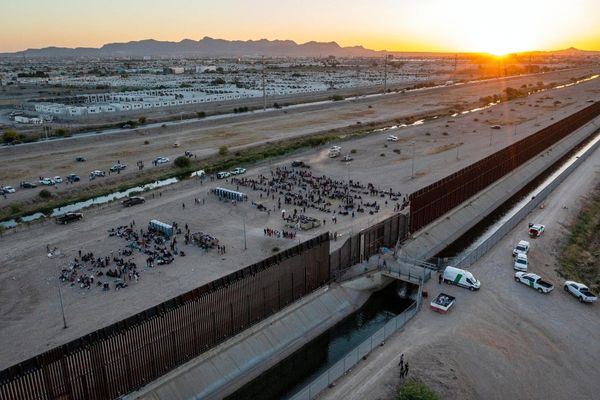
EL PASO, Texas _ More than 40,000 parents and children _ mostly from Guatemala _ were detained at the U.S. border in February, straining U.S. Customs and Border Protection's ability to care for immigrant families even as migrants are being apprehended in the highest numbers in more than a decade.
The border patrol said Tuesday that February was the busiest month since 2007 for apprehensions at the southwest border, where 76,103 migrants were detained in the month. That's up from 58,207 in January _ a more than 30 percent increase.
This year is on track to be one of the busiest in overall migration in a decade, with numbers likely to increase even more as warm weather arrives along with rising job demand, according to statistics released by CBP.
"It should be very clear from these numbers that we're facing alarming trends and a rising volume of people illegally crossing our southwest border, or arriving at our ports of entry without documents," CBP Commissioner Kevin K. McAleenan said during a Tuesday news conference in Washington. "The system is well beyond capacity and remains at the breaking point."
Pushed away from ports of entry because of new restrictions such as Trump's metering system that requires asylum seekers to wait in Mexico while U.S. officials slowly process their cases, migrant families are arriving in larger groups, from the dozens to the hundreds, in rugged, remote areas on the edge of Texas, New Mexico and Arizona.
Since October when the new fiscal year began, at least 70 groups of 100 or more people have turned themselves in at border patrol facilities. By comparison, only 13 such groups arrived in the last fiscal year, and two in the year before.
Remote facilities, mostly hours away from cities, are unprepared to receive families. When the units were originally designed in the 1980s and 1990s, they were designed to hold mostly single Mexican men who were typically deported within hours.
"Regardless of anyone preferred policy outcome, the status quo is unacceptable," McAleenan said. "It presents an urgent and increasing crisis that needs to be addressed."
McAleenan said migrant shelters in border communities, particularly here in El Paso, are overwhelmed with the daily arrival of migrants, often in the hundreds per day. To alleviate some of the pressure, McAleenan said a new massive processing center in El Paso will be built to reduce the time families are spending in small holding cells after they're apprehended.
The center may hold up to 800 people at any time, U.S. Rep. Veronica Escobar, D-Texas, has said.
Brian Hastings, chief of operations for the border patrol, called the current situation "unsustainable" and added that without legal consequences at the border, the border patrol "has no reason to see the trend decrease."
He also noted that intelligence shows that "drug cartels are using (migrant families) as cover and as a diversion" tactic, something that is "highly concerning for us."
Asked specifically what the priority should be _ immigration reform vs. adding new physical barriers, such as President Donald Trump's border wall, McAleenan responded, "We need to do both. We're facing a security and humanitarian crisis," adding that families generally are turning themselves in, but noting that there's a need to fortify the border even more via high technology capabilities and physical barriers.
Critics maintain building a wall would do little to stop the flow of migrants because the current barriers _ steel bollards and wire mesh _ are already built on U.S. soil. Daily, migrants with children arrive and head for the fence and peek through, hands waving, to get the attention of border patrol agents to whom they can legally turn themselves in to file a credible fear asylum claim.
Homeland Security Secretary Kirstjen Nielsen is expected to testify before Congress this week as the debate over funding the wall continues. Trump has declared a national emergency to shift federal funds around to spend billions on a wall, but the U.S. House has already passed a bill to overturn that emergency and the Senate is expected to do so within days or weeks. Trump has vowed to veto the legislation to keep his emergency intact.