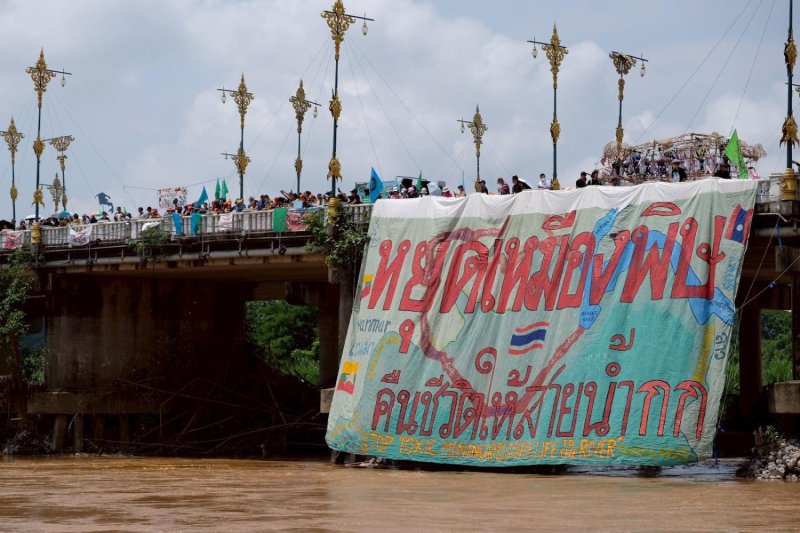
As Myanmar's military junta leader Min Aung Hlaing arrives in Thailand this week, much of the media attention will focus on diplomacy and trade, without raising critical questions. Nevertheless, one crisis directly affecting the health and security of people across both nations requires immediate attention: transboundary river contamination from mining that harms communities along the Kok, Sai, Ruak, Mekong, Salween and Kraburi rivers.
As one village headman along the Mekong on the Thai-Lao border recently described: "The Mekong has changed dramatically. People used to catch enough fish to feed their families. There were once hundreds of fish species, but now only a few dozen remain." His greatest concern today is no longer just disappearing fish, but contaminated water.
"Our village water supply comes from the Mekong. The treatment system only makes the water look clean. It cannot remove toxic heavy metals," he said. "Some families can afford bottled water, but many cannot. Officials tell us contamination levels are still low, but people worry about toxins accumulating in our bodies over time. When a crisis occurs, the government has a responsibility to provide information. It cannot simply leave communities to face this alone."
His words remind us that this is ultimately not about geopolitics. It is about whether governments are accountable to the public, prioritising their health and well-being and that of generations to come.
Thailand's Pollution Control Department (PCD) has repeatedly detected elevated concentrations of arsenic and other heavy metals in several transboundary rivers. In Mae Hong Son, monitoring has found arsenic and mercury contamination in the Salween River at levels five to six times above national standards. Independent researchers have documented hundreds of expanding mining sites in Myanmar's upper Salween basin, particularly in Shan State, many operating with little transparency or environmental oversight. This lack of oversight means toxic runoff flows freely into shared water systems, endangering both local biodiversity and the health of downstream farming communities. This points to a regional crisis expanding faster than governments are willing to acknowledge. That is why civil society organisations are deeply concerned that Min Aung Hlaing's visit could become an exercise in diplomatic normalisation while the destruction of rivers continues unabated.
The concern is reinforced by Myanmar's own response to the United Nations. In its official submission to the UN Special Rapporteurs and Working Groups, the junta denied authorising mining activities in areas controlled by the United Wa State Army. It also rejected allegations that mining in Shan State has contaminated the Kok River, insisting there is no evidence that mining has caused arsenic pollution beyond Myanmar's own standards.
Along the Thai-Myanmar border in the North, Myanmar military positions and UWSA bases operate in close proximity. It is therefore difficult to believe the rapid expansion of mining in eastern Shan State has occurred entirely without the knowledge of authorities in Nay Pyi Taw. Whether through approval, acquiescence or failure to enforce environmental law, these activities cannot simply be dismissed as someone else's responsibility. If Myanmar's official position is that there is no pollution problem, then what exactly is Thailand negotiating? Negotiation requires a shared understanding of facts.
The current draft Terms of Reference reportedly focus almost exclusively on the Kok River and neighbouring areas of Shan State. That is a serious flaw because pollution does not stop at administrative boundaries, nor do toxic heavy metals respect lines drawn on a map by diplomats in negotiating rooms. Nor should this issue be reduced to a bilateral dispute between Thailand and Myanmar.
Many of the minerals extracted from Myanmar's conflict areas eventually enter global supply chains in which China remains one of the world's largest importers and processors of critical minerals and rare earth elements. These influential state and private actors must be held to account for the ecological footprint of their sourcing practices. Any serious discussion of accountability must include not only producing countries but also players in the supply chain. Ignoring that reality allows those who profit most to evade responsibility, leaving downstream communities across the Lower Mekong to bear the environmental, health and economic costs.
Thailand cannot control what happens inside Myanmar. Nor should anyone expect meaningful environmental governance from a regime that continues to wage war against its own people, systematically dismantling civil society in the process. But the Thai government must take urgent steps to address this crisis. Diplomatic pleasantries cannot take precedence over public safety. The government must establish robust, independent water testing protocols along the border and publicly share the results to ensure transparency.
Pianporn (Pai) Deetes is a co-founder and executive director of Rivers and Rights.