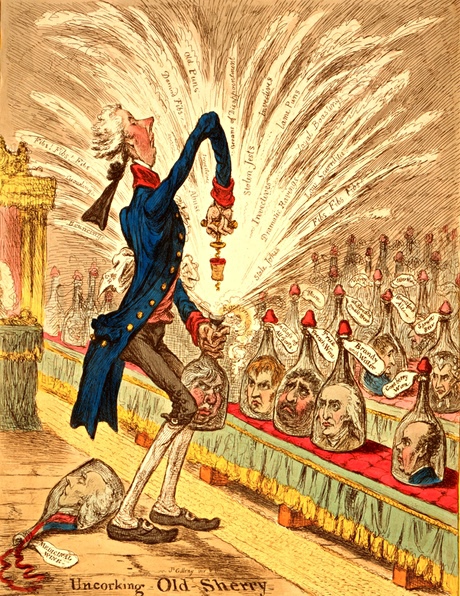
A Nigel Farage photo opportunity with a pint in his hand, an article on the number of bars in the Palace of Westminster, a dose of splenetic outrage about the subsidy of those same bars – these come around as frequently as summer squalls. Yet, if anything, the alcohol consumption of today's MPs and peers falls far short of historic levels. In the late middle ages there was an alcoholic trinity of bars in the Palace, the fairly respectable Heaven and the far less-salubrious underground taverns known as Purgatory and Hell. Several senior politicians were advanced boozers. In 1783, William Pitt the Younger was seen vomiting behind the back of the Speaker's chair before replying to a vital debate as chancellor of the exchequer. When the Tories complained that Thomas Gisborne must have been drunk after he collapsed three times during his defence of the government in a no-confidence debate in 1840, the Whigs said that the problem was that he was not drunk and that when he was tipsy he was really very good.
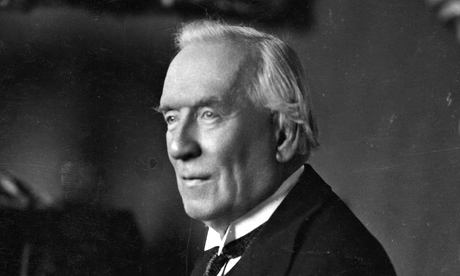
The prime minister furthest advanced in alcoholism was Herbert Asquith, who turned up one evening for the committee stage of the Welsh church bill, which was being taken through by Rufus Isaacs and Herbert Samuel, and promptly fell fast asleep. Sitting opposite, the Tory leader Arthur Balfour complained that the fate of the church was "in the hands of two Jews who are entirely sober and one Christian who is very patently drunk". Countless cabinet colleagues complained. Churchill (ironically enough) called Asquith "supine, sodden and supreme", Richard Haldane told him that he was drinking too much champagne, and Sir Charles Hobhouse complained that his failure to deal with Lloyd George was attributable to the fact that he had been drinking "during the last week or two, pretty hard".
The worst moment for Asquith came at the height of the battle over the parliament bill. It was the key moment in his premiership, two elections had been held in rapid succession over the respective powers of the Commons and Lords, and Asquith was leading for the government – yet he turned up at the dispatch box blind drunk and replied to one important opposition amendment with a speech that was both cursory and incomprehensible, and to another with a very lengthy discourse on everything under the sun other than the amendment in hand. So embarrassing was his performance that Balfour suggested to the chief whip that he take Asquith home. The public, of course, were completely unaware of this at the time and we only know about it because Lloyd George and Churchill told their wives. Armed with that knowledge, it is clear that Balfour's response was laden with intentional double meanings. In a "very strange performance", he said, Asquith had adopted a "peculiar tone" due to "the impossibility which he found in answering the arguments", and it had to be questioned whether the prime minister should be allowed "to indulge". Churchill wrote at the time that "only the persistent freemasonry of the House of Commons prevents a scandal".
He was right. The cameras in the chamber have rightly abolished such secrecy – and politics is on the whole a far drier pursuit today than either Asquith or Churchill would have known.
Chris Bryant's Parliament: The Biography, volume 2, Reform, is published by Doubleday on 14 August.