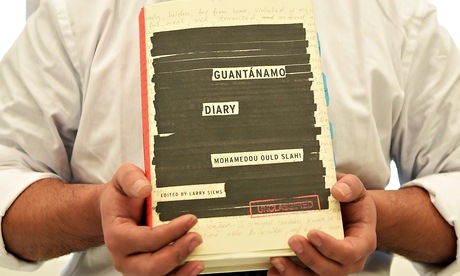
Reviewers were impressed, but also troubled, by Mohamedou Ould Slahi’s Guantanamo Diary. “This must be one of the most remarkable books ever written about the futility of torture,” wrote the Sunday Times’s Tony Allen-Mills, who explained that it took “six years of legal wrangling” before the handwritten manuscript exposing “the scabrous, poisoned heart of America’s War on Terror” could be published, albeit with “more than 2,500 cuts”. In the New York Times, Scott Shane similarly found the book “extraordinary ... gripping and depressing” and its author (who admits having joined al-Qaida but says he quit in 1992) “curious, generous, observant, witty; devout, but by no means fanatical”. For Tim Stanley in the Daily Telegraph the forms of torture he was subjected to “were nothing short of war crimes. They leave one asking what on Earth the west is fighting for.” Alone in taking a different view was the hard-right historian Michael Burleigh, in the Times, who dismissed comparisons elsewhere with Solzhenitsyn, Kafka and Orwell, wondered why the prison diarist had previously “consorted with dangerous Islamists”, and finally asserted that many readers “won’t care” if he was a victim or villain “given the enormity of Islamist crimes that Slahi is too solipsistic to grasp”.
There was less anger around in responses to The Italians by John Hooper, but here too critics were divided. In the Independent the veteran art critic Brian Sewell verged on the patronising as he applauded Hooper – or Hopper, as he also called him – for writing an agreeably “chatty book” full of “whimsy” that avoids “tedious high seriousness”; its author writes “as he might speak in conversation over dinner, never delving deeply into any topic but ready with relevant comment on almost everything”. No such superficiality was detected by the Times’s Richard Morrison, who liked Hooper’s “scores of cracking yarns” but also acclaimed “a lacerating book” whose flinty portrayals of corruption in government, public services and football, and of “medievally repressive Vatican officials”, meant it might be “wise” for its author “to find a different foreign posting”. Morrison concluded by pointing to three “recurring flaws”, however, whereas John Kampfner, in the Observer, found nothing to complain of in a book that “refuses to succumb to easy cliche in explaining the best and worst of Italy”.
Reviews of Johann Hari’s Chasing the Scream: The First and Last Days of the War on Drugs tended to summarise early on the misdemeanours that led to Hari’s resignation as an Independent columnist, then find much to praise in his 400-page comeback. Hugo Rifkind, in the Times, admired the “timely” book’s “forceful” polemic: “it might even change minds”, including “about its author”. Noting that Chasing the Scream is shaped as “a personal journey”, the Sunday Times’s Richard Davenport-Hines wrote that it could be “annoying, garbled and self-important”, but “there is good sense hidden in it, and some of the personal stories are inspiring”. Hari’s biggest fan was the narcotics expert David Nutt, who told London Evening Standard readers his debut was “moving and articulate and impossible to put down. Read it and demand our politicians take note!” The Observer’s Ed Vulliamy identified some significant “omissions”, but nevertheless called Hari “a crucial voice in ... the urgent cause of not merely ‘reforming’ the way society deals with the drugs crisis but tearing it up completely”.