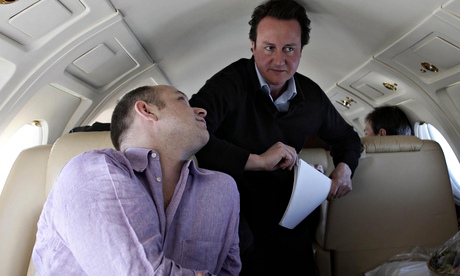
Steve Hilton’s More Human: Designing a World Where People Come First has so far met with largely favourable notices, but his reviewers have been wry as well as enthusiastic, whether mentioning that David Cameron’s former strategy director inspired a fatuous blue-sky thinker in The Thick of It, pointing to the ironies of his post-No 10 stances or discussing his spectacular ideological eclecticism. Nicholas Blincoe, for example, placed him in the clashing traditions of the rightwing sage Friedrich Hayek and the anarchist Peter Kropotkin in applauding his “thrilling book” in the Daily Telegraph; while the Times’s Tim Montgomerie was bewildered by Hilton’s “smorgasbord of views” – sounding like Nigel Farage on Europe, the Greens on supermarkets, Labour’s left wing on bankers and the ruling elite, and rarely like a Conservative – before he belatedly identified a binding theme he liked: the importance of “strengthening social bonds”, with the family awarded a central role. In the Sunday Times, John Arlidge similarly listed so many “faults” that an upbeat concluding verdict looked unlikely, but he managed to produce one, arguing that Hilton’s “fresh ideas” should induce Labour “to persuade the thinking man’s Russell Brand to switch sides”. Brand was also invoked in the Independent by Hamish McRae, in a more sceptical review which grudgingly conceded that “if you can stomach all the hectoring and self-promotion, there are a lot of sensible ideas trying to get out”.
In Closet Queens, Michael Bloch had to choose between “sticking to the hard evidence”, wrote the Mail on Sunday’s Craig Brown, and gathering “a pick-and-mix of rumour, gossip and vague intuition, and parading it as though it were much the same. Unsurprisingly, he has chosen the second path.” For Brown, the trouble with Bloch’s outing of politicians who were supposedly secretly gay or bisexual is that he “employs his random tick-in-box inventory of human characteristics as a gauge of homosexuality, when they apply to heteros and homos alike”. Roland White agreed in the Sunday Times, mocking in particular the evidence provided for including Churchill (such as the damning fact, for Bloch, that he was “at ease” in the company of Noël Coward and Ivor Novello) and Lord Curzon, and quoting the author’s admission that “bricks have had to be made with limited straw”. The Observer’s Chris Mullin seemed more admiring, but remarked on the amount of “conjecture” involved (“evidence for the proposition that Churchill was bisexual is slender; likewise there is no evidence that Edward Heath ever had a sexual relationship with anyone”) and described the book as “an entertainment, as much as a work of history”.
Owen Sheers’s novel I Saw a Man, in which the hero has been robbed of his wife by a drone strike, was praised as “immensely pleasurable” despite being “chilly, macabre” in the Sunday Times by Claire Lowdon, who cited in particular “the confidence of the authorial voice” and the “exhilarating” plotting. In contrast, the Times’s Melissa Katsoulis complained of a plot full of “standard literary thriller fare” (“dark landscapes seen through misty windows ... totally unrealistic dinner party debates about the meaning of art”) but rejoiced that “pulsing through it all is a poet’s commitment to plumbing the depths of the human heart” and that the characters are “deeply but succinctly scrutinised and made real”.