In a complex world a simple intervention from a single agency is seldom enough to make lasting change, and we can't afford wasteful duplication.
That's why increasingly we're seeing NGOs working together with other NGOs, north and south, public and private sector partners and bringing in those with expertise to deliver holistic solutions.
Development organisations have been reluctant to co-operate, fearful of working with the corporate world or seeing other NGOs as competitors. There can indeed be a tension between shared learning and collaborative approaches and the hard-nosed competitive advantage required to win large government contracts for development programmes.
But genuine collaboration shouldn't be driven by funding opportunities. It should be a strategic choice to achieve better outcomes, costs efficiencies and to bring skills or experience together that enable greater depth and reach. If the number of UK NGOs that came together for the If campaign or Make Poverty History is anything to go by, it is clear that there has been some success in collaborating to campaign on key development issues.
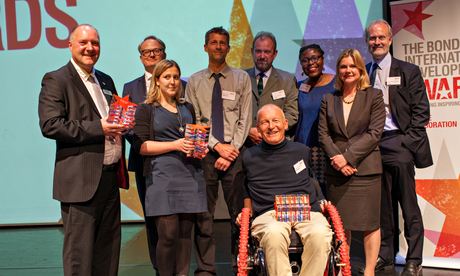
It is collaboration successes like this and many others at smaller scale that we at Bond, the membership organisation for UK international NGOs, were keen to recognise with our first awards ceremony in London on Monday 12 May.
Motivation, one of our three award winners, provides a great example of working together and by doing so delivering results on a truly impressive scale. David Constantine and his team recognised that wheelchairs supplied to disabled people (80% of wheelchair users live in the developing world) were not sited to either the individual or their environment and so their disability effectively kept them prisoner in their own home. By leveraging the clout and reach of the World Health Organisation to set guidelines and get them adopted at an international level, Motivation demonstrates the potential for achieving far greater impact than this relatively small NGO could have ever had by working alone.
Winning in the category of large NGO, and demonstrating a very different kind of collaboration, was Saferworld whose video entry captured the work of its Kenya team ahead of the 2013 elections. After the 2007-08 election with the underlying causes of the conflict that left 1,300 people dead and over 600,000 displaced still unresolved, there was concern that violence, linked to continued ethnic tensions, would be repeated in the March 2013. The Saferworld team brought together community leaders from across all the ethnic and religious groups as well as other local NGOs, the independent electoral boundaries commission and most importantly, the security forces, to build trust, identify potential hotspots, strengthen preparedness, diffuse tension and maintain peace and save lives in the elections.
Street Child United won in the small organisation category. The organisation facilitates learning between their 19 partner organisations who run projects for street children around the world. Street Child United works with NGOs, governments and corporate partners to provide opportunities for children living on the street.
Putting the spotlight on collaboration that is changing lives makes a nice change from criticism levelled at development and UK aid in recent months. But it also allows for a community of practitioners to be inspired by each others work and see what is possible irrespective of the size of organisation. While there's still much we need to do to up our game – UK NGOs must grapple with a changing funding environment other challenges and opportunities – the awards are proof that there are amazingly rich, innovative and inspiring partnerships pioneered by development NGOs. While as a sector we are always striving to do better, to be better, I hope the awards will help us to stop for a moment, reflect on all that we do, and celebrate these hidden civil society collaborations for development.
Read more like this:
• Letters: competitiveness is not a strength
• How to ... make bad NGOs better
• 4 ways global NGOs can help protect their international employees
Ben Jackson is the chief executive of Bond. He tweets as @bondngo.
Join the community of global development professionals and experts. Become a GDPN member to get more stories like this direct to your inbox