In one of the many classic moments in his BBC TV series Civilisation, critic Kenneth Clark stands before Raphael’s frescoes in the Vatican and relates how painter Sir Joshua Reynolds used to warn his pupils that they might find these masterpieces a bit boring on first view. You must keep on looking until you do appreciate them, admonished Reynolds.
“Well, I’ve been trying to do that all my life,” says Clark, “and let me tell you, it has been worth it.”
I feel much the same about 18th- and early 19th-century British satirical prints. I first looked at them as a history student in the British Museum, which owns an immense treasure trove of these cheap and often very cruel popular images. Now here I am, looking at them again in the museum’s Napoleon exhibition, culled mostly from that collection. As art, they are hard work, like Raphael can be. But they are worth the effort.
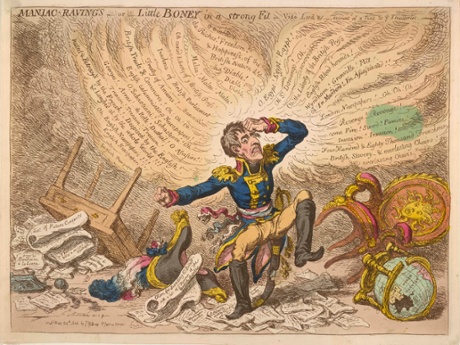
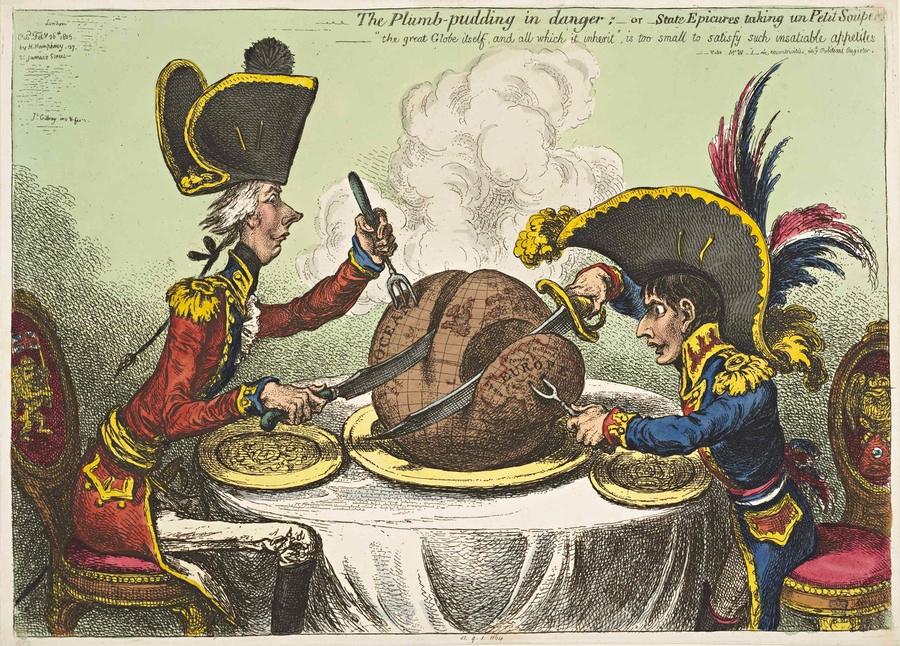
Bonaparte and the British plunges us into the day-to-day history of the Napoleonic wars. Through the eyes of James Gillray, George Cruikshank, Thomas Rowlandson and less well-known print artists we follow the ups and downs of Britain’s fight against the conqueror of Europe. We rage at Boney’s arrogant plans to invade Britain and laugh at him farting across the Channel. We roar with triumph when Nelson blows up most of his fleet at the Battle of the Nile.
A cartoon by Gillray – by far the greatest of these printmakers – celebrates Admiral Nelson’s Nile victory by showing John Bull eating a massive luncheon of French ships. Nelson is bringing him such a huge second helping that even fat old Mr Bull has to admit he’s stuffed.
Huzzah and hoorah … but can we feel the fun of it? Gillray was in the pay of the British government. He naturally gives no thought to the hundreds of French sailors killed. I know this is the anniversary year of the Battle of Waterloo, and I know we’re all meant to get behind every anniversary of British heroism these days (will the Tower of London moat be filled with little handmade statues of the Duke of Wellington?). But it’s hard, 200 years on, to hate the French as much as Gillray was paid to hate them – which makes his images historically interesting, rather than actually funny. That’s what I mean by hard work.
Not every Briton shared Gillray’s loathing. The show begins with a colossal bronze head of Napoleon by Antonio Canova that was ostentatiously displayed in central London in the early 19th-century by Lord Holland. This tremendous and deeply bizarre neoclassical homage to Napoleonic gloire is a breath of fresh air. Not because it is a reminder that some British liberals and radicals actually sympathised with France, but because it is a glimpse of something more artistically awe-inspiring than inky prints.
Napoleon, after all, was a giant, a huge historical force. The trouble with looking at him through one medium – the satirical print – is that it gives us the detailed political events and the British perspective, which was deliberately belittling, without quite capturing emotionally and aesthetically the scale of this epoch.
Nevertheless, this is a rich delve into British patriotism from another age. You will have to read a lot of speech bubbles, but by the end you will almost be ready to sign up for seven years before the mast to get a crack at old Boney. Try and make us eat croissants, would they? Have at ’em.
• Until 16 August. Venue: British Museum, London.