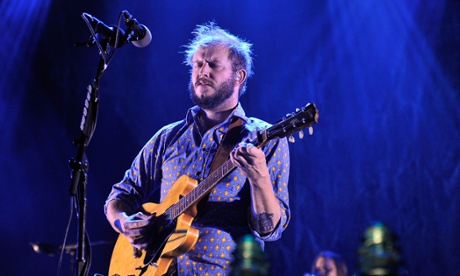
The city of Eau Claire, in the west of Wisconsin, is a community of around 65,000 built by French settlers, lumber barons and tire companies, a mingling of Chippewa Indians and Scandinavians who found this spot in the Driftless Zone a fertile place to make a home.
It is, in the words of the city’s most famous resident, Justin Vernon of Bon Iver: “Elevations and rolling hills and lakes. But it is wild.
“In the winter it’s cold, vastly white and colourless. Even the water is slate. But its transformation is what has drawn me to the place too: there’s an explosion of energy – there’s no other way to say it. It gets so lush. And it gets so lush so quickly.”
This weekend, some 20,000 people will descend on a large field on the banks of the Chippewa River, where Vernon will launch the inaugural Eaux Claires festival. The line-up is quite spectacular – headlined by Sufjan Stevens, the National and, of course, Bon Iver. But the festival also showcases the unexpected and contrary: Melt Banana, brass band, Marijuana Death Squad, Boys Noize.
At Vernon’s request, Indigo Girls will play their album Swamp Ophelia in its entirety. Sam Amidon will lead a shape note singing parade. Grandma Sparrow will host a children’s area. There will be dance, lighting displays, cheese curd stalls, and in the writer Michael Perry, even an official festival narrator.
The idea to hold a festival in Eau Claire had been “a murmuring idea for a long time”, Vernon says.
“I think it was when I went to Bryce and Aaron Dessner’s [of the National’s] Music NOW festival in Cincinnati, and it was like: ‘Holy shit, these dudes are just doing literally what they want!’ It was so inspiring. And they were not trying to have some commercial thing. It awakened my brain to the idea. Because it’s a weird thing – people don’t really do what they want or have vision or listen to their hearts.”
Vernon’s relationship with his hometown lies beneath much of his work. His debut For Emma, Forever Ago, written one winter in a cabin his father built, documented the process of getting over a relationship, but it was also a tribute to the restorative powers of the land itself.
The song titles of its successor, 2011’s Bon Iver, read like a roll of more far-flung locations, from Hinnom, Texas, to Calgary and Perth. But by the time it was recorded Vernon himself had circled back around to Eau Claire, choosing to build a home studio where he could record his own music and that of others – many of whom will play this weekend’s festival, including the Staves, the Tallest Man on Earth, Blind Boys of Alabama and Aero Flynn.
When I interviewed him at home around the time of that album’s release, he spoke of how he was “ready to have a stare in the face of me and this place and wonder if I should still be here”.
He is still there. Perhaps, thanks to the process of establishing the festival, even more than before.
“I’m from Eau Claire, but now I’m truly involved in it,” he says of the practical process of making Eaux Claires happen this weekend – from staking out potential sites to appointments with the sheriff and “sitting through hours of city council meetings to get a permit to have our speakers pointing a certain way. Realising you have to have permits for stuff. The sheer amount of information that we need to know … it’s pretty substantial and it makes me really proud that we’ve done it.”
From the beginning, Vernon enlisted the help of Aaron Dessner, who already had experience of curating not only Music NOW with his brother, but also, among others, Boston Calling – whose team also built Eaux Claires.

“It was sort of instant chemistry between us all, I guess,” Dessner says of the first time he met Vernon, around the time Vernon contributed a song to the Dessners’ Dark Was the Night charity compilation in 2008.
“He is one of the most versatile and generous musicians I have ever come across and we’re both very open and interested in collaboration, as are our respective communities. I also think our shared roots in the midwest had a lot to do that the connection we felt.”
Dessner first visited Eau Claire a year or so later. “I was struck,” he remembers, “by how many amazing musicians come from this small city and how collaborative the scene is. It seemed to be a weird musical utopia that supports many wildly creative and prolific artists like Justin.”
He sees festivals like Eaux Claires, Music NOW and Boston Calling as “basically an official excuse to hang out. And I think the goal is to create an environment where artists of all sorts can try new things and take risks. We hope to see many collaborations and we have commissioned new work from visual artists and musicians.
“For Bryce and I it comes from a sincere desire to collaborate with friends and musicians we admire,” he continues. “We grew up collaborating from the moment we picked up our first instruments, and it’s always been the main way that we socialize, I guess – hanging out and playing music. The music we make, whether it’s weird art music or the National’s songs or whatever, it’s always a product of our community and specific relationships.
“I don’t really enjoy the big mega-festivals with so many stages – but smaller, artist-friendly and artist-curated festivals can be a wonderful excuse to gather community and explore new frontiers essentially. It’s also a way to give emerging artists we are interested in a platform to perform and reach a larger audience.”
Vernon, too, has come to relish his new curatorial role.
“I think my calling is to write songs, but maybe even more than that I enjoy being a facilitator, a role-player, making things happen for other people,” he says. “And in this role I get to think about music and musical experiences and inspiring people, I get to think of all the times I’ve got to see music, to internally critique it or walk away feeling internally fulfilled, I get to use all that data. And I do have a lot of data now.”
He pauses.
“I realise I could be the artist guy with big ideas and no idea how to follow them through,” he says. “But I don’t like having soft hands. I like to work hard.”
Eaux Claires draws on his experience of attending and playing festivals all over the world – from his first festival experience at the New Orleans Jazz Heritage Festival, where he first saw Indigo Girls play “and which is still in my opinion the greatest music thing ever”, to Glastonbury, Roskilde, End of the Road.
“I like the community aspect of those festivals,” he says. “I just started playing too many festivals, and they started to blend together, but those are festivals where it isn’t just about going to see bands. It’s about an experience and a village that seems to happen there. It’s a chance for people to disappear, but in a peaceful way, to experience the good things about being human.”
It will be, he hopes, the antithesis of “all the things I hate at festivals: really loud music all the time, no breaks, bad food, all that kind of thing. Why would you make your rock’n’roll festival the Sony PlayStation Stage? Why would you take the money to do that? You’re working against rock’n’roll, you idiots!”
For many, the weekend’s highlight will be Bon Iver’s headline slot – the band’s first live performance in a couple of years.
“I’m excited to see how we are, to see how it feels,” he says. “It feels sacred because there’s nothing else booked. There’s no plans. But I’m ready. And I hope that shit translates to the audience.”
The couple of years away have seen Vernon recording, producing and collaborating with artists from Gayngs to Kanye West, but they have also given him time to steady himself after the experiencing the strange enormity of success.
“I want to make music, I like performing, but I get distracted by having to be who people think I am,” he says. “That’s really hard for me. I’ve been off for a couple of years now because I really needed rejuvenating. I feel like I lost touch. But I just want to make records. I’m hungry and excited to be getting back on course – to the real course – again. I still live at my recording studio. I just love waking up, having coffee and just immediately working on tunes. I love that.”
The festival’s name came some way into the process, and is the original French spelling for the city, honouring the spot on the Chippewa River where the settlers found clear water.
“It’s perfect,” Vernon says. “It’s about a name, it’s about a place, a mystical place that doesn’t exist the whole time, this special weekend, when this community will exist. And I already have a history of bastardising French spellings of things.”
He hopes this weekend might begin something new for the city he loves.
“I’d like to see this thing blossom,” he says, “and break down the barriers of what it is and what festivals are. That it becomes a thing where there’s a winter version that we could do. Maybe a spring and fall version. Maybe Eaux Claires can stand for something more than this thing you buy a ticket for, that you walk in and walk out and it’s over. Maybe it can mean more in this day and age when shit is fucked up everywhere.”
And has the process of building this festival altered, I wonder, his relationship with his home?
“I don’t know. Maybe now I know even less why I love it. I know less and less why I love it, but I do love it, and I know it has the opportunity to be a special town in this era that we’re in – this era when there’s nothing but Burger Kings everywhere. Maybe there’s a chance to turn that around in Eau Claire.”