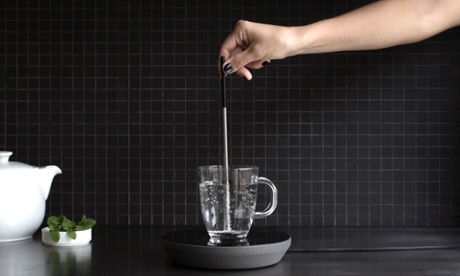
When Nils Chudy came up with the idea of redesigning the humble kettle just over a year ago, he was struck by how little the vital organ of every kitchen had changed over the years. “Five thousand images all of the same kettle. Bit of a different shape or bit of a different colour or bit of a different material but somehow they are all the same,” says the German designer.
Along with wanting to change the look of the appliance, Chudy had also become frustrated over the energy waste involved with boiling a kettle when only some of the water will be used. The outcome is the Miito, a reimagined “kettle” on which you place a cup, mug or jug and heat the liquid inside via a rod immersed in the water (or soup or baby food).
When Chudy was asking how he could overhaul the design, he took apart a popcorn machine and a coffee machine, but found inspiration instead from the induction cooker at his parent’s home.
“There is the induction base on the bottom. It sends out this electromagnetic field, a field of energy that only heats ferrous materials – meaning only things that contain iron, for example steel. It sends out this electromagnetic field and the rod is the only part that gets heated up because it is iron based. Any glass that you would put on it is not heated [neither is] stone or porcelain – ceramics in general. With the induction base, you put the glass or vessel on it and put the stick inside and the only thing that gets heated is the bottom disk of the stick,” he says.
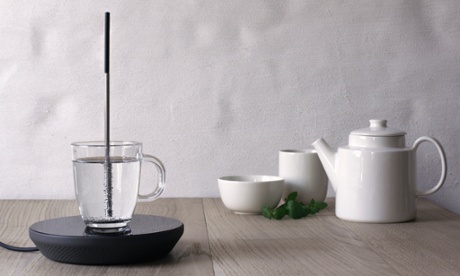
Over the last year, Chudy and his partner Jasmina Grase have developed a prototype of the two-part kettle. The rod is cool when it rests on the 18cm diameter base but when picked up and placed into a cup or jug of water or soup, which is then placed on the base, the device starts heating the rod. As the fluid gets to the right temperature, the rod is taken out and placed back on the base and the unit switches itself off. The upper third of the rod is insulated so it can be picked up and put down.
The designers say that conventional kettles are poorly designed. While the average amount of water needed to make a cup of tea is about 250ml, the minimum fill line of most kettles stands at 500ml, meaning half of the water that is heated is wasted.
Chudy was inspired when developing the idea by Leyla Acaroglu, a sustainability campaigner who says that two-thirds of the people in the UK who drink tea overfill their kettles. One day of this excess energy use is enough to power the streetlights in London for a night, she says.
“It is less about wasting water because – especially in the middle European area – there is a lot of water. But it is absolutely more about wasting electricity because electric kettles need so much electricity, so much power,” says Chudy.
That users will be able to heat food for babies or soups as well as making a cup of coffee in their own cups means the invention has left the kettle far behind, says Grase. “It is actually not a kettle any more. It is a different way of heating liquids. It is not this giant hunk of plastic which sits on the worktop in the kitchen.”
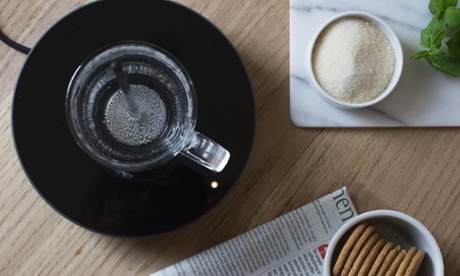
While a prototype has been made, it is still a long way off hitting the shelves, although they have an expected pricetag – about £80. At present the rod is made of iron but the designers intend to make one from stainless steel or iron coated in a material safe for food. “We know that it can work. Saucepans work. There is also an iron core in them that is food safe,” says Chudy.
The Miito does not switch off so it is up to the user to pick up the rod once the liquid comes to the preferred temperature, in much the same way as if the water was boiled in a pot. Chudy and Grase are examining how they can regulate the temperature so that it switches off when used for different fluids, such as 40C for baby food or 70C for green tea.
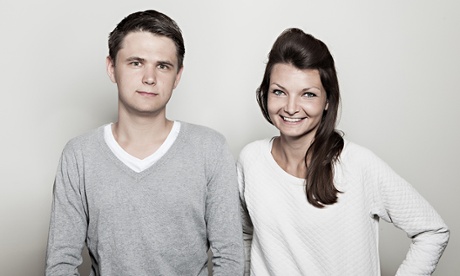
That ability to heat water to a specific level for green tea – after which it becomes bitter – is one unexpected use for the product that the pair have been asked about. Hotels have also inquired about it because it is more discreet an appliance for rooms. Mothers have said that the inconsistency of microwaves means the device could work well for their children’s food, says Grase.
“It is the silent help in your kitchen which will be there every day. That is why the design is minimal but hopefully fully efficient and that is also where people will fall in love with it because it is so simple,” says Chudy.
Their ideal scenario would see the invention in the shops by the end of the summer 2016, depending on how they progress towards a final product and how they navigate the various regulatory obstacles in the meantime. So far, they have been financed by friends and family but a crowdfunding campaign is expected for the next stages.
How induction cooking works
Induction hobs, which use the same technology as the Miito, create an electromagnetic field which uses the conductive properties of pots and pans to heat the food that is in them while the surface of the cooker itself remains cool to the touch. The method of cooking has risen in popularity in recent years with claims that it is safer and more energy efficient than either gas or electricity.