Boeing has agreed with the U.S. government to pay just over $2.5 billion to defer prosecution and resolve a charge of "criminal misconduct" in its certification of the 737 Max, the Department of Justice announced Thursday.
Of that amount, only $243.6 million, less than 10%, is a fine for the criminal conduct, "which reflects a fine at the low end" of the sentencing guidelines, the court agreement states.
And Boeing commits to pay an additional $500 million in compensation to the families of the Max crash victims.
However, 70% of the $2.5 billion cited consists of compensation to Boeing's airline customers that the company has already agreed to pay.
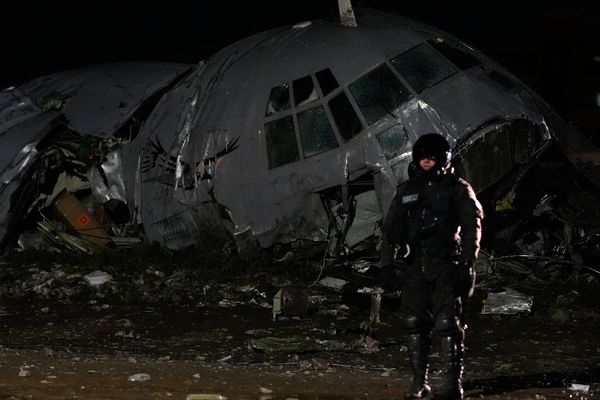
Zipporah Kuria, of the U.K., who lost her father Joseph Kuria Waithaka, 55, in the crash of Ethiopian Airlines Flight 302 on March 10, 2019, issued a statement calling the announcement of the settlement "somewhat bittersweet."
"It won't bring back our loved ones but at least there is clarity that their deaths weren't incidental and there is clarity in liability," Kuria said.
However she added that the penalty for Boeing is a mere "slap on the wrist" that "doesn't even scratch the surface of justice."
"The individuals responsible at Boeing should not be retiring or resigning with bonuses — they should be held criminally liable for their actions," she said.
The criminal complaint charges the company with one count of conspiracy to defraud the government by supplying false information to the Federal Aviation Administration (FAA) during certification of the jet.
The Department of Justice (DOJ) said the criminal charges center on the conduct of two former 737 Max program employees, Chief Technical Pilot Mark Forkner and his deputy Patrik Gustavsson, whose job was to finalize the pilot training requirements for the airplane.
Those two "deceived the FAA" about a new flight control system on the Max — the Maneuvering Characteristics Augmentation System (MCAS) — that activated erroneously to cause both crashes, the DOJ said.
"Because of their deception, a key document published by the FAA Airplane Evaluation Group lacked information about MCAS, and in turn, airplane manuals and pilot-training materials for U.S.-based airlines lacked information about MCAS," the DOJ said.
The U.S. Attorney for the Northern District of Texas, Erin Nealy Cox, said "the misleading statements, half-truths, and omissions communicated by Boeing employees to the FAA impeded the government's ability to ensure the safety of the flying public."
"This case sends a clear message: The Department of Justice will hold manufacturers like Boeing accountable for defrauding regulators — especially in industries where the stakes are this high," she added.
Neither Forkner nor Gustavsson nor other Boeing employees who were interviewed by the FBI have been charged.
However, the court document notes that the agreement protects only the company, not individuals, from prosecution. It further notes that evidence arising from the DOJ investigation may be used to bring charges of perjury, obstruction of justice or making a false statement.
"Patrik Gustavsson never hid anything from the FAA or any pilot," his attorney, James Bennett, said in a statement Thursday. "He ... has been completely committed to the safety of passengers and crew. Any claim to the contrary is false."
Forkner's attorney David Gerger did not respond to a request for comment Thursday. However, early last year he issued a statement saying that Forkner "did his job honestly, and his communications to the FAA were honest."
Responding to the news Thursday, lawyers for the families of the victims of Ethiopian Airlines Flight 302 dismissed the focus on the wrongdoing of the two technical pilots as "just the tip of the iceberg of Boeing's wrongdoing."
In a statement, lawyers Bob Clifford, Steven Marks and Justin Green characterized the DOJ agreement as Boeing paying "billions of dollars to avoid criminal liability while stonewalling and fighting the families in court."
"This agreement, including the 'crash-victim beneficiaries fund', has no bearing on the pending civil litigation against Boeing, which we plan to prosecute fully to ensure the families receive the justice they deserve," they said.
The legal team added that "the FAA should not have allowed the 737 Max to return to service" pending "transparent and independent safety reviews."
The agreement requires Boeing to continue to cooperate with the DOJ Fraud Section in ongoing and future investigations and prosecutions and to report any allegation of a violation of U.S. fraud laws committed by its employees. In addition, Boeing must meet with the Fraud Section at least quarterly and submit yearly reports regarding proposals to ensure its compliance with U.S. and foreign government regulations.
Provided Boeing abides by these obligations, the charge will be dismissed in three years.
Dave Calhoun, Boeing's Chief Executive Officer, in a note to employees called the agreement "a substantial settlement of a very serious matter."
"I firmly believe that entering into this resolution is the right thing for us to do—a step that appropriately acknowledges how we fell short of our values and expectations," he said.
Boeing sought to mitigate the impact of the charge by noting that just "two former Boeing employees" are accused of criminality.
Calhoun's message to employees recalled the infamous text message and email exchanges between the two pilots — full of derogatory remarks about the FAA, the airlines, suppliers and Boeing colleagues — that the company turned over to the FAA and the DOJ.
"The agreement reflects that those former employees, in addition to showing deep disrespect for our regulators and customers, also intentionally failed to inform FAA training officials about changes in MCAS's design," Calhoun wrote.
"The agreement recognizes that other Boeing employees did inform other officials and organizations within the FAA about MCAS," Boeing said in a statement.
"While we deeply regret the conduct described in the agreement, I am confident that it isn't reflective of our employees as a whole or the culture or character of our company," Calhoun told employees.
The DOJ press statement emphasized the culpability of the company, not just the two pilots.
Acting Assistant Attorney General David P. Burns of the Justice Department's Criminal Division said "the tragic crashes of Lion Air Flight 610 and Ethiopian Airlines Flight 302 exposed fraudulent and deceptive conduct by employees of one of the world's leading commercial airplane manufacturers."
"Boeing's employees chose the path of profit over candor by concealing material information from the FAA concerning the operation of its 737 Max airplane and engaging in an effort to cover up their deception," Burns said.
"This resolution holds Boeing accountable for its employees' criminal misconduct, addresses the financial impact to Boeing's airline customers, and hopefully provides some measure of compensation to the crash-victims' families and beneficiaries," he added.
Under the terms of the agreement, Boeing must pay:
—$243.6 million as a "criminal monetary penalty."
—$500 million to a fund to compensate the heirs, relatives, and legal beneficiaries of the 346 passengers who died in the two Max crashes: Lion Air Flight 610 and Ethiopian Airlines Flight 302.
—$1.77 billion in compensation payments to Boeing's Max airline customers
Boeing said that with the compensation to customers already included in previous quarterly disclosures, it will declare an accounting write-off of $743.6 million for the other two amounts in the fourth quarter.
Aside from the cost of compensating victims' families, Boeing has previously estimated the total cost of the Max grounding in extra production expenses and customer compensation costs at $20.6 billion — including $8.8 billion in compensation to airlines.
Chuck Herrmann, a Tacoma-based attorney who represents families of 51 victims of the two crashes, said Thursday Boeing previously had distributed $144,500 to the beneficiaries of each of the 346 crash victims from a $50 million compensation fund set up by the company in 2019.
Herrmann confirmed with the Justice Department Thursday afternoon that the $500 million compensation requirement is additional to this previously distributed money.
Family members of scores of victims of the two crashes also have separately filed civil lawsuits against Boeing. More than 40 of Herrmann's clients have agreed to settlements for undisclosed amounts protected by confidentiality agreements, with nine of his cases still pending, he said.
"There was deception in several directions, and they definitely deserve to be punished. Boeing deceived the FAA, their customers and the pilots of their airplanes. All of that is important, and this action today reveals that," Herrmann said. "I'm reasonably satisfied that Boeing's deception has been revealed and they can't deny it."
The court filing of the agreement explains the leniency in the size of the fine by noting that Boeing received partial credit from investigators for "voluntarily and proactively ... identifying potentially significant documents."
However, the agreement says such cooperation "was delayed and only began after the first six months of the ... investigation, during which time the Company's response frustrated the (DOJ's) Fraud Section's investigation."
The FBI's Special Agent in Charge at the agency's Chicago Field Office, Emmerson Buie Jr., said the penalties in the DOJ agreement "demonstrate the consequences of failing to be fully transparent with government regulators."
"The public should be confident that government regulators are effectively doing their job, and those they regulate are being truthful and transparent," he added.
From the Department of Transportation Office of Inspector General, Special Agent in Charge for the Midwestern Region, Andrea M. Kropf, said, "This landmark deferred prosecution agreement will forever serve as a stark reminder of the paramount importance of safety in the commercial aviation industry, and that integrity and transparency may never be sacrificed for efficiency or profit."
(Seattle Times reporter Mike Carter contributed to this story.)