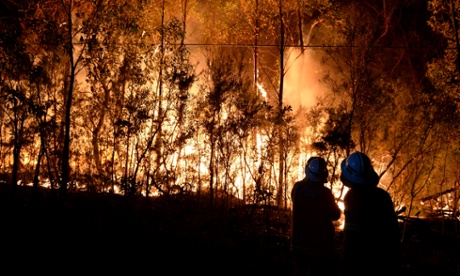
A year on from one of the worst NSW bushfires in decades, residents are still battling. The fires were one thing, but it’s the 12 months of red tape and rebuilding that is really taking its toll.
Last October more than 100 fires – several out of control and at emergency level – threatened communities on the mid-north coast and in the western suburbs of Sydney, the Blue Mountains and southern regions. “This is as bad as it gets,” the NSW fire commissioner, Shane Fitzsimons, warned at the time.
Alan Seaman and his wife, residents of Yellow Rock for 42 years, lost their house and everything in it, except for a wedding ring salvaged by his son Craig.
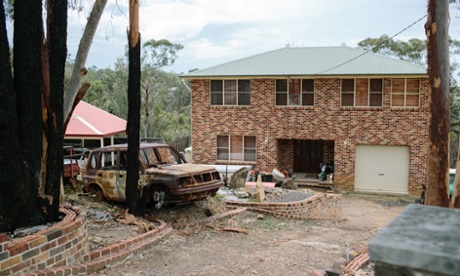
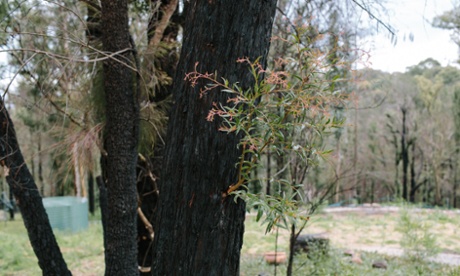
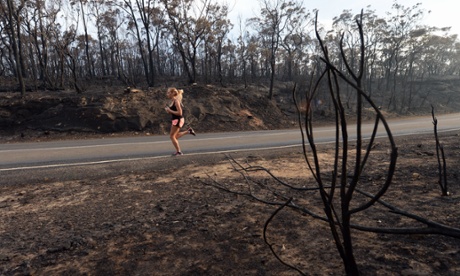
Their area was one of the hardest hit during the emergency, which arrived alarmingly early in the bushfire season. Along Buena Vista Road, where the Seamans lived, and adjoining Single Ridge Road, there are clumps of vacant blocks, housing frames and newly poured slabs, interrupted by the odd house inexplicably left standing. A valley of blackened trees amid lush regrowth, burgeoning lantana and wattle sits behind.
It is a rainy afternoon, and Alan Seaman chats on his construction site with his neighbour Wayne Parker and Craig. They joke about the new fire regulations hampering the build and inflating costs. It’s just one of the past year’s many hindrances, and cynicism about the public service and government officials comes by the bucketload.
“I told the minister they’d written a TV show about the NSW government, and called it Yes Minister. But he had to move on then because people were waiting for him,” says Alan, wryly.
“They keep changing their mind every time there’s a fire,” he says. “When the fire comes through, the bureaucrats don’t sit down with the people affected like us fellas in the building game, to find out what we know.”
“It’s the decision of someone sitting in an office,” adds Craig.
Their consensus is bleakly pragmatic. The front of a house may be rated Bushfire Alert Level (Bal) 40, while the back is “flame zone” – the highest rating – but if your house is really going to burn, it’s going to burn. A different type of wall might just slow it down.
The 1994 bushfires came from one direction: up the “flame zone” ridge. But the 2001 fires came from the opposite way. Both were bad. Last year it was not a fire front bearing down on them, but the devastating unpredictability of ember attacks which came from all directions.
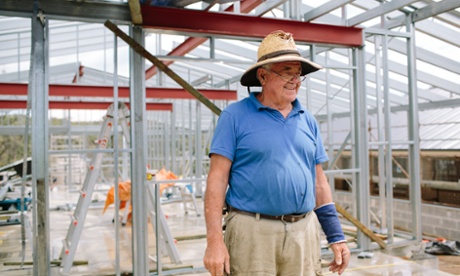
Recovery costs and seemingly arbitrary safety rules grew exponentially. With disaster or war comes increased prices, but the money spent here is not going to the local economy. Residents head to Penrith where they can get the big-ticket items for the rebuilds and shop for groceries at the same time.
In the confusion of the clean-up, anything that could be considered dangerous – and the Seamans and Parker suggest there was a very broad definition in play – was demolished. Even sheds full of rescued furniture.
In Yellow Rock, Guardian Australia also hears claims of farcical battles with various utility companies chasing “unpaid bills” for services over the last year. One man laughs, recounting an attempt to explain to a gas company representative that he could not possibly be using the gas because the house does not exist, and, no, he cannot check the meter anyway because that does not exist either.
But the rebuilds are going OK, not too slowly, and insurance companies have mostly come to the table, say the Buena Vista Road men.
If you were underinsured then bad luck, they say. If you were overinsured, well, the insurers will tell you and they will scale it back. The Insurance Council of Australia does not know how many were underinsured, but told Guardian Australia it is likely that some were.
More than 98% of the 1,812 claims lodged, assessed and accepted from the Blue Mountains fires, had been finalised, said the ICA, and “many” were settled within days.
“Building a new house is supposed to be exciting,” Parker tells Guardian Australia from his own empty block later. But this is different.
Parker’s house was already gone when he got a text warning him to evacuate. “Vaporised”, as he puts it.
Even if he had made it back, the house went up too fast to save it, he reckons. As an example, he points to his water tank and recalls the wood piled underneath it like a pot on a stove, and says: “The water boiled. You can’t fight that.”
According to a neighbour it took just 10 minutes to destroy nearly everything, including his house, aviary of birds, and glasshouses of orchids. People on the scene could hear the glass exploding, as his botany lab went up in flames.
“Hazmat were all over that, thinking it was an eccy [ecstasy] lab,” he laughs.
The fire did spare an outdoor setting under a small canopy. In the aftermath Parker would often find a couple of cops taking a break under the only shade amid the scorched surroundings.
“You gotta stand here and just laugh,” he says, listing a litany of mistakes and grievances over the last year. They range from the insultingly insensitive – a coach company running sightseeing tours along the street while the land was still smoking – to the borderline criminal, including a man allegedly walking house to house checking the meters for a gas company, pocketing copper piping as he went.
It’s just steps too far for some. Navigating the bureaucracy was hard enough for families whose identifying documents were lost in the fires, without the double-handling and other unnecessary complications.
Parker suggests appointed “go-betweens” for the community, people they can go to with these kind of time-wasting, administrative issues while they get on with rebuilding their lives.
Springwood police have helped with this since the role of first responders ended. Superintendent Darryl Jobson tells Guardian Australia his officers maintained a constant presence in the immediate aftermath, “so the community knew we were there”, and to move rubberneckers along.
“My personal view is that the best way to judge someone’s true character is to see how they handle adversity,” he says.
“The way the command came together to support one another and the community was outstanding … As the commander here I’m proud and it’s something I’ll remember fondly in my policing career and beyond.”
“Managing work and also personal issues” is a challenge for his staff, one of whom lost his house in the fires. Jobson estimates 80% of his police officers live in the area.
“They were out there on the fireground and there were a lot of evacuations done,” he says.
“Some of my police got caught in the fires to the extent they thought they may not get out alive.”
Many of the firefighters were also local, including one man who heard a call for back up to his own address over the radio.
“For a little while he didn’t know if his wife was ok or not, he didn’t know if his house was standing,” says Rural Firefighter Service (RFS) superintendent David Jones.
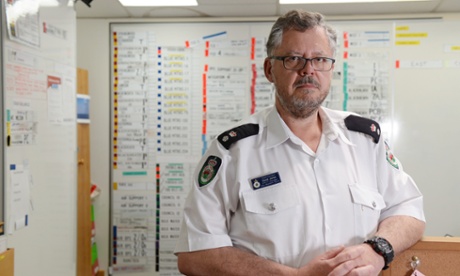
“That occurs quite often – it’s a hidden strain that people aren’t necessarily aware of,” he tells Guardian Australia.
Jones was an incident controller for the Blue Mountains complex fires. They got aerial surveillance on fires near Springwood and Winmalee and it was bigger than they thought.
“Send us some resources, we’re in trouble,” he relayed.
In nearby Winmalee, Tom Collier, 20, is working as a labourer at the end of a leafy cul-de-sac which lost several houses.
He shows Guardian Australia the building materials being used for the new house – it’s triple what was required before the fires. Collier’s employers have four rebuilds on the go in the neighbourhood.
When the fires sparked up he was at Macquarie University in the northern suburbs of Sydney. “I walked out of my class and the sky was orange. And I thought, shit, that looks like my area,” he says.
“I got the phone call and rushed straight home. Thankfully my place was OK, but about five of my friends’ houses were already gone.”
He and his RFS member parents and neighbours were all on standby “for the Wednesday that was coming”, preparing the houses and getting pumps ready.
That Wednesday would be one of the worst days of the week, and botched ordnance exercises at a defence force training ground near Lithgow would spark a blaze which would destroy 50,000 hectares.
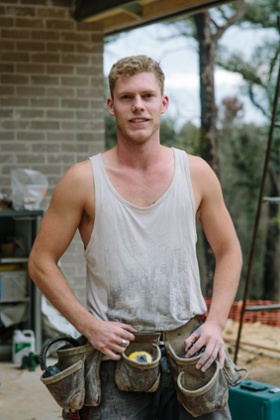
The ADF has since apologised for that fire, and in the aftermath personnel came in to assist the community. Collier says they were helpful, as was the government relaxing regulations around cutting down trees. The house he is working on has cleared them for 30 metres behind – the owners don’t want to take chances.
Collier and some other tradie friends help out a mate rebuilding his home, and says the fire was “beneficial in a weird way” as it pulled the community together.
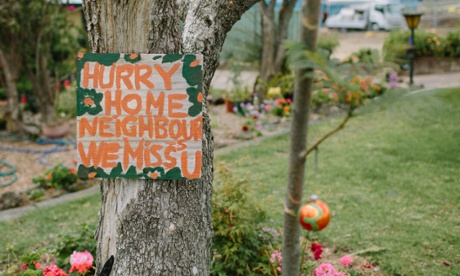
Back on Buena Vista Road, a weatherboard house sits in a garden full of bright flowers, and a sign on a tree: “Hurry home neighbours, we miss u.” In the branches above are Christmas baubles with glittering house numbers – one for each that was lost.
The community has been “terrific”, says Alan Seaman, especially the Salvation Army and the local church which has organised social dinners to get the locals together.
“That’s why most people live up here,” he says.
“The volunteers were absolutely brilliant. You couldn’t have done it without the volunteers,” he says.
It’s been a “humbling” year since the RFS spent over a week fighting the blazes, says Jones.
“There’s been a lot of praise heaped on the RFS and other firefighters that came to help,” he says, but there has been grief and survivor guilt from those whose homes were spared as well.
“Some things won’t change, we live in one of the most bushfire prone places in the world,” but there have been learnings, and Jones says the community is much more aware of the ferocity of fires and the risks they pose.
Springwood police are attending a number of local community events commemorating the one year anniversary this week. Jobson says the resilience shown by the community is one of the positives to come out of the disaster, but he’s mindful that those affected still need support.
“A number of properties were lost, and it’s easy to say they can be rebuilt but we must remember they were people’s homes. There’s a lot of emotion,” he says.
“I’ve got no doubt that some people are still hurting in the community, and their recovery will take place under their own speed.”
Out of respect the disaster should be remembered, he says. “But it would be a failure on everyone’s behalf … not to learn from last year.”
“One of the biggest lessons we can learn is not to be complacent. To make sure that the community … and emergency services and organisations are prepared to respond,” he says.
“From my perspective, complacency is the enemy. If we think it’s not going to happen again, we’re kidding ourselves. Fire will happen again in the mountain.”