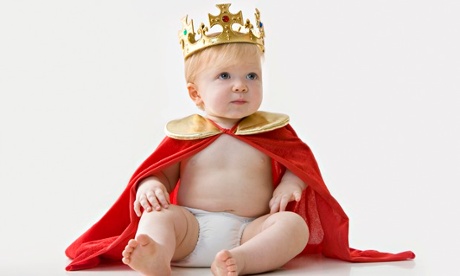
It’s hard to imagine a world where baby girls are not dressed in pale pink or little girls swathed in fuchsia shades, but once upon a time pink was the colour chosen for boys and blue the colour preferred for girls.
Anyone shopping for a gift for the new princess should perhaps note the unfortunate fate of a previous present. In 1923, one well-wisher sent a layette set of baby footwear to Princess Mary. Now housed in the collection of the V&A Museum of Childhood, the set was returned to its purchaser because of one detail: they were pink. As an accompanying note reveals, the contents were deemed unsuitable for Mary’s son George and her subsequent child, Gerald, simply because of their colour. These royals were earlier adopters of the ‘pink for a girl, blue for a boy’ mantra that was, in the 1920s, still a relatively new idea. Cemented over the course of the twentieth century, today it can be hard to imagine things being any other way.
However, during most of the nineteenth century, the situation was very different with male and female babies dressed in interchangeable white robes. White was not only associated with innocence, it was also the most practical choice. White clothes withstood boiling and bleaching, in contrast to garments that used low colourfast dyes.
With the introduction of hardier fabrics, however, things began to shift. Babies and young children – regardless of their gender – were being dressed in an array of ‘nursery’ shades that included both blue and pink. An 1850 painting by Franz Winterhalter shows Prince Arthur, in the arms of Queen Victoria, wearing a lavish gown of white and pink.
Only gradually did ‘pink for girls’ become standardised. In Little Women, published in 1868, the character Amy puts “a blue ribbon on the boy and a pink on the girl, French fashion”. But this was far from being a widely accepted custom. In 1890, by contrast, the Ladies’ Home Journal advised: “pure white is used for all babies. Blue is for girls and pink is for boys, when a colour is wished”, while in the UK the Women’s Institute was still recommending pink for boys up until 1921. In Catholic countries, blue may have been considered more suitable for girls because of its association with the Virgin Mary, with pink being a softer version of Saint Joseph’s more masculine red. Four years after the failed pink gift to the British royals, it was reported that Princess Astrid of Belgium was “optimistically” planning a pink nursery, the traditional colour for boys in her country.
The conventions became more strictly observed in the 30s – making Princess Mary ahead of most of the British population in her refusal of the gift – as the potential market for children’s products was recognised by greetings card makers, as well as clothing manufacturers. Gendering clothing meant items were less frequently passed between siblings and more likely to be bought new.
By the 50s, the lines of colour and gender were clearly demarcated. With Christian Dior proclaiming pink as “the colour of happiness and femininity”, the idea took root in parallel with the growth of the consumer society. Despite attempts in the 60s and 70s to bypass this convention, pink for girls and blue for boys came back with a vengeance in the boom years of the 80s and retains its influence on 21st-century shoppers.
To date Prince George has mainly been photographed wearing ‘masculine’ blue, so it seems likely his sister – will also be dressed in clothes that follow these colour conventions. But there are an increasing amount of options that mean that doesn’t have to be the case – whether it’s the bright unisex designs of Toots MacGinty or the online shop Not Pink Or Blue, which offers products that live up to its name. Perhaps another well-meaning gift to the royal family is in order?
Introducing Valspar paint
Valspar can create as many colours as the eye can see – that’s 2.2 million shades, so if your heart is set on a colour, Valspar can match it. What’s more you can save your colour preferences on Valspar’s system, so whether it’s the ideal shade for Laura’s bathroom, or dad’s study, you’ll remember for future reference.
Available exclusively at B&Q, Valspar’s Premium paints feature a super scrub formula so paint won’t fade or chip off when cleaned and it comes in a range of wide range of high quality interior and exterior paints in a variety of finishes. Visit valsparpaint.co.uk to see how you can start colouring outside the lines, or see the range at B&Q.