Finding jobs in Bangkok is hard for blue-collar workers who leave their rural homes to hunt for work in the capital city.
The task is difficult for many parents who have to leave their young children in their rural hometowns, asking their elderly parents or relatives to take care of their children.
Some working mothers even need to leave their babies right away, without time to breastfeed their children, while many kids only see their parents during long weekends.
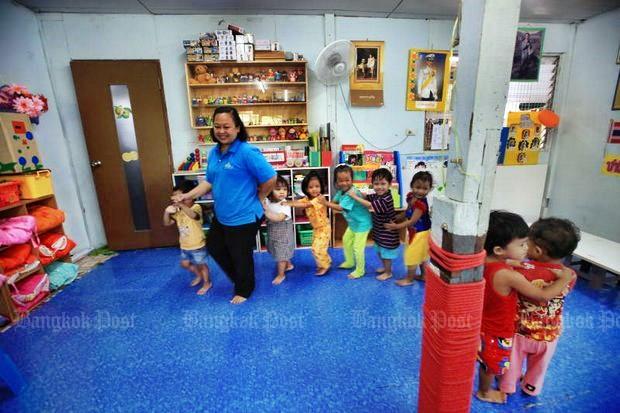
But these parents now have the choice to bring their kids with them thanks to community nursery projects that tailor their service hours and fees to cater to blue-collar workers.
The projects are a result of cooperation between the Foundation for Slum Child Care and local communities.
The organisation has already helped 68 small-scale nurseries open in Bangkok and surrounding areas.
"We are getting good feedback from parents," said Seelada Sagsikanphum, manager of the Foundation for Slum Child Care.
"They said our 'teachers' are kind and dedicated. We hope to expand more because the demand of parents is increasing. Workers from rural areas increasingly move to Bangkok to find jobs and many of them bring their kids to live with them."
The Foundation for Slum Child Care came up with ideas to open special nurseries for blue-collar parents many years ago, and are highly experienced in taking care of children in low-income communities in Bangkok.
The organisation was founded in 1981 by the renowned social worker, Khru Prateep Unsongtham Hata.
The late Princess Galyani Vadhana later placed the foundation under royal patronage.
Its four primary nurseries take care of at least 100 children each, including those of migrant workers.
"Even though the foundation was able to set up more nurseries, it was still unable to catch up with the high demand, so it decided to usher in a project to support local people in setting up child care facilities of their own to take care of kids in their communities," Ms Seelada told the Bangkok Post.
To control the quality, Ms Seelada said the foundation only teams up with "ready and strong" communities.
The organisation provides training to employees of each nursery that it helps open.
The foundation, said Ms Seelada, plays the role of auditor to give appraisals to these 68 nurseries and consistently conducts random inspections to ensure they maintain their standards of quality.
The 68 facilities currently take care of almost 3,000 children.
"This means some parents don't have to send their children to their grandparents in the provinces," said Ms Seelada.
"3,000 kids can grow up living with their mothers and fathers," she said, adding that kids who live far from their parents often feel lonely and can be vulnerable to abuse.
According to her, the nurseries span 30 Bangkok districts and surrounding areas including Nonthaburi, Pathum Thani and Samut Prakan.
Of them, 42 have 3-5 stars and the rest have been rated as having 1-2 stars in terms of quality.
The grading appraisals are carried out to ensure that facilities maintain their quality levels, she said, adding that they are appraised based on child development, environmental management, parent participation and documentation.
Wongnapha Sing, or Khru Nung, who runs a nursery on Soi 23 of Rama III Road, said there are more than 10 factories in the soi, along with many rental rooms and condominiums. She said most of the parents, who send kids to her nursery, are employees at various factories in the area.
Some, she said, even drop their children off before 6am as they need to work overtime in the morning, while some pick their kids up at night as they have to work overtime in the evenings.
"It is common for kids to leave the nursery after 9pm. We understand and have sympathy for parents who have to work overtime so they can earn more income in the face of a higher cost of living," said Ms Wongnapha.
"In the evening, kids are excited and all smiles when their parents come to pick them up."
According to her, parents who drop their kids off at the facility earlier than business hours do not face extra charges. But those who pick their children up after 5pm face an extra charge of 20 baht an hour.
Although she always compromises with parents about various aspects of child care, one strict condition is that mothers must give their breast milk to the nursery, which it feeds to the babies until they are six months old.
Breast milk has good nutritional content, and assists with kids' physical and mental health, Ms Wongnapha said. She and her husband, Khru Tee, work full-time taking care of the kids as well as their three-year-old son.
The pair said the work gives them time to take care of their son while earning income from looking after children in the community.
They earn 2,800 baht a month per child while other private daycare facilities charge at least 3,500 baht a month per child.
They said they also offer discounts to parents who are short of money. Khru Tee said his facility currently caps the number of kids at 20 so they have time to provide proper care for all the children.
Uthit Chanchamni, a 29-year-old company driver, whose twins are taken care of by one of the foundation's allied child care facilities, said he earlier left their kids in the care of his parents in Nakhon Ratchasima but this was a burden on them.
He said he then decided to take the twins back and contacted the nursery to take care of their children. Mr Uthit said he and his wife, a factory worker, will work harder to get more money so that one day they can afford to take care of their twins themselves.
Janpen Kamsiri, or Khru Pu, runs a foundation-linked child care facility in Wang Thonglang district. Her house was redesigned to accommodate children, including wash basins and toilets.
There are three child care facilities in her area and they always share their child care knowledge and experiences with each other.
Namthip Yothatham, 28, said she found it hard to find a nursery ready to take care of her son who suffers from leg muscle problems.
After she relocated to Klong San district, she found a nursery linked with the foundation that could provide help. She said her son's condition has now improved but medical care and physical therapy are still required for him.
"Today I feel at ease. I do not have to worry as much," said Ms Namthip.
People who want to help the foundation support the poor and underprivileged can contact 02-249-2956 and 02-541-6440.