
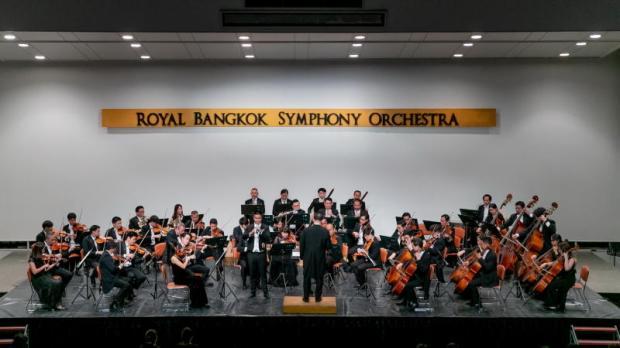
The Royal Bangkok Symphony Orchestra under patronage of HRH Princess Sirivannavari Nariratana opened their 2019 season in exuberant fashion on Jan 25 in the Small Hall of Thailand Cultural Centre. For a good few seasons now, the orchestra has begun its annual offering of musical delights by promoting and showcasing one or more of its home-grown members as soloists.
This time it was the turn of the eye-catching young trumpeter Terdrid Reaungroj to demonstrate how young Thai classical musicians are raising standards year upon year. Today, across the wide orchestral instrumental spectrum of brass, woodwind, percussion and strings, up and coming Thai millennial musicians are achieving internationally comparable levels of competence.
Terdrid's assured, near note-perfect performance of perhaps the second best known classical period trumpet concerto in the repertoire -- Johann Nepomuk Hummel's lively and attractive 1804 creation -- was delivered with an admirably cool-headed stage presence and composure, which spoke volumes about his training. His eminent professor and mentor at Rangsit University was none other than maestro Vanich Potavanich, himself Principal Trumpet of the RBSO since 1986 until present, and conductor of this very concert. The easy rapport between master and apprentice was very much in evidence. The orchestra, for its part, provided crisp and attentive accompaniment.
The overture for this all classical period programme was one of the very best from opera buffa, Mozart's late masterpiece Così Fan Tutte, whose radiance set a tone of gaiety around the auditorium. Its demand for precision also served as an excellent device to prepare the RBSO for some of the even more exacting orchestration ahead, which has a slightly more difficult tonal centre for the string section at least.
Haydn's iconic Concerto For Trumpet In E-flat Major was the chief model for Hummel's slightly later work in the same key, written to mark the occasion of the younger composer's acceptance of the former master's Kapellmeister position at Prince Esterházy's court at Eisenstadt in Austria. Both were tailored specifically for Anton Weidinger, the finest trumpeter known to the composers, and to this day the technical challenges and flourishes of scale/arpeggio bravura remain considerable. Terdrid managed all semiquaver runs and leaps of register with nonchalant ease, also managing to weave a persuasive and engaging phrasing which allowed his instrument to truly sing. This is surely attributable in part to him being equally comfortable in the arena of jazz.
The very obvious borrowing from Mozart's Haffner symphony at the start of this concerto doesn't take anything away from the overall quality of Hummel's own work, the style of which is generally recognised as bridging the transition between the classical and romantic periods. This is most notable in the serene adagio second movement. Again, it is strikingly similar in metric/melodic construction to the slow movement of Mozart's Piano Concerto No.21 In C Major K.467, but Hummel's twist here is the selection of the flattened submediant key of C-flat major.
Quite apart from the tuning difficulties this involves, this most romantic of tonal relationships speaks rather more of the language of Schubert, whose own Symphony No.3 In D Major was splendidly rendered after the intermission.
Lucio Silla, another fine but lesser known Mozart overture from his youthful forays into the world of opera seria, opened the second half with sprightly direction from Vanich and committed playing from the RBSO. Schubert's youthful symphony continued proceedings with similar energy and sparkle, its more expansive compositional canvas allowing certain musicians, such as timpanist Paopun Amnatham, for example, somewhat more scope for expression and dynamic range. The woodwind tuning of the exposed opening adagio maestoso didn't quite match the commendable level achieved throughout the rest of the evening, with perfect fifth intervals in particular a little unstable. However, in the ensuing allegro con brio the entire ensemble once again found its collective stride and revelled with joyous inhibition in the sheer genius of Schubert's thematic and harmonic imagination.
A delightful lightness of touch in the allegretto revealed some lovely chamber-music oriented playing, with much careful listening and sensitive sectional balancing at work. This was an especially pleasing variation of pace before the rumbustious Deutscher Menuetto then paved the way for the most exhilarating of finales. A great start to 2019 RBSO.






.jpg?w=600)






