PANAJI: The Intergovernmental Panel on Climate Change (IPCC) signalled a code red alert on rapid intensification of extreme weather events. In Goa, a chain of unusual occurrences has scientists asserting that the impacts of climate change are not only close, they are literally blowing in our face.
From an episode of anomalous rainfall soon after the new year and hailstorms in winter, to the copious pre-monsoon rainfall and a catastrophic cyclone-fuelled deluge in July, the baffling weather series during the eventful seven months seems to confirm the IPCC’s warning.
“Most of us thought that climate change would affect the Indian subcontinent and Goa in particular in a gradual fashion. But we are seeing the signals of it rattling us as early as now,” reputed meteorologist M R Ramesh Kumar, said.
The quick succession of extreme weather events is viewed as an indication of the worsening climate crisis.
‘Rising frequency of cyclones alarming’
“Each year brings calamities in different forms. In recent years, floods occurred in different parts of the country. Calamities such as cyclones, droughts and landslides have occurred more frequently in Goa and elsewhere,” Kumar pointed out.
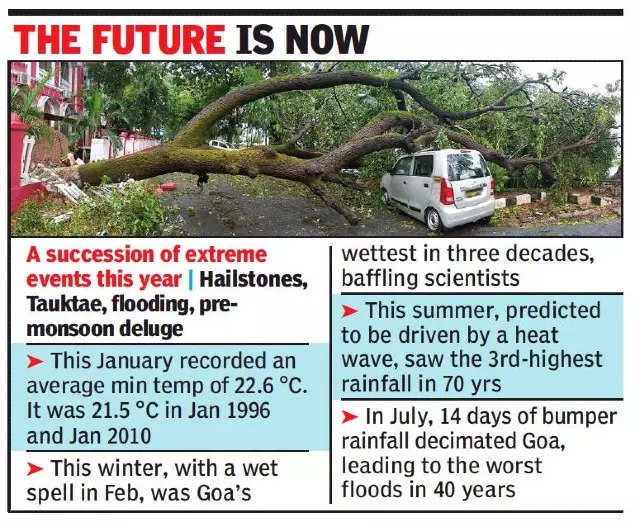
The year 2021 itself began on an ominous note as India meteorological department (IMD), Panaji, recorded heavier rainfall than usual in January. The anomalous rain made it one of the wettest January months in many years. But it ended as a wet and warm January as the month also had higher early morning temperatures than in last 30 years.
The average monthly minimum temperature recorded was 22.6C, as compared to 21.5C in January 2010 and 21.5C in January 1996.
“Compared to previous years, winter started with predominant easterly winds, which increased minimum temperature and anomalous rainfall,” Rahul M, scientist at IMD, Panaji, said.
The winter was also Goa’s wettest in three decades due to heavy rainfall in February as well. Unheard-of events in winter — hail, thunderstorms and vertical cloud formations — during a five-day wet spell from February 19 surprised scientists.
“Usually, winter months are driest and cloud-free, especially over Goa. Hailstones, a very unusual occurrence, form when clouds develop vertically up to 10km height above mean sea level,” Kumar, a former NIO chief scientist, said.
The rain persisted during summer as Cyclone Tauktae struck around mid-May. “Though cyclones over the Arabian Sea during pre-monsoon season are not unusual, Tauktae was one of the closest to pass by Goa’s coast, causing immense devastation,” the IMD scientist said.
What was being speculated as a heat wave-driven summer turned out to be a wet one. “Goa received its third-highest rainfall in 70 years and also saw a very dangerous trend,” Kumar said.
In July, a 14-day bumper rainfall created still more havoc as one of the worst floods in 40 years submerged Goa. “The state recorded an average rainfall of 1,047.3mm against a normal of 471mm owing to increased rainfall activity during this period,” Rahul said.
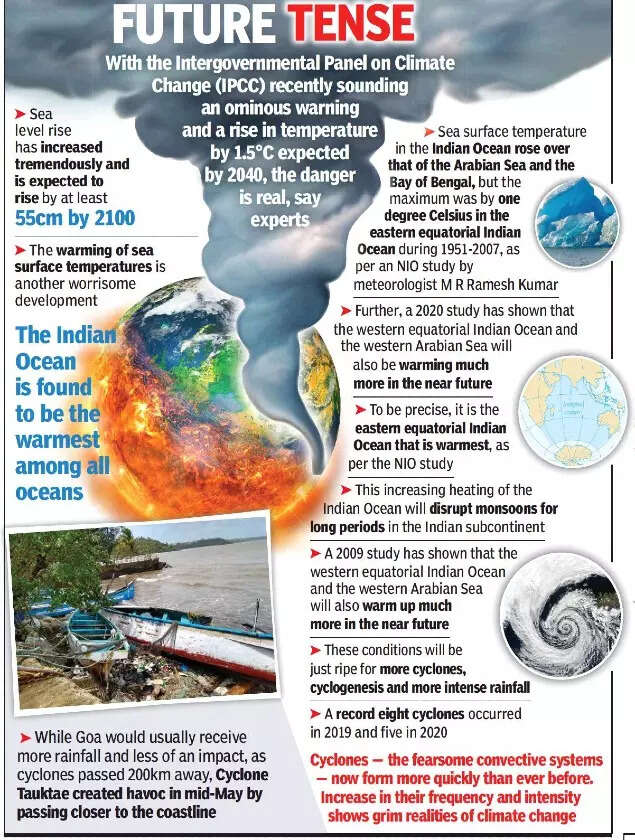
The increasing frequency of cyclones in the Arabian Sea is another worrisome trend. In 2019, the year of cyclones, eight of them — five in the Arabian Sea — ripped through the subcontinent, creating more impacts than ever before. The chain of cyclones continued in the following year as five of them — Gati and Nivar being very severe cyclones — formed in quick succession.
“The frequency and rapid intensification of several cyclones could be attributed to the warming of the Indian Ocean. This is an alarming trend and an indication of future events,” Kumar warned.