Get all your news in one place.
100’s of premium titles.
One app.
Start reading
The Guardian - UK
The Guardian - UK
Science
Rachael Stubbins

Blooming tiny: nano flowers, ferns and gold stars – in pictures

Nanotechnology: Postcard from nanoworld
These 'poppies' are carbon nanotubes (CNTs), bundled together and pulled inwards into tiny pillars. Researchers have proposed the use of CNTs in numerous applications because of their remarkable properties. In biomedical settings, they could be used for a novel transdermal drug delivery system, acting as the scaffolds for microneedles. These have the potential to provide a rapid, self-administered and painless alternative to hypodermic needles. A technique called capillography makes the CNT pillars collapse inwards, increasing their packing density. The greater the packing density, the less pain patients will feel when the needle penetrates their skin
Photograph: Courtesy of Adrianus Aria/California Institute of Technology/Materials Research Society/Science as Art Competition
Nanotechnology: Postcard from nanoworld
A tetraaniline in full bloom. This nano flower was created with oligoaniline molecules, a plastic-like material that is both flexible and electrically conductive. The thin sheets that comprise the 'petals' and 'leaves' are about 20 nanometres thick, which is about 5,000 times smaller than the diameter of a human hair. These materials are promising for applications in bendable supercapacitors that can serve as power sources for electronics, or miniature sensors that can rapidly detect toxic compounds Photograph: Courtesy of Yue Wang, University of California/Materials Research Society Science as Art Competition
Nanotechnology: Postcard from nanoworld
This colourful picture was unexpectedly seen by researchers looking at crystal layers thinner than 50 nanometres thick that can conduct electrons extremely rapidly. The fern-like crystals interact differently with particular wavelengths of light to make a variety of colours. One part of the layer has transformed from the liquid crystal phase into 'flowers', while others have taken the shape of fluttering butterflies. This class of materials has the potential to compete with, and even replace, the silicon currently used in electronic devices. This could lead to the creation of flexible displays and e-papers
Photograph: Courtesy of Ying Diao, Stanford University/Materials Research Society Science as Art Competition
Nanotechnology: Postcard from nanoworld
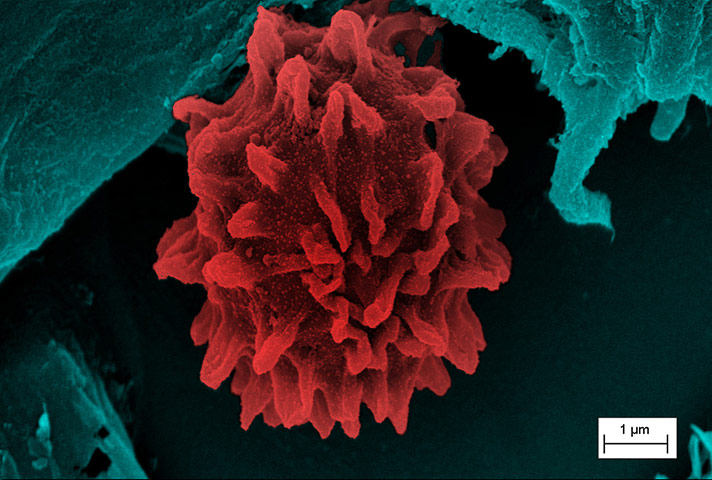
This recoloured image shows a spore of Aspergillus niger – a fungus commonly found in compost and on stored grain – resting on a silicon microcantilever. The resonant frequency of microcantilevers changes when they interact with particles, so they can be used as biosensors to detect microbial growth and will be useful for speeding up disease diagnosis Photograph: Michael Walther/CRANN/Trinity College Dublin
Nanotechnology: Postcard from nanoworld
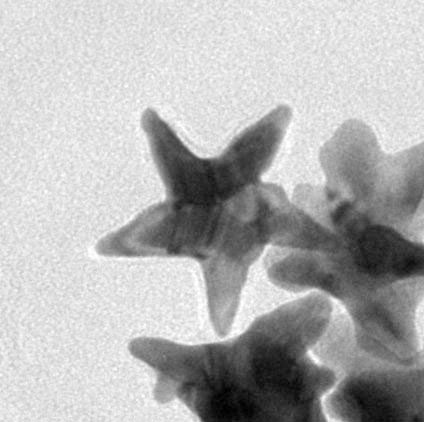
These gold nanostars enable the detection of disease-related molecules at extremely low levels. Researchers attach antibodies that can capture these unwanted molecules, known as disease biomarkers, in a serum sample. An enzyme is used to deposit silver nanoparticles on the stars, leading to a change in their optical properties that can be easily measured. One application is the diagnosis of cancer recurrence after the removal of the prostate at a very early stage, when there is a greater chance of stopping the disease Photograph: Roberto De La Rica/Department of Materials/Imperial College London
Nanotechnology: Postcard from nanoworld
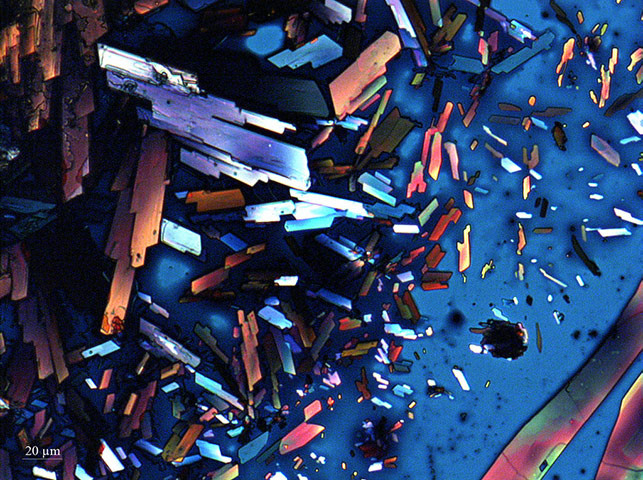
These multi-coloured fragments are extremely small crystals of carbamide, also known as urea, viewed under a specialised light microscope. Carbamide is widely used in nanobiosensors, which have the potential to provide rapid diagnosis of many diseases such as cancer and HIV infection. The colours in the image are real and occur because the crystals interact with light – similar to the technique used in modern 3D cinema glasses
Photograph: Courtesy of Dr Rohit Mishra/Crann/Trinity College Dublin
Nanotechnology: Postcard from nanoworld
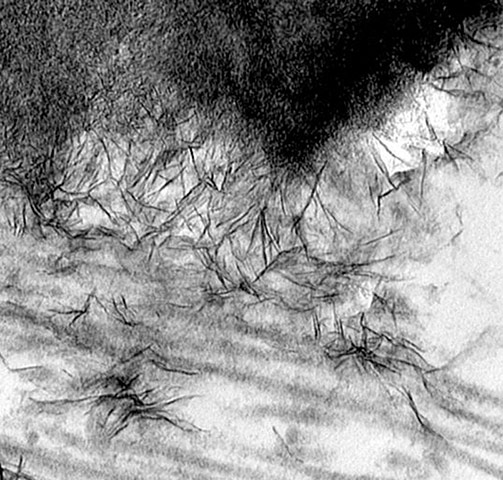
The early stages of bone formation. Bone is made up of a calcium phosphate ceramic called apatite, and the fibrous protein collagen. The dark needles in this image are the ceramic crystals. They can be seen growing along the collagen fibres – the grey fibrous structures. These very small units of mineral and collagen are the building blocks of bone. The mineral (apatite) and protein (collagen) have different mechanical properties: the mineral part is hard while the protein is tough. Together, they produce a structure that is extremely resistant to fracture. In diseases such as osteoporosis and brittle bone disease, the arrangement of the ceramic crystals on the collagen fibres becomes disrupted and the bone loses its resistance to fracture Photograph: Suwimon Boonrungsiman/Imperial College London
Nanotechnology: Postcard from nanoworld
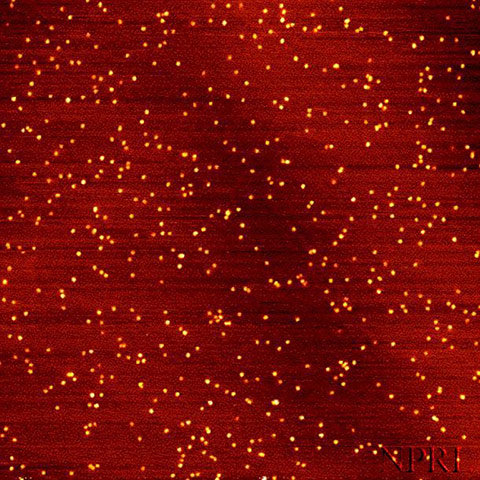
Researchers have found a way to prepare particles containing anything from a few atoms to thousands. In this image, taken by a scanning tunneling microscope, each gold particle contains just 17 atoms. The particles are also known as nanoclusters, and they have different electrical, mechanical and optical properties depending on their size. They act as anchors and can be used to trap individual protein molecules, enabling the detection of biological markers of disease. One potential application is the early stage detection of prostate cancer
Photograph: Richard Palmer/Nanoscale Physics Research Laboratory/University of Birmingham
Nanotechnology: Postcard from nanoworld
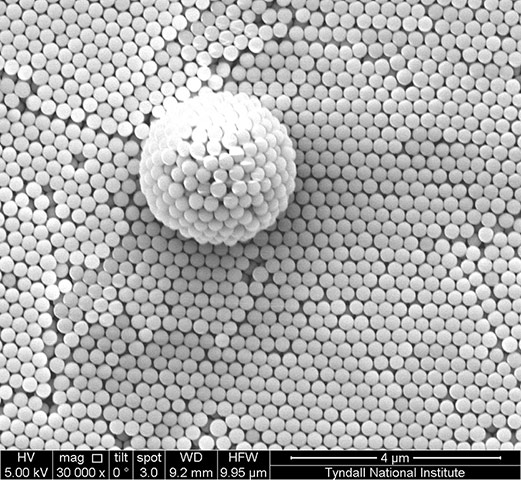
These balls are colloidal spheres of silicon dioxide, the main constituent of sand, magnified about 30,000 times. They are the basic building blocks of opal gemstones, and when they assemble in this way, they display bright colours that vary as the viewing angle changes – known as opalescence. Researchers are studying such materials to manipulate, trap and direct light, with the aim of improving the performance of optical devices such as lasers and solar cells Photograph: Martyn Pemble/Tyndall National Institute
Sign up to read this article
Read news from 100’s of titles, curated specifically for you.
Already a member? Sign in here
Related Stories
Top stories on inkl right now
One subscription that gives you access to news from hundreds of sites
Already a member? Sign in here
Our Picks
Fourteen days free
Download the app
One app. One membership.
100+ trusted global sources.