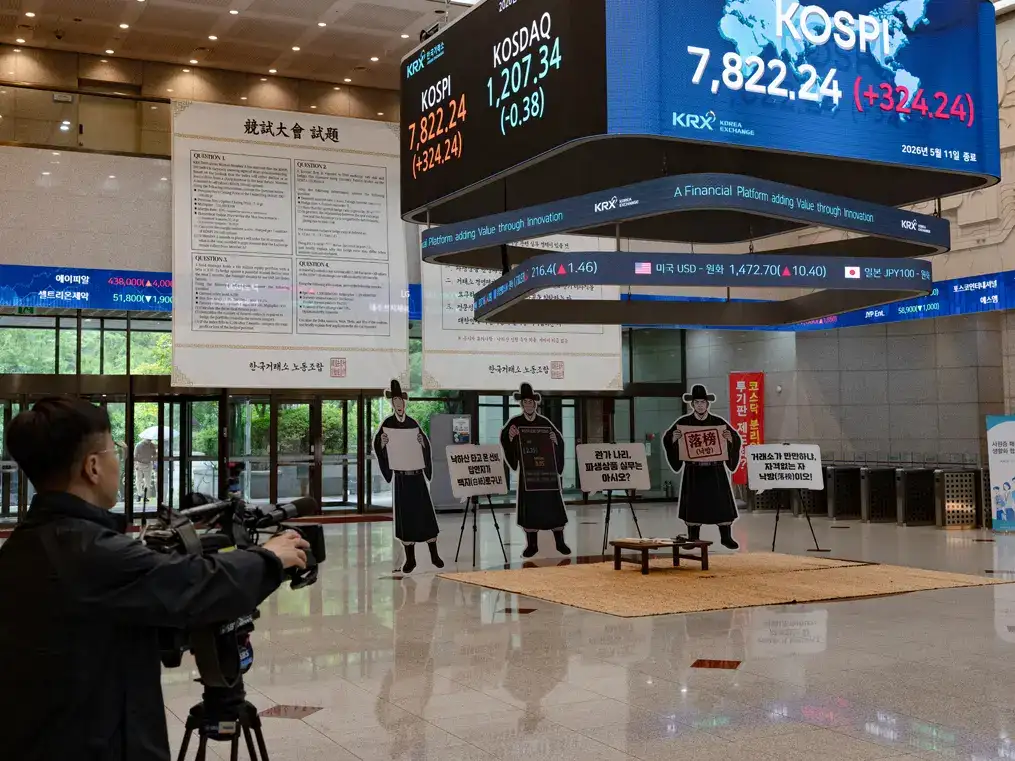
South Korean markets were rocked by a sharp selloff on Friday, with the benchmark Kospi index surrendering all its early gains and plunging more than 6% from intraday highs after briefly crossing the historic 8,000 mark for the first time. Up until Thursday, the index was up a staggering 90% in 2026 alone.
The sudden reversal was driven largely by heavy selling in technology stocks and came amid broad weakness across Asia-Pacific markets. The Kospi was down as much as 7.6% at one point, its biggest intra-day drop since March 9. Foreign investors sold 5.6 trillion won ($3.7 billion) worth of the Kospi shares on a net basis, taking this week’s withdrawal to 14.3 trillion won.
The Kospi eventually closed at 7,493.18 after breaching 8,000 earlier in the session, while the small-cap Kosdaq index slumped more than 5% to end at 1,129.82.
The sharp correction came after an extraordinary rally in South Korean equities that had increasingly raised concerns over concentration risks, particularly around artificial intelligence-linked stocks.
Those fears came to the forefront on Friday as Samsung Electronics dominated market attention. Shares of the technology giant plunged 8.6% after its labour union said it would proceed with a planned 18-day strike beginning May 21 involving more than 4,500 workers. The move came despite Samsung offering to resume wage negotiations without any preconditions. The union, however, said it would be willing to return to talks after June 7.
The sharp decline, despite the lack of any major fresh trigger beyond continuing concerns over Samsung’s labour dispute, underscored how quickly a rally driven by crowded positioning can unwind. Through Thursday’s close, nearly two-thirds of the Kospi’s almost 90% rally this year had been driven by Samsung Electronics and SK Hynix alone.
The selloff quickly spread across regional markets. Japan’s Nikkei 225 fell 2% to close at 61,409.29, while the broader Topix index slipped 0.39% to 3,863.97. Australia’s S&P/ASX 200 edged 0.11% lower to 8,630.8. Hong Kong’s Hang Seng Index dropped 1.6%, while mainland China’s CSI 300 declined 1.12% to 4,859.59.
Investors closely tracked geopolitical tensions and high-level discussions between U.S. President Donald Trump and Chinese President Xi Jinping in Beijing. Following the summit, Trump said the two countries had agreed that Iran cannot possess a nuclear weapon. He left Beijing on Friday after the two-day meeting, which was also attended by several prominent American business leaders, including Elon Musk and Jensen Huang.
Geopolitical tensions also remained firmly in focus. Xi warned Trump on Thursday that relations between Washington and Beijing could face “clashes and even conflicts” if the issue of Taiwan independence is mishandled. According to Xi, failure to handle the matter “properly” could place “the entire relationship in great jeopardy.”
Meanwhile, Trump said on Thursday that his patience with Iran was “running out” after discussing the conflict with Xi and following reports that Iranian personnel had seized a ship near the United Arab Emirates.
The U.S. paused strikes on Iran last month but has since imposed a blockade on Iranian ports. Negotiations aimed at ending the conflict remain stalled, with Iran continuing to refuse demands to abandon its nuclear programme or surrender its stockpile of enriched uranium.
(Disclaimer: Recommendations, suggestions, views and opinions given by the experts are their own. These do not represent the views of The Economic Times)