There has been a growing sense of global concern that people are losing interest in politics. However, this is not always the case, and certainly not in Thailand.
Prior to the general election on March 24, the country had to endure an eight-year wait for a national poll.
Unlike previous elections, many people engaged with politics this time using online platforms. The rise of the internet has had a significant impact on political behaviour, leading to a new phase of politics with more opportunities for citizens to directly participate.
In recent years, social media channels like Facebook, Twitter and YouTube have been used as a platform for expressing opinions and discussing politics. The election has become a subject that is heatedly debated among Thai people, indicating that we are more determined than ever to make our voices heard and choose the right path for our country.
However, faith in the current Thai democratic system seems to waning. As the internet increases the political awareness of citizens, distrust of the government seems to be growing. The results of the general election have been heavily criticised, with many describing it as "rigged".
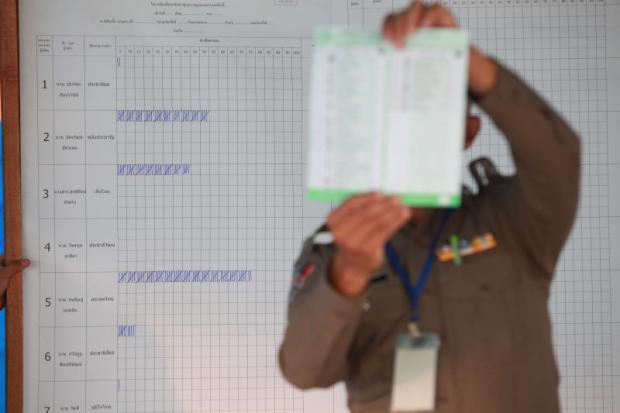
Many suspicious "errors" could be detected throughout the whole process, from the polling stations to the disclosure of the results. Moreover, out of 38.2 million voters, as many as 2.1 million were classified as bad ballots.
Accordingly, the election procedures were "problematic". But modern technology might have found a way to redeem people's crumbling faith in democracy, in the form of blockchain.
Many people equate blockchain with Bitcoin. But while facilitating the original cryptocurrency was its original purpose, blockchain is capable of so much more. It was first introduced in 2008 and is basically a suite of ledger technologies that can be programmed to record or track virtually anything of value.
Blockchain stores information in batches, referred as blocks, which are linked together in a chronological order to form a chain. In order to make changes to the information of a particular block, the change is stored in a new block with the date and time pinned to the new block. This precludes anyone from secretly going back and "rewriting" the past.
The distinctiveness of blockchain mainly lies in its ability to decentralise and distribute across a shared and continuously reconciled network of computers. This decentralisation of information allows the records to be public and easily verifiable to anyone online. The accountability of data is verified through a mechanism called "proof-of-work". In creating a block, a computer must solve a cryptographic puzzle, and then share the solution with all of the other units on the network for verification. Hence, proof-of-work generates the highest degree of trust in each and every block on the chain. Consequently, anything stored in a blockchain platform is safe, secure and transparent.
So, how can blockchain restore a broken electoral system?
Obviously, elections are at the heart of any democracy, and citizen participation is, without a doubt, the main element in the process. However, an election must also free and fair, and blockchain technology can contribute to this significantly.
A blockchain-powered voting system has several advantages over the paper-based system. While the latter might leave huge holes for security breaches, fraud and corruption, the former has distinctive characteristics that can potentially address concerns such as trust and confidentiality.
First of all, its transparency allows for each vote to be tracked, counted and correlated by many sources while still maintaining voters' privacy. Second, decentralisation prevents data tampering and secures data with a backup online, thus reducing the scope for graft. Third, accountability is an essential foundation to building trust in an election, and it is an important variable for a free and fair poll as each vote is guarded and respected. Last but not least, a digital system offers tremendous cost-cutting potential for a large-scale election.
Additionally, a blockchain-based voting system is a highly secure online platform, allowing people to vote without having to physically go to a polling station. Furthermore, security concerns such as the fear of ballot boxes being lost or destroyed are no longer an issue since data transfers and calculations are all done by the secured and incorruptible blockchain-based system.
The idea of a blockchain-based election is quickly gaining traction all around the world. But despite all these theoretical advantages, is a blockchain-based election actually practical?
Keeping up with the trend, many Thai political parties claim to have an interest in the use of blockchain. The Democrat Party even ran a blockchain-based election for its latest primary, claiming it was the first political party in the world to do so. Many leading politicians consider a blockchain-based election to be nothing short of revolutionary. However, just like any other social transition, the initial phase is usually filled with problems and difficulties.
Chadchart Sittipunt, a core member of the Pheu Thai Party, has expressed concern that the current Thai laws and regulations cannot fully support the implementation of a blockchain-based election, and most people still have scant knowledge about the technology, meaning they would need to rely too much on a limited number of experts. As a result, it is not considered appropriate for Thailand at this stage.
Similarly, Buddhipongse Punnakanta, in his capacity as a spokesman for the Palang Pracharath Party (PPRP), claims that most Thais do not really trust IT systems as they worry about being taken advantage of due to their lack of experience or gullibility, especially for something as new as blockchain. "Thai people prefer the manual method of counting ballot papers as they feel more confident," Mr Buddhipongse said.
However, both Mr Chadchart and Mr Buddhipongse insist that blockchain can be beneficial in terms of preventing corruption in an election. They seem confident that if people were more familiar with the technology, it could be put to good use. As such, they suggest the transition must begin with small-scale implementations and gradually increase until people are ready to "fully convert".
On the other hand, Chris Potranandana, a founding member of the Future Forward Party (FFP), thinks the sooner we convert, the better. While he admits blockchain could present some challenges, the benefits for the public, in his eyes, make it worth the risk.
Fortunately, despite all the conflicting opinions, Prinn Panitchpakdi, managing director of CLSA Securities Thailand, claims that with the current technological resources and programmers at its disposal, Thailand is already capable of running a successful, blockchain-powered election. However, he said it must offer both electronic and manual voting for the most inclusive results.
Democracy means more than just an election, however. As Mr Chadchart put it, freedom and equality are its very cornerstones.
But, of course, there is no "one size fits all" policy. Mr Buddhipongse points out that people in different geographical areas have their own conflicting desires and political views. However in Thailand, most of the power lies heavily vested in the central administration, rather than local governments, which leads to greater domestic conflict. That being said, Mr Potranandana stresses how the rights of minorities should not be overlooked.
Even though decentralising power into smaller divisions would allow the government to tackle various problems according to the needs of the people who live in those localities, it is almost impossible to implement this without greater public participation.
And even though modern technology allows people to have greater access to channels of expression, a format that converts opinions to their being implemented is still missing.
Some believe a new approach like blockchain technology could plug this gap.
For direct participation to be effective, the government requires a great level of accountability to ensure people's voices are heard. That is why blockchain can serve as a platform for a stronger connection between voters and their representatives. Voters and representatives can all be publicly verified and citizens can actively engage by providing feedback on policy issues, resulting in a direct democracy with better representation.
We have learned so far that Thailand's democratic system is failing, but it is never too late to fix it. Regardless of the results of the recent election, politicians are merely representatives of the people. What is needed is greater direct participation.
Sorakit Kittayarak is a former intern researcher at the Thailand Institute of Justice (TIJ). He is studying International Relations at the University of Leeds.