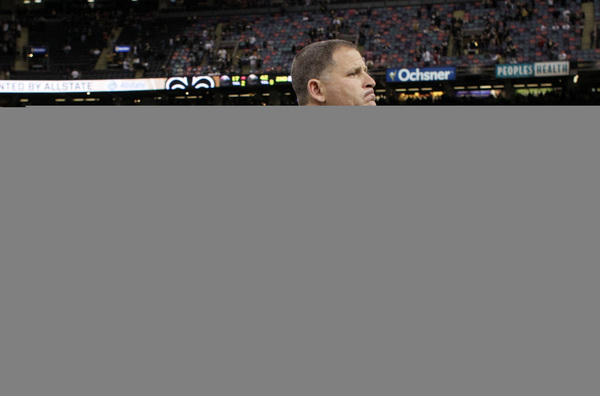
Have you followed the news at Tennessee? On Sunday, the Vols had their new football coach _ Ohio State defensive coordinator Greg Schiano _ and then they didn't. When word got out Schiano was the choice, enough of the fan base flew into a cyber-rage to have the process halted.
The uproar was related to Schiano's time as a Penn State assistant working with defensive coordinator Jerry Sandusky. Testimony released in 2016 suggested Schiano was aware of child sexual abuse by Sandusky.
Schanio denied knowledge of the crimes, but the backlash killed the Tennessee deal orchestrated by athletic director John Currie, who left his job at Kansas State to take over in Knoxville in February.
Which got us thinking ...
Transitions in coaching and athletic administration at the college level can be a messy enterprise, and we've seen our share of turmoil right here in the Kansas City area.
Here are examples from each of the area's Power Five programs.
Kansas, April 9, 2003: "He chose to crush me"
The driveway of KU athletic director Al Bohl provided the scene for a memorable news conference.
Bohl never got along with men's basketball Roy Williams, and their differences likely started two years earlier when Bohl, who had been on the job for a few months, had fired football coach Terry Allen, a friend of Williams.
Fast-forward to the 2003 NCAA Tournament. The Jayhawks were rolling toward the Final Four in New Orleans when North Carolina fired its coach, Matt Doherty. Williams, who turned down the job at his alma mater three years earlier, got the full-court press from Dean Smith and other power brokers in Chapel Hill.
There was a sense among Kansas leaders that firing Bohl could be a deciding factor in keeping Williams.
Bohl's unpopularity grew and he was booed as he took the stage at pep rally before the Jayhawks' semifinal game against Marquette.
Kansas won that game, lost to Syracuse in the final and two days later Bohl was fired. He opened a news conference from his driveway with this:
"It's a sad day in college athletics when a college basketball coach has the power to hire and fire an athletic director."
It got testier.
"I believe the Kansas basketball coach had the power to hold his athletic director in his hand like a dove. And he had a choice to either crush me with his power of influence or let me fly with my vision for a better, total program. He chose to crush me."
For sheer imagery, there have been few better exit lines.
Missouri, March 26, 2006: Coach hired; is AD fired?
A tumultuous few weeks culminated on a dramatic Sunday in Columbia when the school introduced men's basketball coach Mike Anderson. Nothing dramatic about that, until you consider the circumstances surrounding Anderson's hire.
Six weeks earlier, Quin Snyder resigned, and that was a mess. Athletic director Mike Alden had sent his special assistant, radio analyst Gary Link, to deliver a message to Snyder. But the something got lost in translation.
According to notes by chancellor Brady Deaton, the Link-Synder conversation went like this: "Quin, the team is not looking good," Link told Snyder. "We know how the book is going to end. The question is how do we write the last chapter."
In other words: Step away now or after the season.
A few days later, Alden said he sent Link to ask Snyder if "he might want to step away." An independent investigation released later revealed Link's decision to deliver an ultimatum was made on his own.
Still, Alden was criticized for apparently sending Link to do his dirty work, and the athletic director's detractors grew. On the day Alden was to announce the hiring of Anderson at Mizzou Arena, the press conference was delayed while the Board of Curators met to consider firing Alden.
Alden was retained and introduced Anderson at the end of a bizarre day.
Kansas State, Nov. 5, 2008: The secret deal
Replacing Bill Snyder after he resigned in 2005 wasn't going to be easy. But how could the end of his successor's tenure become so tangled?
Ron Prince started out OK, a winning record and a bowl game (the Wildcats lost to Rutgers, coached by Schiano). But two losing seasons followed, and after a third straight loss to rival Kansas, K-State announced with three games remaining that Prince wouldn't be back. His buyout cost the school $1.2 million.
Only a small circle knew at the time that Prince and athletic director Bob Krause had signed a secret agreement that was to pay Prince $3.2 million in settlement money if he was fired before the end of 2008. President Jon Wefald said he knew nothing about the agreement and fired Krause.
Kansas State declared the secret deal invalid. Prince's attorney counter-sued and the parties settled on a $1.65 million payment on top of the $1.2 million Prince had already received.
K-State was now in need of an athletic director, and found its winning candidate at Tennessee. He was a young administrator who held several titles, with several others in development.
In May 2009, John Currie was introduced in Manhattan as the Wildcats' next athletic director.