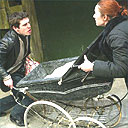
A year ago Vassily Sigarev made a big impact with Plasticine: a dark, Dostoevskian study of a Urals urban hell. But, where that relied heavily on visceral shock, Sigarev's new play strikes me as an infinitely richer affair that blends a portrait of a marriage with a vivid picture of Russia's unending contradictions.
Sigarev's setting is a railway station in a provincial hell-hole. And waiting for a non-arriving train are Levchik, a Moscow trader, and his heavily pregnant wife, Poppet, who have come to fleece the locals by selling them cheap Malaysian toasters. But Sigarev achieves an astonishing second act reversal by showing the young couple, 10 days later, still stuck in the same station: the key difference is that Poppet, having been delivered of her baby by a local midwife, wants to settle down in this rural backwater.
What makes the play so exciting is its effortless mix of personal and social detail. On one level, it's an account of an abrasive modern marriage in which antagonism equals love and every endearment is spelt with four letters; and, just when you think Levchik is a total bastard, Sigarev upends all your assumptions by implying he may also be Poppet's protector. Through his portrait of two city slickers descending on the provinces, Sigarev also demonstrates Russia's perennial divisions: nothing is more moving than the sight of the locals come to protest about their useless toasters and being cowed by Levchik's brazen impudence.
But the moving thing about the play, in Sasha Dugdale's translation, is that it feels both ancient and modern. Chekhov or Gorki might have recognised its image of a rural Russia in which there's not even a local hospital, though as the station ticket clerk revealingly remarks "there was a first aid post once". At the same time Sigarev offers a sardonic account of the new, post-communist Russia in which spivvery is rampant and in which, as Poppet claims: "It's trendy to hate and look down on everyone."
Where Plasticine was dominated by its promenade style, here Simon Usher's Theatre Upstairs production captures exactly Sigarev's social nuances. Delia Peel's railway station is a masterpiece of decay. Paul Ready also suggests that Levchik's bullying bravado and rat-like cunning conceals an unarticulated love while Sarah Cattle's Poppet changes from metallic urban hard-heart to pallid rustic dreamer. Gary Oliver as an ineffectual hitman and Suzan Sylvester as the ticket clerk who is both exploiter and solicitous child carer confirm Sigarev's point that the contradictions in the Russian pysche remain eternal.
· Until March 1. Box office: 020-7565 5100