On May 25 in the US city of Minneapolis a 46-year-old black man named George Floyd died after white police officer Derek Michael Chauvin knelt on his neck for several minutes.
A number of bystanders filmed the incident, with footage showing Floyd repeatedly saying he couldn't breathe due to the knee on his neck and calling for his mother.
After several minutes of Chauvin kneeling on his neck he fell unconscious, though the police officer continued to apply pressure to Floyd's neck until an ambulance arrived and emergency medical technicians told him to move away from the unresponsive man.
The ambulance reported that Floyd was going into cardiac arrest en route to the hospital. He was pronounced dead at Hennepin County Medical Center less than an hour later.
George Floyd's official post-mortem has declared his death a homicide, with the cause of death being "cardiopulmonary arrest complicating law enforcement subdual, restraint, and neck compression". One of the possible causes of a cardiac arrest is lack of oxygen.
Chauvin has been charged with third degree murder and second degree manslaughter, while three other police officers involved in Floyd's death have been fired.
The homicide of George Floyd has prompted several days of large scale protests and riots across the US, with fires started and police using tear gas on crowds of protesters. The situation shows little sign of de-escalating as the police have clashed with demonstrators for successive days.
In the US
Curfews have been established in cities across America, though protesters have not been stopped by efforts to force them from the streets of their cities.
The disorder across the US is the largest since the aftermath of Martin Luther King's assassination in 1968. Protesters are hoping their efforts might finally lead to real change after previous years of demonstrations did not result in the end of unjust deaths at the hands of police officers.
Police have used tear gas and rubber bullets on the protesters, with many recorded incidents of unarmed and peaceful protesters being attacked by police officers. Journalists and camera crews covering the demonstrations have also been on the receiving end of violence from the police.
Officers facing people protesting against their excessive use of force have responded with more force, reports the New York Times. They recount incidents of police violence including two police cars being driven into a crowd of protesters and an officer in riot gear shoving a man with a cane to the ground.
In some areas the interactions between officers and protesters have been more peaceful, but there are still many incidents of violence and excessive force. Demonstrators have taken to filming their experiences at the protests to ensure as much of the violence is recorded on camera.
US president Donald Trump declared he would deploy military force in states which refused to use the National Guard to pacify unrest. He said he would bring an end to the "riots and lawlessness" which had overtaken many American cities.
Among the demonstrators dispersed by the police were those outside the White House and the president has been accused of tear-gassing peaceful protesters so he could have his photo taken outside the nearby St John's Episcopal Church.
Trump said "justice will be served" to George Floyd's family but accused the protesters of committing "acts of domestic terror", describing the violence of the last few days as "an offence to humanity and a crime against God".
Earlier in the protests the president had threatened to use military force on protesters, tweeting "when the looting starts, the shooting starts".
Around the world
What started in the US has led to global demonstrations of solidarity being held in the UK, Germany, Poland, Denmark, France, Italy, Brazil, Mexico, Syria, the Republic of Ireland, Canada, Australia and New Zealand among other countries.
Groups of people holding Black Lives Matter signs gathered in cities across the globe to show solidarity with the protests in the US and call for justice for George Floyd.
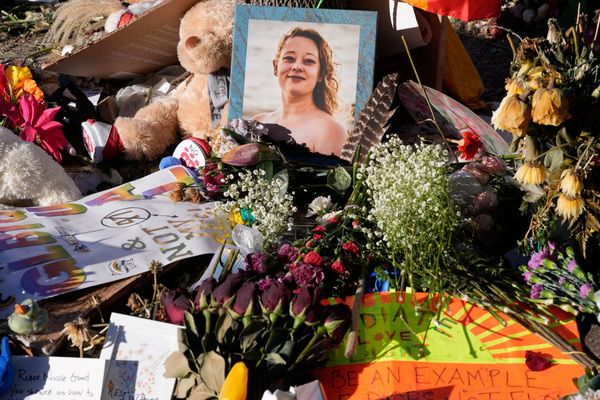
Placards with slogans have been paraded through city streets, murals have been painted and candles have been lit for vigils in tribute to Floyd.
People have used the protests to demonstrate against racial injustices in their own nations. Racism and discrimination is more entrenched than many nations would like to admit.
Black Lives Matter is helping arrange demonstrations in the US and across the world to protest at the unequal treatment black people receive in many countries.
Racism is widespread and deeply entrenched in many nations, people all over the world have plenty of local reasons to protest against it in addition to showing solidarity with the protesters in the US.
The Facts
According to the complaint filed against him, Derek Chauvin kept his knee on George Floyd's neck for eight minutes and 46 seconds, including a period of time where he was unconscious and unresponsive.
Pushing a knee into a person's neck is banned by most police departments in the US, while Minneapolis police regulations say an officer can only do it to a person who is "actively resisting".
Floyd spent minutes pinned to the ground by Chauvin and fellow officers Thomas K. Lane and J. Alexander Kueng, who applied pressure to his legs and torso respectively.
A study from Rutgers University found that a black man in the US had a one in 1,000 chance of being killed by the police, making them 2.5 times more likely to have it as a reason for their death than a white man. Black women, Latinos and Native Americans were also more likely to be killed by police than their comparable white peers.
African-Americans make up 13.4 per cent of the US population but amount for 23.4 per cent of fatal police shootings and around a third of the prison population.
They are disproportionately more likely to be killed by the police than their white peers and are more likely to be arrested for offences such as drug use despite national surveys showing black and white people in the US use drugs at a similar rate.
The Lancet reported that police in the US killed more than 300 black men each year, with at least a quarter of those who died being unarmed.
Trump's ability to send soldiers against the protesters depends on the 1807 Insurrection Act.
The Posse Comitatus Act of 1878 prevents troops from carrying out law enforcement duties in the US, but in extreme cases a president is allowed to invoke the Insurrection Act and use National Guard troops on active duty for law enforcement purposes.