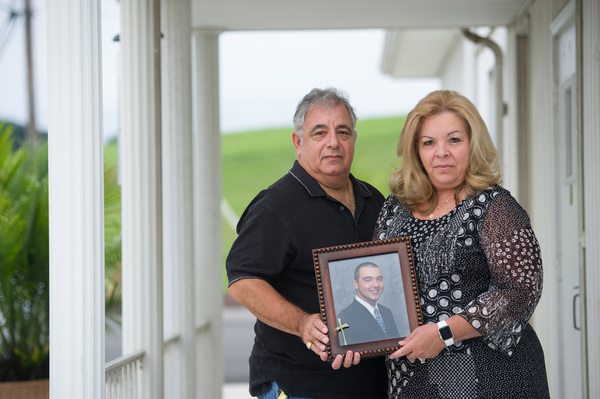
PITTSBURGH _ After the horror of watching their 26-year-old son, Patrick McKallip, battle opioid addiction for six years before he finally died May 24, 2016, of an overdose, Michelle and Anthony Donatelli found some solace 10 months later.
The day he died at Allegheny General Hospital, they decided to donate his organs. Later, they sent letters to the recipients of his kidney, liver and heart, hoping they would hear back from them.
The first to reply was a man in his 60s who received McKallip's heart, saving his life. The Donatellis, from New Kensington, went to visit him in his Pittsburgh area home in March.
"He tells us every day (he exercises) he says, 'Come on Patrick, let's go for a walk,'" recalled Anthony Donatelli, who became McKallip's stepfather when McKallip was 7.
"The heartache continues. It's like an open wound. It just never closes," Anthony Donatelli said of losing his son. "But after that (because of the organ donation) you realize he gave the greatest gift you could give anybody: Life."
That bittersweet situation has been replayed in ever-rising record numbers over the last three years in Western Pennsylvania, Appalachia and the entire country.
In a rising tide of tragedy with no end in sight, figures through half of this year point to another record year locally and across the country in 2017.
The number of donors who died of overdoses more than doubled across the country from 625 in 2014 to 1,263 in 2016, and is projected to rise to about 1,400 this year, according to federal data. That same data shows that most of that increase came from Appalachian states like Pennsylvania, the Northeast and the Midwest, which tracks with where the opioid epidemic has hit hardest.
"It's tragic," said Dr. David Klassen, chief medical officer for the United Network for Organ Sharing, the organization that oversees the nation's organ transplant system. "But (by recovering the increased number or organs) we're trying to salvage a young person's tragic death."
The dramatic rise in organ donations is the reason CORE set a record for the number of deceased donors from any cause _ 237 _ in 2016, which also meant a record number of people received life-saving organ transplants.
"'Record.' It sounds strange to say it that way," said Kurt Shutterly, CORE's chief operating officer. "I'd rather say that we had more donors than we ever had. It's sad. It's just tragic what is happening."
With no expectation that it will slow down this year, CORE in January approved increasing the number of organ procurement coordinators _ the employees who go to the hospitals to try to convince families to donate organs and to evaluate the organs themselves _ from 15 to 20.
"We're evaluating more drug-related deaths than ever before," said Shutterly, who began with CORE in 2000 as an organ procurement coordinator. "And I don't see anything changing that right now and that's a tragedy."