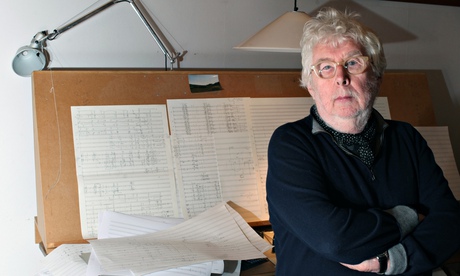
The Southbank Centre made sure it got the last word in the celebrations of Sir Harrison Birtwistle’s 80th birthday this year. Its weekend of concerts and events was kicked off by the London Sinfonietta, laying claim to its own; the ensemble has been this composer’s champion since it first gave a Birtwistle premiere in 1969.
There were two new pieces here, too, tiny ones. Violute and Echo add to the ongoing series of duets Birtwistle is writing for the Sinfonietta’s inspiringly can-do players. Violute is a restless, insistent stream of notes for flute and violin that seems almost mechanical, like one of Nancarrow’s player piano pieces. Echo finds horn and trombone trading full-toned and muted sounds as if from neighbouring mountainsides.
The works got bigger. First came Virelai, which does for a 14th-century song what Stravinsky did for baroque music in Pulcinella; then In Broken Images, in which the three opposing yet complementary groups of players included members of the Royal Academy of Music’s Manson Ensemble alongside the Sinfonietta. Finally there was Theseus Game, in which, one after another, individual players walked out to the front and the rest, seated, switched allegiance between the two conductors, Geoffrey Paterson and David Atherton. Playful ideas generated fascinating, complex textures.
All this was the perfect context for the following night’s UK premiere of Birtwistle’s new piano concerto, Responses: Sweet Disorder and the Carefully Careless – though disorderly was hardly how you would describe Pierre-Laurent Aimard’s rigorously virtuosic playing, or that of the London Philharmonic under Vladimir Jurowski. There are hints of mischief – wah-wah trumpets in a jaunty fast episode, for example – but it’s a serious piece. And yet it wears its dense textures lightly, and the piano always has the space to be heard as it questions the orchestra. Framing it we heard the original version of Stravinsky’s Symphonies of Winds, with emollient alto flute and alto clarinet, the same composer’s ballet Orpheus, and Messiaen’s Oiseaux Exotiques, in which Aimard was dazzling once again.