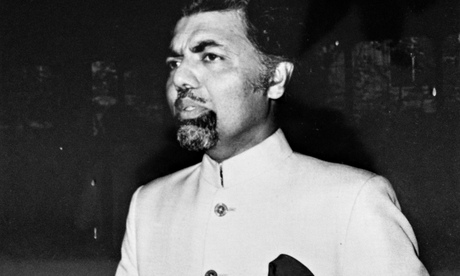
My husband, Birendra Shankar, who has died of cancer aged 82, was the director of the Sanskritik Centre of Indian Arts, London, and artistic director of the annual Sanskritik Festivals of Arts of India, which took place at the Southbank Centre from 1970 to 1988.
When he arrived in Britain in 1958, Birendra planned to stay for only a few years, aiming to acquire some professional qualifications and work experience, before returning to his homeland and starting up his own business. He ended up doing something far more creative.
His passion for the classical performing arts of India began in his youth: his father, Sailendra, was a lawyer in the high court of Calcutta (now Kolkata), but among Sailendra’s cousins were the dancer Uday Shankar and the musician Ravi Shankar, who was at one time married to the surbahar player Annapurna Devi. In the 1950s, when he was a student in Calcutta, Birendra convinced famous musicians to perform without fees, in order to raise funds for student health clinics (now established as the Students Health Home).
In the mid-60s, Ravi Shankar requested Birendra’s help with publicity for his concerts in London, and then in 1966 Birendra presented the sarod player Ali Akbar Khan at the Piccadilly theatre and the Festival of Light and Folk Music of India at the Royal Albert Hall. In 1967 he organised Dance and Music of India at the Scala theatre, London.
Birendra realised that a professional platform was needed in the UK for Indian classical arts performances and in 1969 he established the Centre of Indian Arts, the organisation that subsequently ran the Sanskritik festival.
The first of these opened in 1970 to wide acclaim and over the years Indian classical performing arts were presented professionally in top venues. The festival was described by Meirion Bowen in the Guardian in 1979 as “irreplaceable”.
After the festival closed, Birendra focused on completing Sanskritik: A Celebration of Music of India, four albums that were released in 1995. He also wrote a book about his life, Heritage Harmony and Understanding, which he managed to have printed shortly before his death.
Birendra always had time for others, would engage in conversation with anyone and loved to entertain. He took great delight in his grandchildren and his role as “Dadu” was the one he cherished most.
He is survived by me, our son, Arjun, and daughter, Kanika, and grandchildren, Leela, Arun, Maya and Jai.