When I have to avoid getting too close to a bird because it might kill me, I know I’m not in Somerset anymore, Toto. I’m actually nearly ten thousand miles from home, in “TNQ” – Tropical North Queensland.
During my whistlestop tour of Australia’s most bird-rich state, I saw well over 200 different species – almost half of them new to me. But among the bowerbirds and boobies, whipbirds and woodswallows, fairy-wrens and fig parrots, there’s one bird that I want to see more than any other. And now it’s standing just a few feet away from me, on the terrace of the aptly named Cassowary House.
The southern cassowary rivals another Aussie giant, the emu, for second place behind the world’s largest bird, the ostrich. As it’s over 6ft tall, and weighs almost as much as I do, I am naturally cautious. And as this is one of the very few birds in the world able to kill a human being – with one quick swipe of its razor-sharp hind claw – I’m being especially careful.
Another reason to approach slowly is that this particular bird, a male, is accompanied by a two-month-old chick, a humbug striped creature on long, slightly wobbly legs. He is being rather protective of his offspring, shepherding him around like a fussy dad on his child’s first day at playgroup.
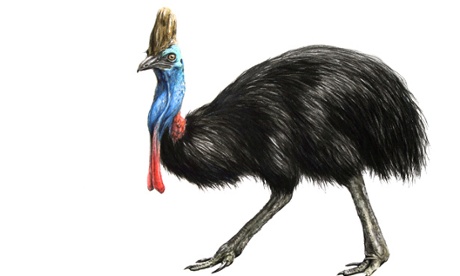
I lift my binoculars gently – though I hardly need a closer look – and am struck by the impossibly bright blue on the bird’s neck, the long, red wattle and the prominent, horny protuberance on his crown, which looks as if it could do quite enough damage on its own.
Then he turns and stares at me, with all the malevolent menace of one of those lethal velociraptors in Jurassic Park. If I ever needed reminding that birds descended from dinosaurs, this is that moment.
I’ve never seen a bird that looked less bird-like; even ostriches have that plume of feathers sticking out behind, but the cassowary looks as if it is wearing a thick fur cloak. Native Australians apparently did not regard the cassowary as a bird either, and they may have had a point.
Cassowaries are, like so many Australian birds, losing out to the ever-growing numbers of human beings with whom they share this beautiful land. Although they are also found in Indonesia and New Guinea, here in Australia they are confined to a narrow strip of rainforest in north-east Queensland; a habitat that is increasingly under threat from farming, logging and development. Now there may be fewer than 1,500 of these splendid creatures left here.
Roads are another major problem. My companion, top Aussie birder Sean Dooley, tells me that the mother of this chick was killed just a few weeks ago by a car – a fate shared, sadly, by many cassowaries.
The male normally brings up the chick on his own anyway, but the absence of the mother bird has attracted another female (the male’s old mate) to hang around. Although this is not the breeding season, she is, in Sean’s well-chosen words, “gagging for it”, and so keeps harassing the unfortunate male, who just wants to get on with his paternal duties.
Then the female turns her attention to us, and so we beat a dignified retreat, leaving these incredible birds in peace.
Twitter: @stephenmoss_tv
Stephen Moss travelled courtesy of Tourism North Queensland