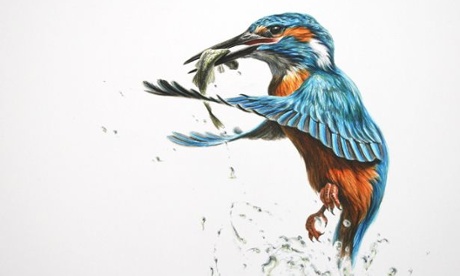
If there’s one bird that brightens up even the dullest winter’s day, it’s the kingfisher. But you have to be quick to appreciate it: once you hear that high-pitched, metallic call, you only have a moment before a blue-and-orange flash shoots away from you and out of sight.
I’ve seen a lot of kingfishers lately. Partly this is because I’m on a New Year fitness kick, so I’ve been cycling and running (well, jogging) around the lanes behind my Somerset home.
Kingfishers sit unseen in the rhynes (the narrow ditches that drain water off the land) and then fly rapidly away as I approach. As always, I’m struck as much by their tiny size – barely bigger than a sparrow – as by their undeniably dazzling colours.
Other birds I’m encountering on my dawn and dusk outings are rather more cooperative: the buzzard that sits tight even as I cycle past, the stonechats that pop up on top of the hedgerows and, best of all, a barn owl – the first I have seen so close to home – that hunts for voles among the hay-bales still sitting in the fields.
I’ve also seen kingfishers on both my local patches: the new one on the coast, where they fly up and down the River Brue as it reaches its mouth; and my original, inland one.
You’d think I’d know better by now, but I’m always surprised when I inadvertently flush the kingfisher that perches on the edge of the drain at the southern end of my inland patch. Little egrets feed here too, just below the banks, so that sometimes I can get really close to them before they notice me and fly away on their snow-white wings.
Otherwise, it’s been a fairly quiet year so far, probably because it’s been such a mild winter. At the coast, I’ve been getting used to the wide-open spaces and sheer numbers of birds. On one visit a flock of at least two thousand dunlins twisted and turned in the late afternoon sun, flashing alternately dark and light as they searched for somewhere safe to roost at high tide.
There have been a few surprises, too: a lone brent goose by the Huntspill Sluice; a flock of 50 or so avocets feeding on the opposite side of the river, against the incongruous backdrop of Hinkley Point nuclear power station; and a rock pipit feeding among a dozen of the commoner meadow variety.
Inland, I’ve enjoyed fabulous close-up views of bearded tits, one of which has joined forces with a winter flock of blue, great and long-tailed tits. There are also goldcrests and treecreepers foraging for tiny insects in the wet wood, and a singing coal tit, whose joyous, explosive sound really did make me imagine for a moment that spring was just around the corner.
But the best sighting of all was not a bird, but one of our most elusive mammals. Visiting with a friend, as we reached the drain at the southwest corner of the patch we saw the kingfisher shooting away upstream.
My companion and I were just congratulating ourselves on seeing this dazzling bird, when a long, slender figure lolloped across the path: an otter.
Like most otter sightings, it lasted barely two seconds before the animal disappeared into the reeds; but like all of them, it will linger long in the memory.
Twitter: @stephenmoss_tv