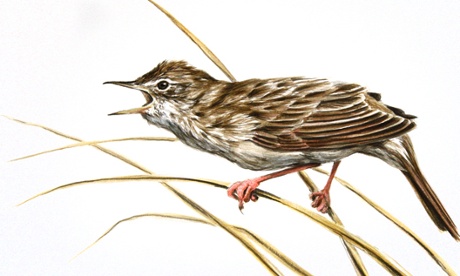
For a moment, I wasn’t aware that I was listening to a bird at all. That insistent buzzing, coming from somewhere deep inside the scrubby, overgrown reedbed, sounded more like some kind of insect. Then it dawned on me: it was a grasshopper warbler, whose entomological epithet couldn’t be more apt, given that strange, relentless, clockwork sound.
I scanned the reedbed with my binoculars, and there he was, perched on a low bush. A small, brown warbler, with a few desultory streaks across his back; his gape wide-open, pouring out that strange song into the early morning air.
The grasshopper is just one of 11 different kinds of warbler I have seen and heard on the Somerset Levels during this glorious spring. The early arrivals, chiffchaff and blackcap, have been singing in my garden since late March and early April respectively. In mid-April, they were briefly accompanied by willow warblers. But after a few days these headed further north to breed.
On both my local patches – inland and on the coast – I’ve enjoyed a bumper crop of reed and sedge warblers. The former stay hidden, deep inside their vertical habitat, chuntering away repetitively from dawn to dusk, while their brasher relatives launch themselves skywards, to deliver an altogether more haphazard and enthusiastic song. Meanwhile the other resident of the reedbeds, Cetti’s warbler, is just as skulking as ever, and just as loud.
Along the hedgerows at the back of my home, where I try to keep fit by jogging or cycling, the common and lesser whitethroats are also singing. The lesser whitethroat seems to be having a very good year, judging by how often I am hearing its repetitive, rather yellowhammer-like song. The garden warblers are back too. Their rapid warble can sound remarkably similar to the commoner blackcap, but my friend and fellow birder Dominic Couzens gave me a useful tip: blackcaps sound like a speeded up blackbird, while the garden warbler’s song has the rhythm of the skylark.
The most unexpected of my 11 spring warblers was discovered by twitchers who flocked in their hundreds to Shapwick Heath reserve, to see one of the rarest birds ever recorded in Britain: a Hudsonian godwit. This vagrant from North America was found among a flock of its commoner relatives, a hundred or so black-tailed godwits, and drew crowds of birders from all over the country.
While I was watching this unusual visitor, I heard that someone had come across a wood warbler; a species normally found only in the oak woods in the west of the county, and very scarce on the levels. I soon caught up with the bird: a lemon and green sprite flitting around in the bushes and singing his beautiful, shivering song.
My final surprise of this eventful spring was perched in the car park of my inland patch on bank holiday Monday at the start of May: a spotted flycatcher, just arrived from West Africa; these are one of the latest migrants to come back here. Along with the warblers, godwits, and a host of other returning summer visitors including cuckoos, swifts and hobbies, this charming little bird was one of the highlights of the best birding spring I have ever enjoyed.
Twitter: @stephenmoss_tv