It’s early morning on New Year’s Day, with a sky so grim that even well after sunrise it’s still not really light. I’ve come to my new local patch – where three rivers meet before they enter the Bristol Channel – determined to start off the birding year with a bang.
My walk begins before dawn, in a side street on the edge of Highbridge. The first bird of the year is a chinking blackbird, closely followed by a singing robin and a cooing collared dove.
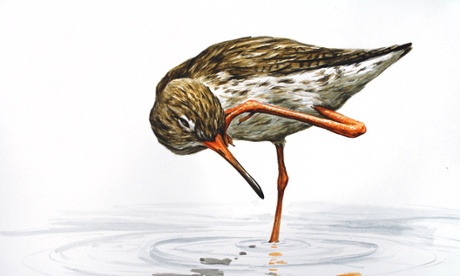
I cross the clyce – a local word for a sluice gate – over the first of these three rivers, the Brue; and immediately pass from suburbia into a landscape of wide-open skies, wind and birds. Soon I hear the first sign that I am nearing the coast: the alarm call of a redshank as it heads away down the river.
Redshanks are notoriously flighty, and have earned the nickname “sentinel of the marsh” for their habit of calling as soon as they spot an intruder. Normally this sets off all the other waders, but today the redshanks have the river basin to themselves.
A mile’s stiff walk into the strengthening breeze and I reach the second river, the Parrett. It has wended its way here across the Somerset Levels, widening at its mouth to create a huge area of mudflats at low tide.
The main beneficiaries of this muddy dining table are shelduck, hundreds of which use this estuary throughout the winter; but there are also large flocks of gulls, smaller groups of curlews, and the odd grey plover.
A cry overhead signals a small flock of lapwings, accompanied by one larger, longer-winged bird. Its black and white wings and tail enable me to identify it as a black-tailed godwit, which has stayed put while its relatives have headed further south.
I walk along the sea wall, where pied wagtails probe the ground for tiny insects. They are accompanied by a bulkier, darker bird: a rock pipit, which unlike the wagtails will live its whole life along this coast. After another mile or so I reach the third river: the Huntspill. Unlike the Brue and Parrett this is an artificial waterway, built in the 1940s to supply water to a nearby explosives factory.
I turn inland, totting up a few new species including reed bunting, redwing and song thrush in the hedgerows, while a lone kestrel hovers overhead in search of prey. A long trek back via the church at West Huntspill (rooks and jackdaws) and across some open fields (jay and a passing peregrine), produces a final total of 44 species – not bad for my first visit to this new patch.
The next day I drag my children and their friends out on a muddy walk to the sea wall and back, adding a few more species including little egret, skylark and a pair of stonechats. There’s also a surprise: a flock of 20 turnstones roosting with redshanks on the muddy banks of the Brue – they are usually found on rocky shores.
Over the next year I plan to alternate visits between my old, inland patch and this new, coastal one; and compare and contrast the two very different sites. Between them, as the seasons change, I hope to see well over 120 different species, a good cross-section of the birds of this delightful area around my Somerset home.
twitter: @stephenmoss_tv