Soon after dawn, the scavengers began to arrive. First the ravens, glossy blue-black in the pale early morning light, hopping about on spring-loaded legs. Then the griffon vultures: huge, shaggy birds with long, bare necks, floating down from the brightening sky to land in the scrubby trees.
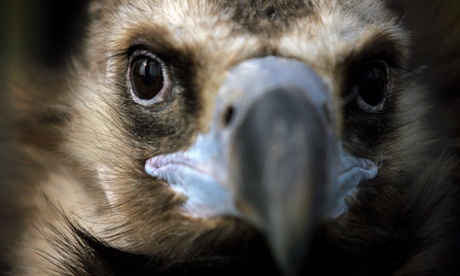
And finally, the king of European raptors – huge, dark and with the sort of expression that suggests it rules the roost – the black vulture. A score of these magnificent birds had come to feed on the remains of a dead donkey.
The black (also known as the cinereous or monk) vulture is one of the largest birds of prey in the world, only beaten in size by the New World condors. These mighty raptors are well over a metre long, with a wingspan of more than three metres. They tip the scales at up to 14 kilos, making them one of the world’s heaviest flying birds.
Although black vultures are found throughout much of southern Europe and central Asia, from Portugal in the west to Korea in the east, they are nowhere common, and like so many large raptors they have suffered huge declines in recent decades. But now, thanks to careful conservation measures, they are making a comeback – notably in one of Spain’s most scenic and bird-rich regions, Extremadura.
Extremadura – the name itself suggests “extreme” and “hard”, belying the stunningly beautiful landscape – is one of Europe’s most accessible yet overlooked wildernesses. Just three hours drive south-west of Madrid, it is a land of mountains and hills, open fields dotted with cork oaks, rivers, stunning medieval cities and, above all, birds.
Of all the birds that I saw on my whistle-stop tour of this hidden kingdom, the raptors were the most prominent and spectacular. Not just the vultures – griffon, black and the smaller, paler Egyptian – but four falcons (peregrine, merlin, kestrel and lesser kestrel), common buzzard, both red and black kites, and no fewer than four species of eagle: golden, booted, short-toed and the mighty Spanish imperial. In all we tallied 14 species in three days, just one fewer than breed in the whole of Britain.
It was not just the variety of raptors, though, but their profusion: at least 200 griffon vultures came to feed on that memorable morning, while whenever we looked up there seemed to be birds hanging lazily on outstretched wings in the blue spring sky. Even the cities have their own special birds of prey: a colony of lesser kestrels – one of Europe’s rarest raptors – nest on the ancient buildings of Trujillo.
As do, of course, white storks. Almost every rooftop had its own storks’ nest – made of a huge pile of sticks – where the birds, newly returned from Africa, were indulging in their courtship displays, clattering their bills noisily together to renew their pair-bond.
This wasn’t the only sign that the seasons were changing: gaudy yellow and orange Cleopatra butterflies fluttered around in the sun, while swallows and house martins swooped for tiny insects in the clear air above our heads.
It was a welcome sign that spring has already returned to southern Europe, and that the new season, so full of hope and promise, will soon reach us here at home.
• Stephen Moss travelled to Spain courtesy of the Extremadura Tourist Board
Twitter: @stephenmoss_tv