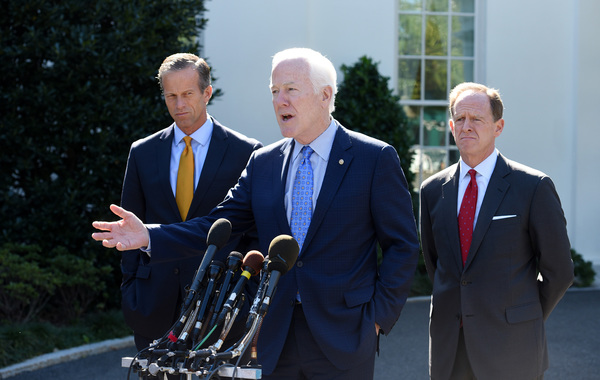
WASHINGTON _ After huddling with President Donald Trump and a handful of Democrats, Senate Republican tax writers said an overhaul bill that secures bipartisan support would be more "durable" than a GOP-only path.
Senate Republicans are moving ahead with plans to ensure a tax bill could pass with as few as 50 GOP votes, with Vice President Mike Pence casting the 51st and decisive vote. But after a White House meeting with Trump and five Senate Finance Committee Democrats, three GOP members of that panel said they agree with Trump that a bipartisan bill is preferable.
And a key House GOP tax writer indicated some tax deductions might be changed under that chamber's plan to allow more taxpayers to benefit.
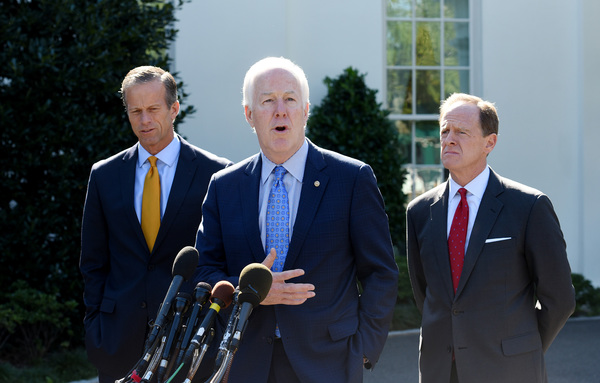
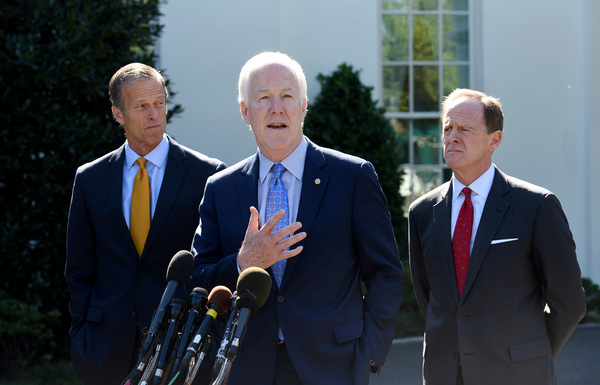
Finance Committee member and GOP Whip John Cornyn _ flanked by John Thune of South Dakota and Patrick J. Toomey of Pennsylvania _ struck an upbeat tone about getting Democratic support, a goal of Trump's.
Cornyn said a tax bill with Republican and Democratic votes would be more permanent than one sent to Trump's desk with just GOP votes. That's because Democrats would have some ownership, making them less willing to change it in an eventual change in power.
"If we do this on a bipartisan basis and get the economy going again, increase take home pay, bring jobs back from overseas, that will be a win for the American people," Cornyn said. "And if we're able to do it on a bipartisan basis, it'll be durable. It'll be something that'll be sustainable."
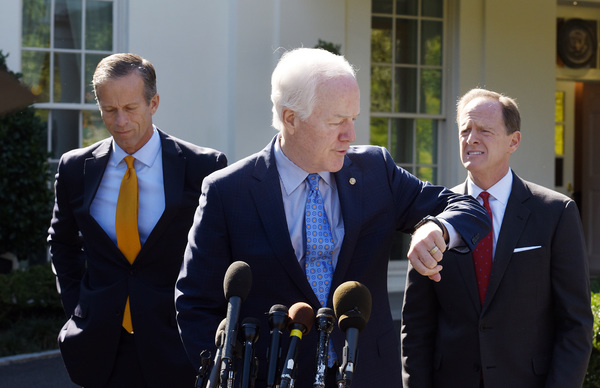
Toomey said there are principles both parties "broadly agreed" on.
"One is to directly lower the tax burden on the hard working families that we all represent," he said. "And the other goal that's just as important to get the economy growing at the rate it's capable of, get back to the 3 percent-plus kind of growth that used to be normal for America and can be normal again."
Like his GOP colleagues, he expressed optimism about bipartisanship. "Many of our Democratic colleagues appear willing to work with us," he said.
None of the five panel Democrats who attended the session _ ranking member Ron Wyden of Oregon, Debbie Stabenow of Michigan, Sherrod Brown of Ohio, Bob Casey of Pennsylvania and Claire McCaskill of Missouri _ came outside to address reporters. And instead of responding to questions, the three Republicans turned and walked back into the West Wing.
One Democrat who was there, however, issued a statement several hours later expressing concerns with the direction in which GOP and White House tax negotiators apparently are heading.
"During today's meeting, I expressed concerns that the Republican tax proposal would give 80 percent of the benefits to the top 1 percent, take away important tax incentives for Michigan manufacturers and small businesses, and add to our nation's deficit," said Stabenow, referring to her home state.
"I told President Trump that instead of spending over $1.5 trillion on tax cuts for the wealthy," she said, "we should work together to stop tax breaks for companies that ship jobs overseas and give middle-class families a bigger tax cut."
The White House, meantime, did echo the Republicans' hopes for Democratic support and the goals they described.
"The group discussed the historic nature of tax cuts and reform, and stressed the urgent need to deliver tax relief for the middle class by cutting taxes and simplifying the burdensome tax code," the White House said in a statement. "The administration looks forward to continued opportunities to reach across the aisle in an effort to provide tangible quality of life improvements for the American people."
"We're confident that we're going to get tax cuts done," White House press secretary Sarah Huckabee Sanders said a few hours after the lawmakers departed.
She also was less insistent than her boss has been about getting Democratic votes, saying the goal is to "get enough votes to pass tax reform." Though the president says he wants some Democrats to vote for a measure that is still being written, he regularly hammers the party for, as he sees it, opposing rate cuts and only in favor of raising them.
While Senate tax writers were meeting with Trump, House Ways and Means Chairman Kevin Brady was wrapping up his latest plug for tax legislation at the Baker Institute for Public Policy at Rice University.
The Texas Republican reiterated his talking points about the benefits of rewriting the tax code, while fielding questions about more specific aspects.
While he didn't reveal many new details, one area he did offer some insight was on House GOP tax writers' plans for popular deductions like the mortgage interest and charitable deductions.
GOP leaders say they want to keep those deductions but it has not been clear whether they would remain itemized deductions or be altered so more taxpayers can claim the benefits.
Brady acknowledged that the latter is an option they're exploring, saying he has encouraged his committee to "think fresh" about those and other key provisions and they're looking at ways to make mortgage interest and charitable deductions available "across the economy," not just to taxpayers who itemize.
GOP tax writers estimate nine out of 10 taxpayers will not itemize under their simplified tax plan.
On the mortgage interest deduction, Brady said they're considering making that available "for all phases of home ownership," but he did not elaborate what that would entail.
All Republican members of the Senate panel attended the meeting with Trump except Judiciary Chairman Charles E. Grassley of Iowa, who was leading a hearing with Attorney General Jeff Sessions, and Intelligence Chairman Richard M. Burr of North Carolina, who is not going to the White House while leading that panel's probe of Russian interference of the 2016 U.S. elections.
Seven of the panel's 12 Democrats skipped the meeting, according to the White House: Michael Bennet of Colorado, Maria Cantwell of Washington, Benjamin L. Cardin of Maryland, Thomas R. Carper of Maryland, Bill Nelson of Florida, Robert Menendez of New Jersey and Mark Warner of Virginia.