
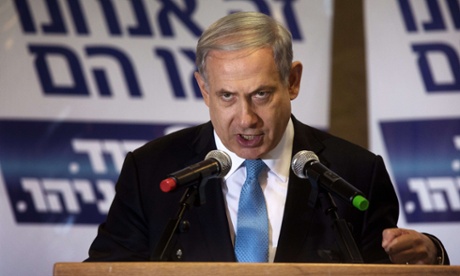
Israel’s prime minister Binyamin Netanyahu has been forced into an embarrassing climbdown after being ordered by the country’s attorney general to reinstate three judges he had removed from the prestigious Israel prize because of their leftwing political views.
In his capacity as acting education minister, Netanyahu had ordered that two judges on the literature prize and one on the film prize be removed, later claiming on his Facebook page that the prize panels were being dominated by “extremists” and “anti-Zionists”. Critics denounced his actions as a “purge”.
The fierce controversy, coming a month before 17 March elections when Netanyahu will seek a fourth term as prime minister, has dominated the media in recent days and taken on a political significance that has reached far beyond the prize itself – awarded annually to figures in the arts, sciences and for lifetime achievement.
Instead it has been read by critics as evidence of Netanyahu’s desire to silence any criticism of which he disapproves.
Netanyahu’s climbdown came after Israel’s attorney general Yehuda Weinstein wrote to Netanyahu’s office on Thursday night to demand he “reverse course” on his decision to exclude the judges, one of whom had signed a petition a decade ago supported academics and students who chose not to serve as soldiers in the occupied Palestinian territories.
In reply the prime minister’s office said it “respects the Attorney General’s directive to desist from dealing with the appointment of Israel prize judges, due to the upcoming elections”.
Netanyahu warned, however, that should he be re-elected in the elections he will seek to rewrite the rules for how judges for the prize will be selected.
The controversy had seen 13 judges selected for three different award categories resign in protest, while Israel’s Haaretz newspaper quoted sources in the country’s justice department describing Netanyahu’s actions as “bordering on illegal”.
Justifying his move on Facebook on Thursday, before he backed down, Netanyahu replied to the criticism saying that the prize committees had become the “private playground of the radical Left, anti-Zionist and pro-Palestinian, that preaches refusal to serve in the IDF”.
The announcement that the judges would be reinstated followed the decision by this year’s favourite for the literature prize, the internationally feted author David Grossman, to withdraw his candidacy.
Speaking on Israel’s Channel 2 Grossman had denounced Netanyahu’s decision to remove professors Avner Holtzman and Ariel Hirschfeld from the literature prize and director Hayim Sharir from the film prize as an “incitement against Israel’s senior scientists and authors”. He added: “Netanyahu’s move is a cynical and destructive ploy that violates the freedom of spirit, thought and creativity of Israel, and I refuse to cooperate with it.”
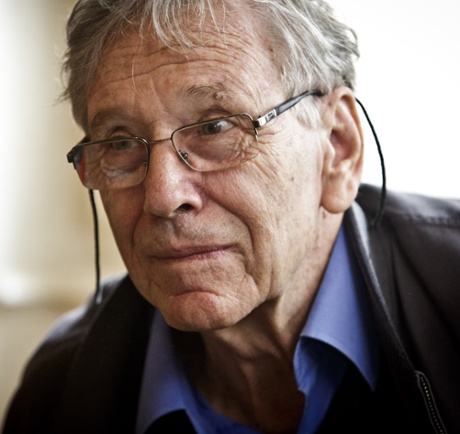
Speaking on the same channel, Amos Oz, another of Israel’s most leading literary figures echoed Grossman’s charge adding: “[Netanyahu] does not just want to replace the committee, he wants to replace the writers and judges too. The truth is, he would probably replace the media if he could.”
The row over the Israel Prize, first inaugurated in 1953 and awarded in different fields on Israel’s Independence Day, had inspired fierce criticism of Netanyahu by some Israeli intellectuals several of whom compared his behaviour with that of a Soviet minister.
Describing his own reasons for withdrawing, author Haim Be’er, a candidate for the literature prize who withdrew the day before Grossman, said: “It’s not the prime minister who awards the prizes. This isn’t like Soviet Russia, where Stalin awarded the Lenin prize. He’s the man who stands there and hands over the envelope, not the person who awards it.”











