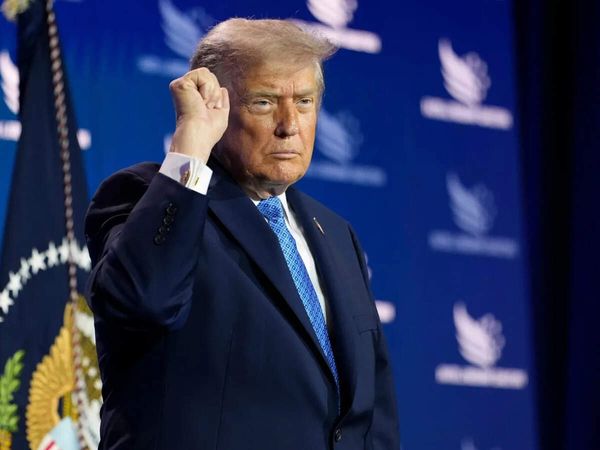
Donald Trump has drawn renewed attention online after sharing AI-generated military imagery depicting a US warship using laser weapons against Iranian targets during heightened tensions in the Strait of Hormuz. The image, posted on Trump's Truth Social account, showed a US-flagged vessel firing a laser beam at an aircraft carrying an Iranian flag alongside the caption: 'Lasers: Bing, Bing, GONE!!!'
The AI-generated image did not depict a real military operation. However, the post appeared shortly after reports of overnight exchanges involving US and Iranian forces near the Strait of Hormuz, where global shipping routes and energy supplies remain under pressure following months of regional instability.
The online reaction intensified after a Pentagon technology official shared a separate post using the phrase 'Bing. Bing. Gone.' Critics questioned the use of stylised AI war imagery during an active geopolitical crisis, while supporters described the posts as symbolic displays of US military strength and technological superiority.
Bing, Bing, GONE!!! pic.twitter.com/pv1LfSriAX
— The White House (@WhiteHouse) May 12, 2026
🚨 LMAO! President Trump just posted this gem
— Eric Daugherty (@EricLDaugh) May 8, 2026
“Lasers: Bing, Bing, GONE!!!” 🔥 pic.twitter.com/4aLwKnD42H
AI Military Imagery Shared During Gulf Tensions
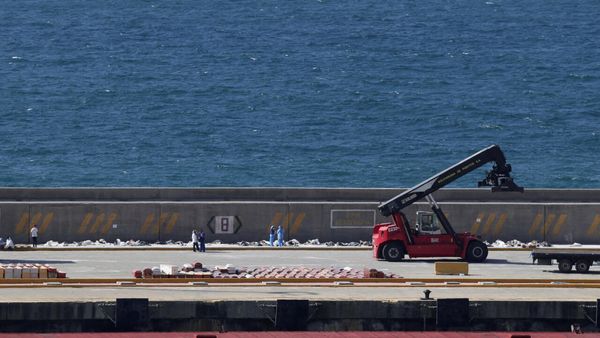
Trump's post came as US officials continued monitoring the fragile ceasefire established after recent conflict involving Iran, the United States and Israel. According to ITV News and other international outlets, US military forces reportedly exchanged fire with Iranian forces near the Strait of Hormuz before disabling two Iranian oil tankers.
Washington is also awaiting Iran's response to a proposed agreement linked to reopening the strait and limiting Tehran's nuclear activities. US Secretary of State Marco Rubio said he hoped to receive what he described as a 'serious offer' from Iran regarding the negotiations.
The Strait of Hormuz remains one of the world's most strategically important shipping corridors, with disruptions in the area contributing to volatility in global fuel markets and international trade concerns.
— Pete Hegseth (@PeteHegseth) May 12, 2026
Bing. Bing. Gone. 🇺🇸 pic.twitter.com/2IC9ZivVog
— Department of War CTO (@DoWCTO) May 12, 2026
US Military Has Tested Laser Weapon Systems
The AI-generated image shared by Trump showed a futuristic naval scenario involving laser-based defence systems. The US military has spent years developing directed-energy weapons, including the Navy's HELIOS system, a high-energy laser designed to target drones, missiles and fast-moving small craft. The technology has already undergone testing aboard US Navy destroyers, including the USS Preble, although such systems are still considered limited in operational deployment.
This drone in the picture will easily be shot down with The U.S. Navy laser weapon, AN/SEQ-3 Laser Weapon System, often called “LaWS” (Laser Weapon System).
— Marilyn Hauck (@rhauck777) May 10, 2026
It is a powerful beam of concentrated light that burn through and destroys drones.
HELIOS stands for High Energy Laser… pic.twitter.com/CAGxUI86ye
The technology has undergone testing aboard US Navy destroyers, including the USS Preble, as part of wider Pentagon efforts to develop advanced defensive systems capable of intercepting aerial threats at sea. Defence analysts have noted that while laser weapons have shown promise during testing, many systems remain in limited operational deployment and continue undergoing evaluation for broader military use.
The Pentagon has increasingly invested in directed-energy systems in recent years as militaries explore alternatives to conventional missile defence technologies, particularly against drones and low-cost aerial threats.
Regional Security Concerns Continue
The latest exchange involving AI-generated military imagery comes amid continuing uncertainty surrounding security conditions in the Gulf region. Maritime incidents, drone activity and disputes involving shipping lanes have remained major international concerns since fighting escalated earlier this year.
While Trump's supporters viewed the posts as displays of confidence and deterrence, critics argued the imagery risked escalating tensions or contributing to misinformation during a volatile diplomatic period.
The episode has also renewed broader discussion about the role of artificial intelligence in political communication, particularly as governments, military agencies and public figures increasingly use digitally generated content to shape public narratives during international crises.