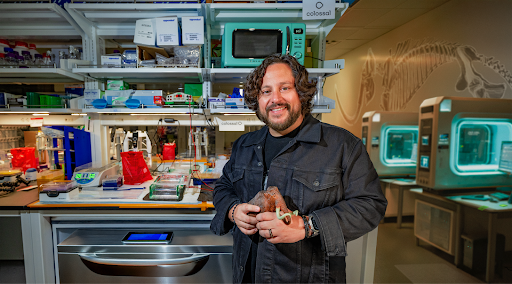
Over the past four years, billionaire entrepreneur Ben Lamm has launched the de-extinction company, Colossal, built an entirely new category of business, and brought back to life the first previously extinct species with the birth of the dire wolf pups Romulus and Remus. But what comes next?
The company and Lamm himself routinely point to the announced roadmap of projects which includes the de-extinction of the woolly mammoth, the dodo, the moa and the thylacine. And, while Lamm is notoriously secret about his plans beyond those, he did recently shed light on what might be next.
Colossal achieves genetic breakthroughs
Lamm, a serial entrepreneur, co-founded the Dallas-based biotech firm in 2021 alongside Harvard geneticist George Church to bring extinct species back using advanced genome engineering.
"At this point, I think everyone knows Colossal is a de-extinction company," Lamm said. "We are building a scientific platform that could reshape conservation and genetics for decades to come. Our team has been rapidly making progress against those goals."
Progress includes the birth of a woolly mouse and the dire wolf pups, but also includes numerous advances in gene editing, in vitro fertilization, and reproductive cloning.
Colossal creates global movement
"We created the woolly mouse as a scientific proof of concept, but people latched onto it emotionally," he said. "I didn't think we'd see memes and parents asking where to get one. The same thing happened again with the dire wolf pups. It's so surreal."
Lamm credited part of that visibility to Colossal's roster of high-profile investors, including filmmaker Peter Jackson, author George R.R. Martin, actress Sophie Turner, and athletes like Tom Brady who helped evangelize Colossal's mission and create a global phenomenon.
As Colossal moved forward with more species, Lamm said they followed a loose framework when selecting projects that focused on genome viability, impact on ecosystem restoration, and whether it honors cultural input from the communities most connected to the species. The company had formed partnerships with indigenous leaders in regions tied to species like the moa. Lamm said those relationships shaped the way Colossal approached research and restoration.
Beyond de-extinction, the company has also invested heavily in biodiversity preservation. Through its nonprofit arm, the Colossal Foundation, the organization raised $100 million to support open-source conservation tools. According to Lamm, more than 65 global partners are now using Colossal's technologies on endangered species and he expects the number to rise in the coming years.
"We're building tools that serve both extinction recovery and real-time conservation and we want to get those tools to the partners who need it."
Colossal takes big steps forward
Lamm shared Colossal is rapidly accelerating their work through the innovation of AI and synthetic biology.
"The pace of innovation is speeding up," he said. "With AI, modeling, and gene editing converging, what once took decades now happens in months. The future of biology is programmable. It's a huge opportunity for our company which has already been sitting on the front lines of what's next."
While Lamm remained tight-lipped about what exactly is possible, he hinted at the fact that these advancements could mean that now Colossal scientists can expand on more animal de-extinction projects, at scale on even shorter timelines. Doing so would also require new advancements in both artificial womb and cryopreservation technologies which the company has already publicly committed to exploring.