

Headquartered in San Jose, California, BILL Holdings (BILL) is a leading provider of cloud-based software that automates financial operations for small and midsize businesses (SMBs). Founded in 2006, the company offers an end-to-end platform that streamlines accounts payable (AP), accounts receivable (AR), and spend management. By integrating with major accounting software and financial institutions, BILL enables businesses to eliminate paper-based processes, manage cash flow in real-time, and execute digital payments globally.
BILL Stock Rebounds
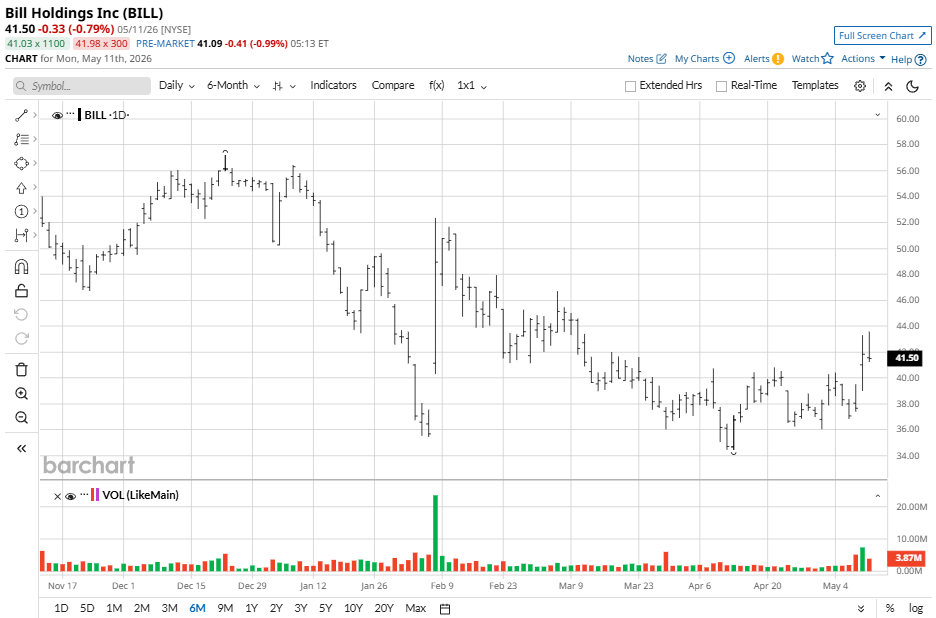
Bill Holdings' stock has faced significant headwinds throughout 2026, losing roughly a quarter of its value as investors rotated out of high-multiple fintech names. However, shares recently rebounded by 2.48% in aftermarket trading following a strong Q3 earnings report, recovering from a 52-week low of $34.44.
Compared with the Russell 1000 iShares ETF (IWB), BILL has significantly underperformed the broader market over the last 12 months. While the Russell 1000 gained 24.68% during the past year, driven by the AI mega-cap rally, BILL’s shares have struggled, falling by double digits in the same period.
BILL Posts Strong Earnings
BILL Holdings reported a landmark third quarter for fiscal 2026 on May 7, achieving GAAP profitability for the first time in its history with a net income of $12.8 million. Total revenue reached $406.6 million, a 13.5% increase year-over-year (YOY), beating analyst estimates.
This growth was fueled by Core Revenue, which climbed 16% to $371.1 million, driven by strong adoption of its integrated platform. Total payment volume (TPV) reached $89 billion, up 12% from the prior year, while transaction fees rose 18% to $296.6 million. The company also saw a 39% surge in joint customers using both its AP and Spend & Expense solutions, reflecting successful multiproduct adoption.
Looking ahead, management raised its fiscal 2026 guidance, projecting total revenue between $1.642 billion and $1.652 billion, reflecting 15-16% growth in core revenue. The company is leaning heavily into its "AI-first" priority, having already deployed AI agents to over 100,000 customers to automate complex human workflows and reduce transaction costs. For the fourth quarter, BILL expects non-GAAP EPS of $0.69 to $0.72, well above the consensus mark.
With $2.17 billion in cash and short-term investments, the company is leveraging its strong balance sheet to fund its massive $1 billion buyback program while continuing to scale its AI-native finance workflows for its expanding upmarket customer base.
Bill Lays Off 30% of Its Staff
In a major strategic shift to bolster profitability, BILL Holdings announced a significant 30% workforce reduction alongside its third-quarter earnings. The San Jose-based fintech expects to incur restructuring charges of $30 million to $60 million, primarily impacting its fourth-quarter fiscal 2026 results. This aggressive cost-cutting move, which sent shares climbing over 8% in extended trading, comes amid intensifying pressure from activist investors Starboard Value and Elliott Investment Management.
The restructuring follows a challenging period where the stock lost nearly 31% of its value in early 2026. By prioritizing lean operations, BILL achieved GAAP profitability this quarter.
While the firm remains a potential acquisition target for private equity giants like Hellman & Friedman, these internal changes aim to stabilize the business independently by the first quarter of fiscal 2027.
Should You Buy BILL?
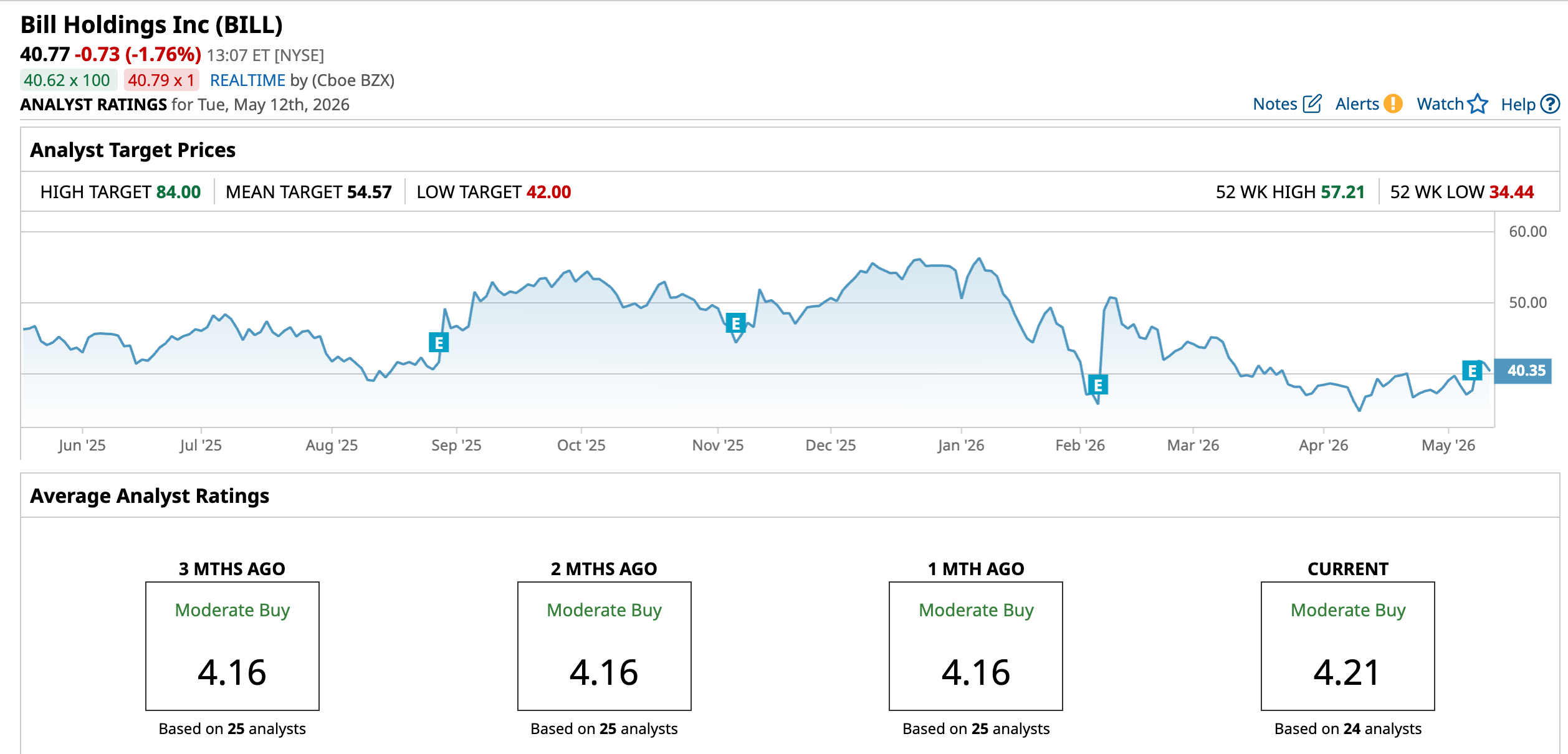
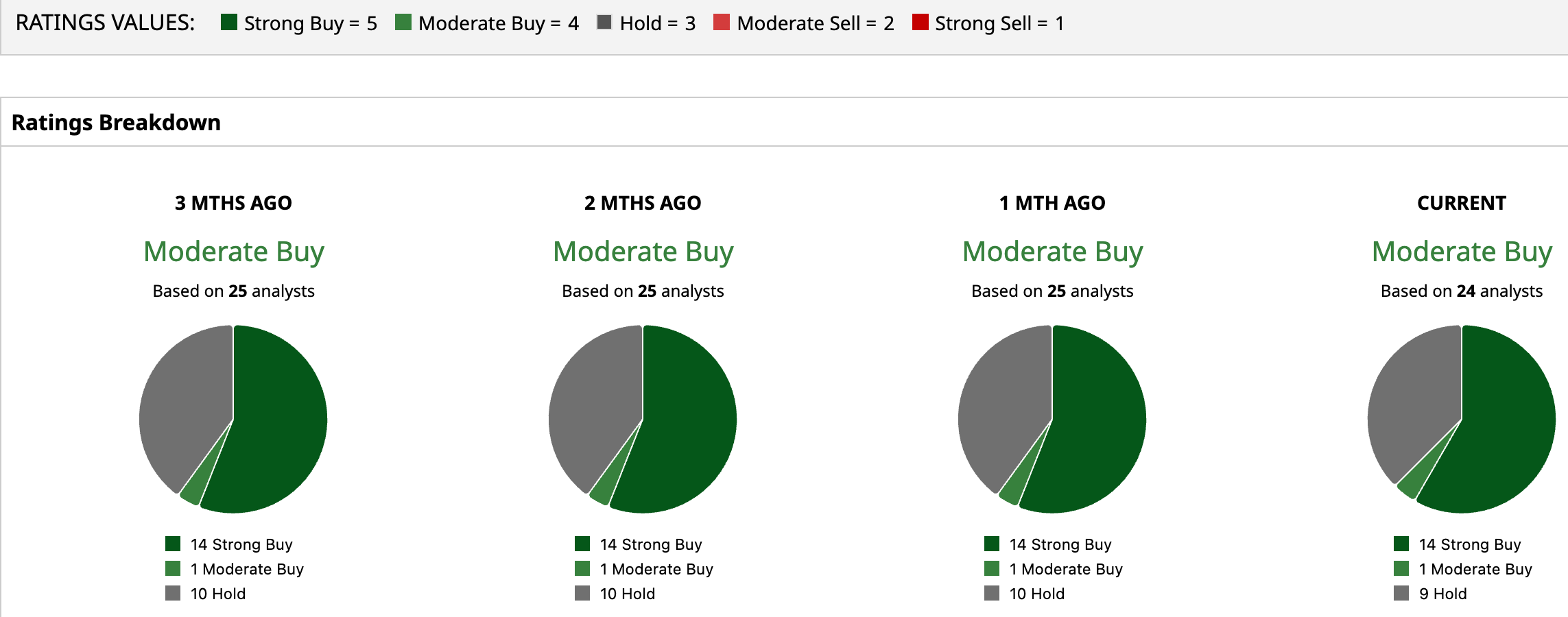
The recent 30% workforce reduction signals a decisive shift toward permanent profitability, addressing activist pressure and stabilizing the bottom line. Currently, BILL holds a consensus "Moderate Buy" rating supported by 14 "Strong Buy" ratings, one “Moderate Buy,” and nine "Holds" out of 24 reports. With a mean price target of $54.57, the stock offers a projected 33.9% upside from current levels.
For investors, the combination of a $1 billion buyback program, newfound GAAP profitability, and potential acquisition interest makes BILL an intriguing value play in the consolidating fintech sector.