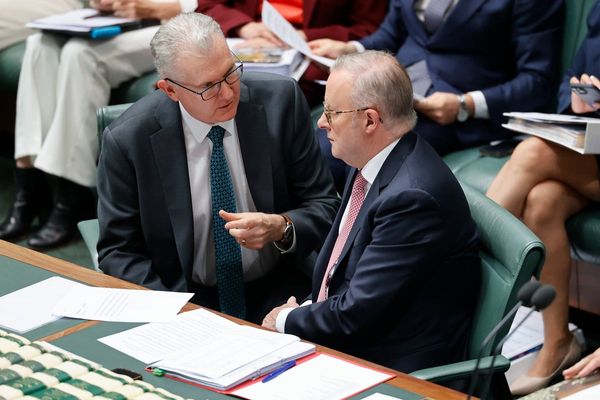
Bill Shorten says Malcolm Turnbull needs to make it clear he is not on the side of people intent on “doing Daesh’s dirty work” in Australia.
The opposition leader told reporters on Friday that Islamic State’s “crazy fundamentalists” in northern Iraq and Syria regularly made arguments Islam was incompatible with western democratic liberal values, “and now in Australia we have got people who are doing Daesh’s dirty work by repeating the same allegations, except from the far right”.
“It’s time for Malcolm Turnbull to tell Australians which side he is on,” Shorten said. “Is he on the side of the people who want to split and divide our country, or is he on the side of the rest of us who know that we’re a great country and we do best when we bring people into it and involve everyone?”
He said given the balance of interests in the new parliament, the government wanted to “try to appease Pauline Hanson, and some of the views that have emerged from that end of the political spectrum” – “but a government is not worth its salt if it’s not willing to stand up for minorities”.
Shorten’s comments on Friday end a week in which polling suggested 49% of Australians support One Nation’s call for a ban on Muslim immigration.
According to the survey by Essential, support for banning Muslim immigration is highest among Coalition voters at 60% and non-major party voters at 58% – but the ban also has substantial support among progressive voters. According to the poll, 40% of people identifying themselves as Labor voters support a ban on Muslim immigration, and there is 34% support among Green voters.
In an interview with the the Guardian Australian politics live podcast, the race discrimination commissioner, Tim Soutphommasane, warned the country was approaching a tipping point in race relations. “Make no mistake, we are in a time when our values and our harmony are being tested, and we need to rise to this test and ensure we live up to the best of our traditions as a nation of immigration,” Soutphommasane said.
“Some of the political rhetoric we are hearing at the moment is taking us down a very different path.”
On Friday morning the manager of government business, Christopher Pyne, said Australia was committed to a non-discriminatory immigration policy and the results of the Essential poll were possibly attributable to nervousness in the community about safety.
“People are worried about their safety when they see the television or read the newspapers and hear Islamic State or al-Qaida or any of these other terrorist organisations making dire threats against the west and against Australia, [it] obviously makes them nervous,” Pyne told a breakfast television program.
Like the prime minister earlier in the week, Pyne said a tough border protection policy was critical to maintaining community support for multiculturalism.
Turnbull said in New York this week that “strong borders” and one of the most generous humanitarian programs in the world “go together” because the public accepted migration when the government appeared in control of its borders.
Pyne said on Friday: “The government and the opposition have to keep reassuring people about the strength of our borders and national security, putting in place the measures to protect us as much as we possibly can, which we have been doing for the last three and a bit years.”
But Richard Marles, Labor’s former shadow immigration minister, rounded on the immigration minister, Peter Dutton, declaring there was “no reassurance when you have got an immigration minister who talks about illiterate, innumerate refugees coming to the country and stealing our jobs and being on the dole”.
Marles was referring to comments made by Dutton made during the election campaign, when he said refugees “won’t be numerate or literate in their own language, let alone English. These people would be taking Australian jobs, there’s no question about that.
“For many of them that would be unemployed, they would languish in unemployment queues and on Medicare and the rest of it so there would be huge cost and there’s no sense in sugar-coating that, that’s the scenario,” Dutton told Sky News on 18 May.
Marles said Friday: “If you want to give people a sense of confidence about our multicultural society, we have got to see leadership from our government.”
On Thursday night Hanson told Sky News she believed support for banning Muslim immigration was higher than 49%. “I’ll tell you something, I believe it’s a lot higher than that, because people would have been in fear to answer the question, the polling, because they don’t know who’s taking the call and they don’t want to be registered of what their views are.”
The Essential poll is out of step with other surveys which have recorded high levels of community support for Australia’s non-discriminatory immigration program.
Guardian Australia revealed on Friday that Labor is preparing to launch a proposal inviting all federal parliamentarians to sign up to a code of race ethics, echoing an initiative advanced by the ALP and the Australian Democrats during the period Hanson was last in the parliament.
The previous parliamentary code of race ethics was pursued by the then Labor senator Margaret Reynolds and the Democrat senator John Woodley in 1996, prompted by concern about the debate about racism that erupted in that year’s election campaign.
The code required parliamentarians to sign on to a set of principles, including respect for religious and cultural diversity, supporting tolerance and justice within a multicultural society, and “to speak and write in a manner which provides factual commentary on a foundation of truth about all issues being debated in the community and the parliament”.