Night time politics
Righteo, I’m off like a fish in the sun.
Today, we know:
- Turnbull has consulted his department for advice on the dispute between attorney general George Brandis and solicitor general Justin Gleeson. He stood by Brandis but says both men have his confidence.
- Julia Gillard says abuse of women in politics deters them from careers.
- Wayne Swan called on the BHP board to explain their tax policies, accusing the big miner of avoiding tax through Singapore. BHP said they pay their fair share.
- Pauline Hanson has won favour from the government, with the Coalition agreeing give her a government spot on a parliamentary committee - not something any party gives up easily.
- Foreign powers could present a cyber security attack but the government will not name which ones
- Resources minister Matt Canavan is bitterly disappointed that BP is pulling out of oil drilling in the Great Australian Bight.
- The Singapore PM Lee Hsien Loong addressed the parliament on the Australian Singapore relationship.
-
The high court chucked out a case of four former ministers trying to protect their parliamentary perks relating to the life time gold pass.
Thanks for your company, as always. And thanks to Gareth Hutchens, Paul Karp, Katharine Murphy and Mike Bowers.
Tomorrow Thursday which means it is the last sitting day this week. But then, we have Brandis and Gleeson appearing at the senate committee on Friday.
Goodnight.
I have tracked down Tony Burke’s amendment to the International Tax Agreements bill.
As a result the house agreed to call on “the government to explain why it has failed to close tax loopholes and increase transparency in Australia”.
You might ask which minister was in the Parliament at the time?
— Tony Burke (@Tony_Burke) October 12, 2016
Answer: Kelly O'Dwyer Minister for Revenue with responsibility for tax
That means the house of reps now has a unanimous resolution about how bad the government is on multinational tax avoidance.
— Tony Burke (@Tony_Burke) October 12, 2016
Here's the story....
— Tony Burke (@Tony_Burke) October 12, 2016
The government forgot to vote no.
The manager of opposition business Tony Burke is causing problems again.
Today for the first time in the history of Federation an Opposition second reading amendment was carried.
— Tony Burke (@Tony_Burke) October 12, 2016
This was not the government's plan
WA One Nation senator Rod Culleton after his marathon first speech @GuardianAus @gabriellechan #politicslive pic.twitter.com/OKBvzce8X5
— Mikearoo (@mpbowers) October 12, 2016

Katharine Murphy reports on an odd story of the government giving up a precious number on a senate committee for Pauline Hanson.
The Turnbull government has removed a veteran Nationals senator from the membership of a parliamentary committee to give one of its own spots to Pauline Hanson.
John Williams has confirmed he stepped aside from the parliament’s national broadband network committee to accommodate Hanson’s request to participate.
Hanson had tussled with the Nick Xenophon Team senator Stirling Griff for membership on the committee, but Griff secured support from Labor and the Greens, giving him the numbers in a ballot to take the spot
After she lost the ballot, the government asked Williams to stand back from the NBN committee to accommodate the One Nation leader.
This turn of events is unusual; the major parties guard their positions on parliamentary committees.

One Nation senator Rod Culleton breaks down as he thanks his wife and three children and ends.
Well may we God save the Queen because nothing will save these bankers.
Senate president tells Culleton to wind up his first speech.
ANZ Bank and the other major banks, including Rabobank, have clearly performed financial terrorism on the people of this country #auspol
— Senator Rod Culleton (@SenatorCulleton) October 12, 2016
We are onto the family court now. Lawyers don’t want marriage reconciliation because they will lose fees, says Rod Culleton.
Rod Culleton says a royal commission into banks will happen.
Senator Rod Culleton says bank advertising should carry a warning like cigarette ads, because of the risks from loan agreements #auspol
— Tom McIlroy (@TomMcIlroy) October 12, 2016
The majority of farmers signed over to the ANZ Bank, before the ink was dry they were forced by the ANZ to pay up their loans and defaulted
— Senator Rod Culleton (@SenatorCulleton) October 12, 2016
He recalls SWAT teams turning up at properties to evict farmers. He is very emotional.
The truth will come out.
Culleton says if he had a choice of being humiliated in the media or removing the gun from a boy’s hand, he would choose the former.
He claims one farmer in the gallery tipped petrol over himself and walk into an open farmer, spending six months in hospital.
While bankers say sorry, I say sorry doesn’t cut it.
Culleton is now going through the long legal battles which saw him lose the farm. As I have not across the details chapter and verse, I will not add anymore as there are still court cases ongoing.
Rod Culleton in full flight, well over time. George Brandis bails.
— Tom McIlroy (@TomMcIlroy) October 12, 2016
Senator Rod Culleton calls for Australia to exit the UN - which he says is a global government #auspol
— Tom McIlroy (@TomMcIlroy) October 12, 2016
If our children were disrespectful, they had to pack their own survival kit and go camp outside the front gate #auspol #firstspeech
— Senator Rod Culleton (@SenatorCulleton) October 12, 2016
The term privatisation itself, is a con, the reality is foreign corporations are the beneficiaries of our tax laws... #auspol #firstspeech
— Senator Rod Culleton (@SenatorCulleton) October 12, 2016
Rod Culleton said when he came to the senate, he received a pocket copy of the constitution. He realised what a powerful document. Why aren’t school children taught about the constitution.
This nation stands at a minute to midnight.
When his children disrespected their family, he used to make them take a survival pack and send them to camp off the land. They soon learned to respect the family.
Culleton: Aust now paying the highest grocery prices in the world.
— Shane Wright (@swrightwestoz) October 12, 2016
Culleton is railing against the systemic policy failures by government. He blames the National party for failing to do their job for rural families. Culleton accuses the ANZ of stealing his farm.
Rod Culleton starts by attacking large corporations and the courts.
Having been locked into a financial crocodile roll, I have lost all incentive to invent anything again.
Next, One Nation senator Rod Culleton. He starts which lots of references to farming, puncture kits and people trying to keep him out of parliament. He says he is a long time National party voter but now refers to his fellow One Nation senators as the “awesome foursome”.
By way of background, Swan’s intervention follows coverage in the Financial Review by Neil Chenoweth on September 22:
The tax and royalties bill for BHP Billiton’s Singapore controversial marketing operation has hit close to $1.4 billion with ongoing audits likely to push the total higher.
BHP Billiton chief financial officer Peter Beaven said the tax dispute was a debate about valuations rather than tax avoidance and the company was very confident of its position.
But the latest disclosures by the big miner show a cascading series of consequences that have flowed from its decision to market iron ore through a Swiss subsidiary operating in Singapore.
These include a $117 million assessment for the Mineral Resources Rent Tax in 2013, after the Tax Office ruled that parts of BHP’s Singapore income should have been attributed to its Australian profits.
Peter Beaven, chief financial officer at BHP Billiton, gave a defence - also in the Financial Review.
For every $1 of pre-tax profit we made in Australia in the 2016 financial year, 57¢ is payable in taxes and royalties to governments here.
We have paid about $65 billion in taxes, royalties and other payments to Australian governments over the past decade, as part of $US85 billion ($111 billion) we paid globally.
To put this in context, our Australian tax and royalty contribution over the past decade would build the NBN twice over, or pay for three years of Medicare for the entire nation.
Our average global effective tax rate over the past decade is 39.8 per cent, including royalties. When you take royalties out, that average is 31.9 per cent, so either way you look at it, it’s consistently higher than the 30 per cent corporate tax rate in Australia.
I know it has been a long time coming but I promised a chunk of former Treasurer Wayne Swan’s speech on BHP and what he claims is the company’s aggressive transfer pricing.
He began on a general note:
We’ve all heard of “trickle-down” economics, but this is its older and uglier brother – the straight rip-off where companies refuse to play by the rules, and their cronies in government simply look the other way. Last year as a result of Labor’s tax transparency legislation, tax office data revealed that one in three private companies paid no tax and one in four public corporate entities operating in Australia paid no tax. In addition, half of the foreign companies operating in Australia had no taxable income while 56 millionaires paid no income tax in 2013, not even the Medicare levy.
Swan then got specific about BHP and called on the board to provide a full and frank explanation of their role.
There is a stark contrast between the esteem in which BHP, its executive and the board expect to be held and their actual behaviour.
BHP has an experienced Board; Jack Nasser, Andrew MacKenzie, Malcolm Brinded, Malcolm Broomhead, Pat Davies, Anita Frew, Carolyn Hewson, Ken MacKenzie, Lindsay Maxsted, Wayne Murdy, Dr John Schubert and Baroness Shirti Vadera.
The Board should provide a full and frank explanation of their role in approving this aggressive transfer pricing scheme. The board of BHP has not been true to the values they espouse in their charter of corporate responsibility.
Corporations are not ends in themselves. The community cannot allow the corporate veil to hide the moral responsibility of those that run them. When companies fail to pay their fair share of tax, revenue must be found elsewhere from businesses and individual taxpayers.
The billions of dollars avoided are forever lost to education and infrastructure, which are investments vital to growth and ultimately support the bottom line for business....
At a time when this government hacks and slashes at the social safety net in the name of budget repair, it is simply obscene for corporates to walk away with money on this scale.
There is a stark contrast between the respect boards and executives expect and what their actual behaviour merits. The actions of these businesses tear at the very fabric of our community and erode trust in business and government.
The actions of these businesses tear at the very fabric of our community and erode trust in business and government.
BHP rejected Swan’s claims. A spokesman told Guardian Australia:
Our Australian adjusted effective tax rate, inclusive of corporate tax, PRRT and royalties in FY16 was approximately 57%. Our global rate was slightly higher at 59%. This demonstrates that we pay our ‘fair share’ of tax both in Australia and globally.
Updated
We have a number of first speeches this afternoon. Ben Morton, Liberal MP for Tangney in WA has just given his first speech. He is the new Dennis Jensen, who was dumped in the preselection prior to the 2016 election.
Labor MP for Oxley, Milton Dick, is giving his first speech now. The seat where Pauline Hanson cut her teeth.
In a moment, we have One Nation senator Rod Culleton, who is still facing a challenge to his eligibility to sit in the Senate in the Court of Disputed Returns.
There is still the regular matter of public importance going on in the house: Labor’s motion regarding “the government’s failure of leadership in energy system modernisation”.
After that, the lower house will go back to the plebiscite debate.

Mmmmmm....

Smashing the happiness index.


I promised the fact check on the treasurer’s figures re the deficit.
Scott Morrison told the parliament:
Since this government came to office in 2013, the level of nominal expenditure on payments by the Government which was set out in the 2013 PEFO [Pre Election Fiscal Outlook], the payments by the government for $424.4bn. That was the estimate. The actual amount of payments in the 2016 PEFO was $425bn. This is a government that has ensured we have controlled expenditure. The budget I handed down in May, based on the final outcome figures, will see expenditure as a share of the economy fall.
This from Greg Jericho:
The Treasurer argues that the 2013 Pre-election fiscal outlook predicted “the level of nominal expenditure on payments by the Government for 2015-16 to be $424.4bn and that the “actual amount of payments” for that year was $425bn.
This, he argues, means “this is a government that has ensured we have controlled spending, controlled expenditure.”
It all sounds good until you realize he is playing around with nominal figures. Nominal figures don’t take into account inflation or the increase in the size of the economy.
In the 2013 Pefo, the expected expenditure in 2015-216 was $424.9bn but this was calculated to be 24.6% of GDP. The $425bn that was actually spent in 2015-16 was instead worth 25.8% of GDP (because the economy didn’t grow as fast as they thought it would).
So while in nominal terms the Abbott/Turnbull government had met their target, in terms of percentage of GDP they were out by 1.2% of GDP – or about $19.8bn.
And if Morrison really wants to talk in nominal figures, he should also note that the 2013 Pefo predicted a Budget deficit in 2015-16 of $4.7bn, and it ended up being a deficit of $39.94bn.
Turnbull has consulted his department on the solicitor general's dispute with Brandis
Labor’s Tony Burke asks Malcolm Turnbull: Has the prime minister sought advice from his department about the current conflict between the attorney-general and the solicitor-general and does the prime minister have confidence in the solicitor-general?
Turnbull says yes and Brandis and Gleeson have his confidence.
I can say that I have discussed it with my department and my secretary, indeed, and I have spoken to him about it. The advice we have is that the attorney-general has... consulted with the solicitor-general in the manner he has described in his submissions that he has made, so the attorney-general has my complete confidence.
Labor asks, what about the solicitor general?
Absolutely, the solicitor-general has my confidence, too, sure.
A Dixer to Peter Dutton: will the minister update the house on the importance of Australia’s strong and consistent border protection policies and is the Minister aware of any alternative approaches?
Dutton uses it to identify Labor MPs who don’t support the Labor party’s boats policy in full.
Labor to Turnbull: I refer to the member for Warringah’s [Tony Abbott] comments that it’s good to be popular. Given the prime minister’s plebiscite is almost as unpopular as his Government, when will he dump the member for Warringah’s plebiscite and have a free vote on marriage equality?
Turnbull:
Only a few years ago her leader, the member for Maribyrnong [Shorten], the Leader of the Opposition, advocated a plebiscite in the course of a meeting with the Australian Christian Lobby. He went to see them and told them he supported a plebiscite.
Only a year ago the Greens party supported a plebiscite and advocated there should be a plebiscite. The two parties that are steadfastly opposing it in the Senate, or promise that they will,are the Greens and the Labor Party, each of whom has advocated one.
Agriculture minister Barnaby Joyce gets a question on supporting the dairy industry which segues into an answer on Labor failing to support a 19% backpacker tax. (We don’t have a final position from Labor yet.)
Joyce says:
I note it is incredibly important that we went into bat for the backpacker industry, the backpacker labour and we have now got a package that comes forward with a 19% tax. This is after consultations with 178 industry groups, welfare groups, unions, labour hire companies and we invited participation for the general community and got over 1,700 submissions.
ARRGHHHHHH! Having not consulted initially on a 32.5% tax, having cut the tax from 32.5% to 19%, which is an increase from 0%.
Labor’s Mark Butler to Malcolm Turnbull: In July 2011, the Prime Minister said that 100% of stationary energy will need to come from clean sources by the end of the century. Prime Minister, what happened to you?
Turnbull:
It is a complex business reducing emissions, as we know. The object of government policy is to do so at least cost. The Emissions Reduction Fund has been very successful and we are well on track to meet our 2020 targets, indeed, to beat our 2020 targets....
We are [meeting the targets] but in a clear-eyed, hard-headed rational manner. It is not an ideological matter, we are approaching it methodically and effectively.
A government question to Julie Bishop: Will the Minister advise the House why it’s crucial to have a strong coherent position on important geo security issues? (This goes to the South China Sea dispute and Paul Keating’s comments.)
Plibersek to Morrison: It’s now three years since this Government took office. When will the government take responsibility for blowing out the 2015-16 deficit by over eight times in that period? You’ve octupled it.
Labor holds up eight fingers en masse. We get the point, says Speaker Smith.
Morrison goes straight to Wayne Swan and his promised surpluses.
Since this government came to office in 2013, the level of nominal expenditure on payments by the Government which was set out in the 2013 PEFO [Pre Election Fiscal Outlook], the payments by the government for $424.4bn. That was the estimate. The actual amount of payments in the 2016 PEFO was $425bn. This is a government that has ensured we have controlled expenditure. The budget I handed down in May, based on the final outcome figures, will see expenditure as a share of the economy fall.
Hang on to your hats. Greg Jericho is going to fact check that one.
A government question to financial services minister Kelly O’Dwyer: How will our enterprise tax plan proposals for small business and income tax cuts for individuals help grow the economy and create jobs and higher wages for the hard-working Australians of Dunkley and elsewhere?
Bowen asks Morrison: Why is the Treasurer refusing to listen to Ceda, the Grattan Institute, International Monetary Fund, Moody’s, Standard and Poor’s on the urgent need for revenue measures to get the budget back into balance and maintain Australia’s three AAA credit ratings agencies?
Morrison:
What this country has to face is to grow our economy so we grow revenues. You grow small businesses into larger businesses.You ensure Australians can increase their earning capacity. That companies can profit more. Wage earners can earn more on their wages. When you achieve economic policies that increase the earnings of Australians, that’s how you raise the revenue. You don’t do it by jacking up taxes like those and others have suggested. What we have done is make sure Australians pay their fair share of tax, multi-nationals will be paying their fair share of tax.
In Senate question time, senator Penny Wong has taken up the attack on attorney general George Brandis by asking why he failed to stick up for the solicitor general when he was criticised by senator Ian MacDonald.
Wong said that as the first legal officer, Brandis is obliged to stand up for independent statutory officers like Justin Gleeson and Australian Human Rights Commission president, Gillian Triggs.
MacDonald accused Gleeson and Triggs of “being involved in political games”, and Wong adds MacDonald said Gleeson’s advice “has not been all that hot” and his submission to an parliamentary committee examining the spat with Brandis was “terribly unprofessional”.
The attorney general sticks to his guns that he didn’t read or hear MacDonald’s speech and adds that in an interview with Radio National Brandis had said “some very gracious things” about Gleeson.
Let’s see how cordial the attorney general and solicitor general are when they appear on Friday before the committee inquiring into Brandis’ veto over referrals for legal advice.
"It's nice to be popular Mr Speaker" Tony Abbott reacts to interjections from labor #QT @gabriellechan @GuardianAus pic.twitter.com/fe3l4dNc3c
— Mikearoo (@mpbowers) October 12, 2016
The Dixer question to Morrison is on Labor not supporting the government’s enterprise tax plan which cuts tax for small moving to large businesses.
Labor goes to negative gearing. Very interesting.
Bowen to Morrison: Yesterday the chairman of Ceda said there is no believable end to the deficit in sight and revenue measures are “the only realistic way to balance the budget quickly”. Does the treasurer agree with this advice from Ceda and why won’t the government embrace negative gearing reform?
Morrison gets shouty. After a rant about Labor increasing questions, the treasurer says:
no, Mr Speaker, we do not agree with the Opposition that the road to dealing with the budget issues is to increase taxes and to increase the deficit as those opposite proposed at the last election.
BTW, Scott Morrison has supported limiting negative gearing excesses in the past.
Tony Abbott has come in from the cold.
Come on down Tony.
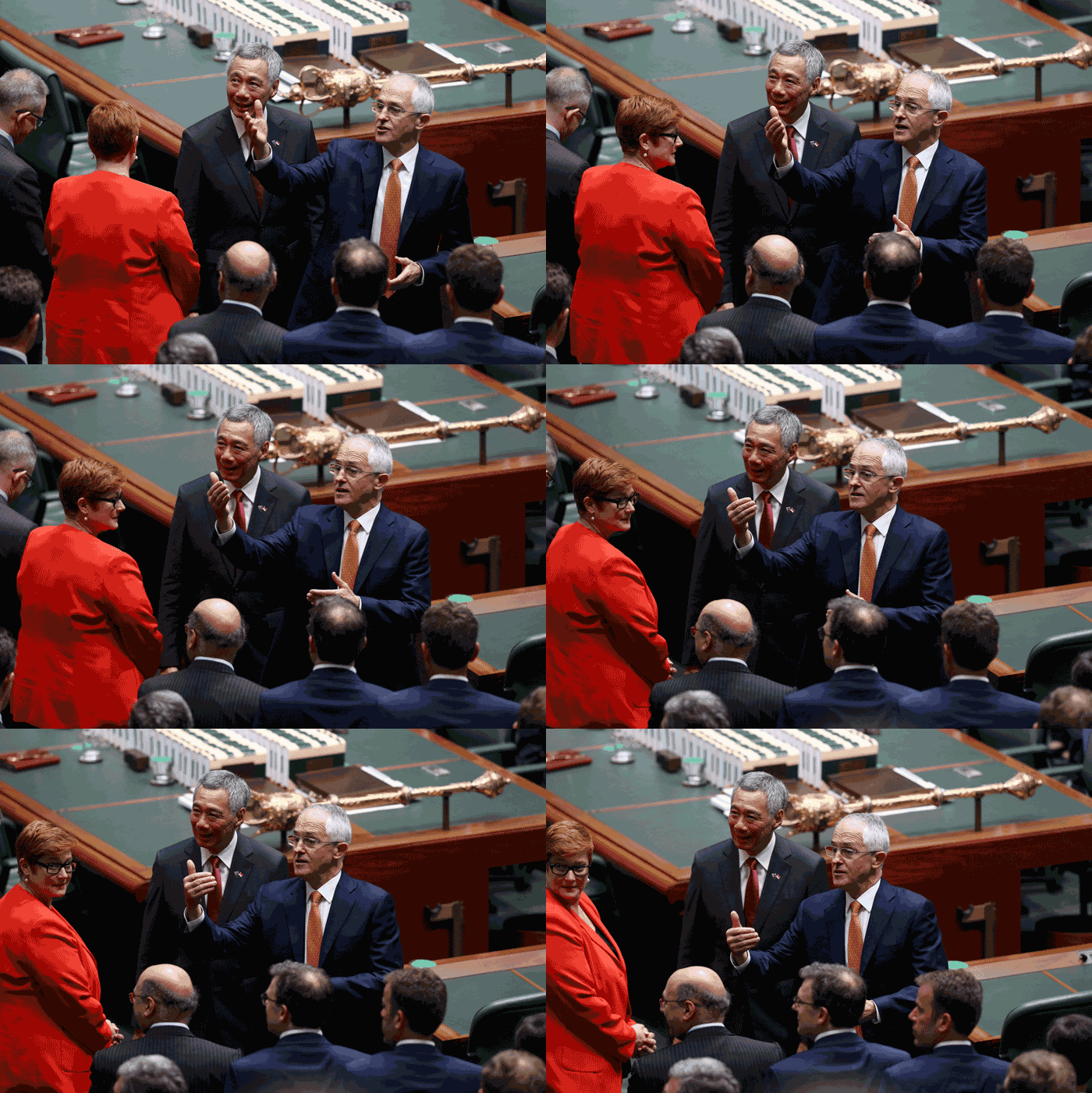
Tony Abbott gets a question to the trade minister Steve Ciobo. Applause and cheers erupt from the Labor benches. Abbott looks genuinely pleased, noting “nice to be popular”. Abbott asks: Will the Minister update the house on how the expanded Singapore-Australian Free Trade Agreement will support the government’s plan for jobs and growth?
In the senate, attorney general George Brandis has revealed in Senate question time that since the Coalition won government in September 2013, “740 people from 29 people-smuggling vessels have been intercepted and returned to their country of departure”.
Rebekha Sharkie, of NXT asks transport minister Darren Chester: South Australia is grossly under-funded for road infrastructure and in 2014 we lost the supplementary local road funding that addressed this inequity. During the devastating recent storms, my electorate suffered over $10 million worth of damage to local roads, a cost my community can ill afford. Will the Government urgently review their funding model to make it urgent for SA and consider an urgent one-off grant to help repair the badly-damaged roads in my electorate of Mayo?
Chester says the Coalition government had provided $3. 2bn through the Roads for Recovery program - which is not related to the supplementary road funding. He says he will be happy to meet with Sharkie about other funding. We made some promises during the election, Chester says, in many more words. But he does not answer the question.
The next Labor question is to Turnbull on whether he has obtained further advice on the mental health effects on the plebiscite on the LGBTI community.
Turnbull posits a new argument.
Professor McGorry made the point that, to agree with my proposition that Australians are able to have a civil discussion about this but he said he was concerned there were some small elements, sub-groups I think was the term he used, which would be intemperate in their conduct and that that could cause distress for some people in the LGBTI community.
I simply leave honourable members with this question, it’s a very fundamental one for our democracy. Are we going to say that we may not have a public debate on a topic when it is alleged that there will be a minority, some small groups, that will act intemperately?
He raises the constitutional referendum for Indigenous recognition, which seems to be a poor example because it is required for constitutional change.
Next government question is to Christopher Pyne, defence industry minister, on Singapore’s defence relationship with Australia.
Labor’s Andrew Giles asks the PM: “After the election, the prime minister said he’d learned a lesson, a very clear lesson, about his attacks on Medicare. So why hasn’t the prime minister abandoned his cuts to breast screening, MRIs and X-rays which will mean Australians will have to pay more for vital scans?
Turnbull flicks the question to the health minister, Sussan Ley, who says:
The truth is that this government is investing more in Medicare than any previous government, including any previous Labor government. The truth is that this government saw 17 million more bulk-billed consultations than any previous Labor government. The truth is that the cuts, as you describe them, are not that at all.
Updated
The first government question to Turnbull is the importance of trade and investment, specifically with Singapore.
First question from the opposition leader, Bill Shorten to the prime minister, Malcolm Turnbull, on Medicare, followed by: “Can the PM answer this without a tantrum on a text message?”
Turnbull:
I thank the honourable member for his question and he shows his glass jaw very neatly there. Clearly the text message is a bit of an issue for them. While it is amazing, eventually, even the leader of the opposition realises that deceiving millions of vulnerable Australians is wrong. Even the leader of the opposition is starting to feel the shame, just a little bit, it’s creeping up ... We are investing more in Medicare every year ...
Updated
Here is a range of reactions to the plebiscite from MPs and senators.
Updated
Julia Gillard: women need power to change things
Julia Gillard has given a speech on the life of British MP Jo Cox. It is well worth a read. Here are a few highlights:
I genuinely believe that politics is a noble calling, not a grubby, necessary evil. We are so incredibly fortunate to live in free and fair democracies where we have the right to run for parliament. Jo was an exceptional person, there’s no doubt about it. But she wasn’t unique, and she would have been the first person to say so. There are so many women in our communities who could serve with distinction: we need to help them to get into parliament and to be proud to be political.
Of course, this isn’t just about numbers, and it’s not about ‘having a go’. It’s about results. Women need power to change things. You can’t change things if you are a name on a ballot, a quota filled – you need your seat in parliament. Participation is the start, but power is the end. Jo knew that – it’s why she worked so hard across party lines to make sure that women were running for seats they could win and it’s why she herself joined a party where she stood a shot of becoming an MP and, one day, a minister, even a prime minister.
Jo had courage, but she was also unashamed to have ambition. She wanted to go far, and she wanted to lift up others as she climbed. There’s no stain in aspiring to the highest office in your country. It doesn’t taint the purity of your purpose.
Today, I want to say to you loudly and clearly: have the highest of ambitions for yourself, for your purpose. Jo believed Britain could be a force for change in the world, and she fought for that.
There is a lot more, in fact I could copy the whole speech over but question time looms.
Updated
Wong again calls for Brandis to resign.

Updated
Here is Wong’s case:
This matter started when senator Brandis made an amendment to the legal services directions in May.
The legal services directions set out rules and requirements for the performance of commonwealth legal work.
Brandis’s amending direction bars the solicitor general from providing legal opinions or advice to anyone in government without the attorney general’s permission.
It prohibits any commonwealth agency or officer from referring a question of law to the solicitor general without the written permission of the attorney general.
This is a blatant power grab.
It is a bid to control the flow of legal advice from the independent solicitor general to government departments and to senior figures in the government.
Updated
Wong is reprising the dispute between the AG and the SG.
Wong says Brandis seems to believe that the only legal opinion anyone may need is his opinion.
OK, in the Senate, Penny Wong is talking George Brandis, his greatest hits and his latest dispute with the solicitor general.
She says the attorney general should not mislead the parliament and the public. It is not trivial and represents a major attack on the solicitor general.
Updated
Tell 'em they're dreaming – high court to pollies
Here is the next take from AAP on pollie perks ...
High court judges unanimously held that amendments to legislation and rulings by the Remuneration Tribunal did not constitute acquisition of property.
A majority held that changes to the life gold pass legislation, reducing return air trips for retired MPs from an unlimited number to 25 and now 10, also did not constitute acquisition of property other than on just terms.
In The Castle, the Aussie battler Kerrigan family resort to the high court when developers seek to acquire their home to expand an airport.
The case hinged on Section 51 (xxxi) of the constitution which says that property can’t be acquired other than on just terms.
Entitlements for politicians, past and present, remain deeply controversial and have been progressively wound back from their most generous heights.
The high court directed that the four meet the unspecified but likely substantial cost of their challenge.
Updated
High court tells doesn't get the vibe on pollie perks ...
Like this!
Breaking news from AAP and the high court:
Four former federal politicians have lost their high court challenge over reduced post-parliamentary perks.
The four – a Howard government defence minister, John Moore, the Hawke government minister Barry Cohen and Labor MPs Barry Cunningham and Anthony Lamb – had used the same legal principle made noteworthy by the Australian comedy movie The Castle.
They argued their entitlements under the Superannuation Act and to a life gold travel pass were their property which had been acquired by the commonwealth other than on the just terms required by a section in the constitution.
We are awaiting more from our colleagues at AAP.
Updated
The Singaporean PM is addressing a lunch in the great hall in parliament over lunch. Malcolm Turnbull and Bill Shorten have both spoken. It is of a similar vein to earlier, so unless there is a cracking line, I will move on to other matters.
A minister for young people? Cathy McGowan thinks so
The Indi independent, Cathy McGowan, gave a speech last night calling for a minister for young people and a campaign from the Australian Electoral Commission to engage young people in civic participation.
There is a backstory.
McGowan won her first election in 2013 against the Liberal frontbencher Sophie Mirabella by 439 votes. After the election, there were complaints referred by the Liberal party and an investigation by the Australian relating to allegations of electoral fraud by a number of young voters who were involved with the McGowan campaign. One was McGowan’s niece.
The original story ran in September 2014 and there were allegations raised during the joint standing committee on electoral matters (Jscem). The Australian Electoral Commission investigated and then the Australian federal police.
The AFP then charged Maggie Ellen McGowan, 27, and Sophie Petrea Fuchsen, 24, with providing false and misleading information, alleging the pair voted in the seat of Indi while living in Melbourne during the 2013 election.
The case dragged on and eventually was thrown out in April this year, almost two years after it began. From the story:
Outside court the women’s lawyer, Rob Stary, said the case was bound to fail and a terrible waste of resources.
Both women were students at the time and the AEC website clearly said students did not need to change their “home address”, he had told the court.
“The original complaint, whoever it was that initiated it, was quite scurrilous,” Stary told reporters.
The heart of the issue is around country kids who go to cities to study. As they often have no fixed address, they remain enrolled for voting and other purposes at their family home. But within this loophole, someone found cause to complain. On the numbers, given these are conservative electorates in regional Australia, it seems incredible that the complaint may have originated within the Coalition. If these young people cannot enrol at their home address, it is likely they would remain without a vote.
Anyway back to McGowan. She wants the appointment of a minister for young people, to “address systemic barriers that prevent young people from civic participation, to advocate on their behalf, and help ensure that when policies affecting young people are considered, they do not have an adverse impact”.
This is what she said last night.
There is confusion about enrolment rules. The involvement of the Australian federal police, Australian Electoral Commission and media in the affairs of 27 young people in my electorate caused the loss of trust in our democratic political institutions. In 2016 approximately 350,000 eligible young people were not enrolled to vote. In the eyes of many young people, these events are even more reason why they feel it makes no sense to engage. No wrongdoing was found after rigorous investigation but these young people are still being scrutinised. We need to stand up for our young people, we need to support them and we need to encourage them to participate in politics. The AEC needs to be supported to engage young people.
Updated
A summary, before the time gets away.
- The Singaporean prime minister has addressed the parliament praising the relationship between Australia and Singapore. Lee had good words for the advances in agreements such as the free trade agreement, the comprehensive strategic partnership and the natural marriage between Victoria Bitter and chilli crab.
- The resources minister, Matt Canavan, says he is bitterly disappointed that BP is not going ahead with a plan to drill oil in the Great Australian Bight but he hopes the company can make good on some of its commitments.
- The treasurer introduced the new backpacker tax bills into the house, including the $5 increase in the passenger movement charge.
-
The marriage plebiscite bill debate will continue in the house today.
Updated
Old chums.

Updated
Come on down.
Malcolm the Magnanimous calls Tony Abbott down to see the Singaporean PM, who praised the former PM’s significant barbecue skills.

Updated
Sound the bells! The Australian Bureau of Statistics declares:
Australia records more than 96% preliminary response rate for the 2016 census
The Australian Bureau of Statistics would like to thank Australia for participating in the 2016 census of population and housing. The preliminary response rate is now confirmed at more than 96%. This ensures we are on track to deliver the quality census data Australia needs.
With the last of the 38,000 census field staff wrapping up after more than six weeks out in the field, the ABS will now focus on processing the 4.9m online and 3.5m paper household forms.
Updated

Updated
The house now does not sit until 1.30pm. The Senate comes back at 12pm.
Updated

Updated

Updated
Shorten also mentioned the 130,000 Singaporeans who had gained degrees in Australian universities (*cheers Dad*). And Shorten fondly remembers losing out to the Singaporean University team at intervarsity debating in the late 1980s.
There are more than 20,000 Australian expatriates living and working in Singapore, including friends of mine who voted at the royal golf course in the last three weeks of June, a booth we targeted most heavily. These Australians return to their friends and family praising a place where they know they’re welcome. Singapore is a culture that is different enough to feel novel, familiar enough to feel at home.
I promised more of Bill Shorten. He said Labor welcomed the comprehensive strategic partnership agreement.
Labor welcomes the comprehensive strategic partnership that will see our 14,000 Singaporean troops train in Shoalwater Bay in Queensland per year. This is good news for the region and good news for our region. And both our nations are engaged in countering a new threat of extremism, the fight against Daesh, its agents and imitators. We also share a tradition of learning from each other, from your father’s famous warning, a rebuke that shook Australia out of its lethargy and certainly my own party has pursued of an outward-looking economy to engage with key markets of Asia.
Updated
Lee goes through the benefits of the comprehensive strategic partnership concluded by the two leaders.
In defence, the Singapore armed forces will have more training, space and opportunities in Australia.
In the upgraded free trade agreement, professionals from both countries will be able to work in each country.
In innovation and science, the two countries have identified some key challenges to tackle, including basic urban problems such as water supply and energy conservation and “we have much scope to cooperate more in R&D”.
A new Australia-Singapore arts group will provide for exchanges between museums, art festivals, visual and performing arts.
Updated
Lee talks about the education exchanges and congratulates the foreign minister, Julie Bishop, on the new Colombo plan that provides for student exchanges.
By the end of this year, Singapore universities will have welcomed some 800 Australian new Colombo plan students. They will continue the spirit of exchange and renew the connections and good will between our peoples into the next generation. Our people also visit each other frequently. Last year some 400,000 Singaporeans visitedAustralia and 1 million Australians visited Singapore. Some come for education or business, more come for holidays or to visit family and friends. We feel quite at home in each other’s countries. Singaporeans may not quaff quite as much beer as Australians but I have it on good authority that Victoria Bitter goes well with chilli crabs.
Updated
Lee says more than 20,000 Australians live and work in Singapore, in all sorts of professions.
He notes the Singapore-Australia free trade agreement signed in 2003 was Australia’s first FTA outside of New Zealand.
It has helped make little Singapore your fifth-largest trading partner and investor. We have also worked together on regional economic integration, first with Apec and now with the Trans-Pacific Partnership, the TPP, and the regional comprehensive economic partnership, the RCEP.
Our two countries cooperate closely on security issues and humanitarian missions. Our security agencies work closely and quietly together to fight terrorism, sharing intelligence and information, carrying out counter-terrorism operations, exchanging notes on religious rehabilitation and deradicalisation programs. It’s important always and is especially worth mentioning today on the anniversary of the Bali bombings.
Updated
Lee on his meeting with Tony Abbott last year:
Our societies are both egalitarian. We don’t stand on ceremony and we frown on rigid social hierarchies. We are informal and can hang loose. Thus, when prime minister Abbott visited Singapore last year, I could invite him to join my constituents for an Aussie-style BBQ at a public park, only to find he was much better at barbecuing than I was. Afterwards, we went to dinner nearby. I made sure to choose some good Australian wine! But, alas, I neglected to check the steak. After dinner, prime minister Abbott asked the chef where the beef was from. The chef, with Singaporean directness and candour, replied: “From the US, sir.” I will have to do better when prime minister Turnbull visits us next year.
Updated
Lee says Australia and Singapore are both open economies that rely heavily on international trade, on global markets. And Australia and Singapore both want to deepen ties between Australia and south-east Asia.
Updated
Lee:
How is it that Australia and Singapore, two very different countries, as prime minister Turnbull said, a wide brown land and a little red dot, can forge such a deep bond? In land area, Australia is more than 10,000 times the size of Singapore! We are smaller than many sheep farms. The ACT alone is three times the size of Singapore. Australia has abundant natural resources, Singapore has none. We even have to import water from Malaysia. We are both Commonwealth countries, yes, but historically Australia has been Anglo-Saxon in composition and identity while Singapore is an Asian society, even though we speak English and we have the cosmopolitan outlook of a port city. Yet we are good friends because, fundamentally, we have similar strategic interests and perspectives.
Updated
Lee notes Australia’s contribution to Singapore in world war two.
Singapore will never forget their sacrifice. During the Malayan emergency, Australian soldiers fought Communist guerrillas in the Malayan jungles. When Singapore joined Malaysia in 1963, the president of Indonesia launched Konfrontasi, a low-intensity conflict to undermine the new federation. Australian forces defended Malaysia in Malaya and Borneo. In 1965, Singapore separated from Malaysia to become an independent republic. You were one of the first countries to recognise our independence and the first to establish diplomatic relations with us. You played a key role in publishing the five-power defence relations in 1971.
Updated
Just having some tech issues here. Bill Shorten has just given a very warm and personal address to Lee, mentioning Australia-Singapore ties, his visits to Singapore, Lee’s renowned maths and sudoku skills and Singapore’s food.
I will bring you more on Shorten in a minute but Lee has started now.
Updated
Turnbull concludes:
We are countries with different histories and different cultural traditions yet we are countries familiar and comfortable with one another. We prize informality, we are suspicious of pretence, we speak plainly and with pragmatism, as friends should. We focus on outcomes and deliveries not pomp or protocol. Each of us can lay claim to be among the most successful multicultural societies in the world so our bright future is not just about complimentary interests and strengths, it is about common human qualities. To borrow from prime minister Lee, I and I’m sure all members of this parliament are immensely reassured that our relationship with Singapore springs from the heart as much as it does from the head.
Updated
Turnbull says Singapore and Australia have similar world views on innovation, trade and rule of law.
Singapore and Australia are at one in defending the rule of law and rejecting the proposition that might is right. Australia and Singapore are firm proponents of institutions that that support regional stability and prosperity such as Asean and the East Asian summit. I am delighted Singapore will be the chair when they host leaders for an historic summit here in 2018 …
Last year, on the 50th anniversary of diplomatic relations, prime minister Lee Hsien Loong and Tony Abbott signed a 10-year plan to expand the frontiers of our bilateral corporations across economic, strategic and people-to-people dimensions. Tomorrow governments will sign initiatives under our comprehensive strategic partnership.
Updated
Turnbull:
Australia was the first country to establish diplomatic relations with Singapore but the relationship was forged even before that, in world war twI and the defence of Singapore in which over 1,700 Australians lost their lives, more than a thousand of them are buried in Singapore soil.
Updated
Turnbull on Lee Kuan Yew, Lee’s father:
Prime minister, your father was one of the giants of the 20th century. He founded a nation whose only assets are its people and location and created what has become a 21st-century city state, one which embraces the rapid march of technology and science, just as it does the trade and open markets upon which success has been established.
Updated
Applause. Lee shakes hands with the Speaker and the president.
The Speaker, Tony Smith, welcomes Lee.
Malcolm Turnbull notes this will be the first time a Singaporean PM has addressed the Australian parliament.
Updated
There are four Australian flags. The senators have joined the house MPs. Lee Hsien Loong enters the chamber.
Coming up, Singapore’s PM, Lee Hsien Loong, addresses parliament.

Updated
The former treasurer Wayne Swan has given an explosive speech accusing BHP of aggressive transfer pricing schemes to avoid tax. He goes through the whole mining tax episode.
Corporations are not ends in themselves ... we live in a community not a corporation.
There are two tax systems, one for the super wealthy and one for the rest of us.
I am scrambling to find the text as I missed the beginning owing to previous legislation. Swan is speaking to an empty chamber but it is certainly worth following up. He talked about BHP using Singapore for transfer tax pricing, which is interesting given his was the last speech before the address by the Singaporean PM.
I shall bring you more shortly.

Updated
Peter Dutton, immigration minister, has introduced the criminal code amendment (war crimes) bill. This is the law change that allows Australian forces to target combat support services and was revealed by Malcolm Turnbull in his statement to parliament at the beginning of September. Labor has provided in-principle support but was waiting to see the legislation.
Updated
Scott Morrison has also introduced the bill to establish a register of foreign ownership of water entitlements to be administered by the commissioner of taxation.
This bill provides for the collection of information and publication of statistics about foreign holdings of registrable water entitlements and long term contractual water rights.
That is, it will give us a picture of who owns the water entitlements in Australia – in line with the register of who owns agricultural land.
As an aside, there have been significant purchases of Australian water entitlements by foreign pension funds. The former Murray MP Sharman Stone talked about this in the last parliament and Sue Neales of the Oz has reported on it here.
Neales reported last year that soaring irrigation water prices and a water shortage in northern Victoria were “forcing hundreds of dairy farmers to sell cows, cut milk production and stop irrigating once-green paddocks despite booming demand for Australian food in China.
Overseas pension funds — including one owned by New York firefighters and another by Canadian teachers — currently own water in the Goulburn Murray irrigation district, with their quest for the highest returns believed to have led to water being held back until the drought deepens and prices rise well above $300/ML.
Updated
Scott Morrison is ripping through the backpacker bills in the house. Now the former head of Tourism Australia is speaking to the $5 increase in the passenger movement charge.
He segues into lecturing on how, if Labor doesn’t support the $5 increase on tourists, it will be asking taxpayers to pay for a reduction in the backpacker tax.
Breaking: This bill is NOT A REDUCTION IN THE BACKPACKER TAX.
IT IS AN INCREASE TO 19% FROM ZERO.
(runs off screaming into corridor … )
Updated
Dear Liberals, co-sponsor a bill with me. Signed Penny Wong
We are working on the assumption that the plebiscite bill is dead. Penny Wong has been asked what about the tactics will be over the next few years.
First, on the broader issue, I think the community will keep the pressure on. I think the community have moved. In the period I have been in this parliament I have seen an enormous shift in the Australian community and it has been heart-warming. So I don’t think the community are going to accept people continuing to vote not to have a vote. But, I’m happy to talk about tactics, and I want to say this: any Liberal senator who is prepared to move a marriage equality bill, I’m up for it. If you want to co-sponsor a bill with me in the Senate, I’m up for it.
Updated
Malcolm Turnbull has gone into a meeting with the Singaporean PM, Lee Hsien Loong.
Updated
The house and Senate begin.
Scott Morrison is in the lower house introducing the backpacker tax bills.
The Greens senator Peter Whish-Wilson is in the Senate asking questions about the income tax “bracket creep” bill which lowers the rate for people earning more than $80,000.
Morrison says under the Labor government, backpackers were having a working holiday and a tax holiday.
Updated
You can see why Albo was such a good leader of the lower house. No one got away under his watch.

Updated
Shameless, that Albo.
Bowers reports that the press gallery is into the grand final and the pollies came second last or fifth out of six teams. He speculated that it was the loss of Stephen Conroy which did the pollies down. Conroy was an enthusiastic, some say brutal, player. Albo may be taking the mantle.

Updated
The Big Issue’s Parliamentary Street Soccer Cup in Canberra was on this morning.
This is a very good cause that raises awareness for the Big Issue’s federally funded Community Street Soccer Program, which supports homeless and disadvantaged men and women around Australia.
These are hard-fought games and Mike Bowers played and took photos – showing his many talents.
I am no football expert but I am not sure this tackle by Anthony Albanese is legal.

Updated
The sound of canons ...
Don’t panic. It is the gun salute for the Singaporean PM.
Updated
Resources minister pushes BP to 'make good' on commitments in the bight
The resources minister, Matt Canavan, says he is “bitterly disappointed” with BP’s decision to not go ahead with its controversial plan to drill for oil in the commonwealth marine reserve in the Great Australian Bight.
He said BP had been allowed to explore for oil in the marine reserve by making almost half a billion dollars worth of commitments to do work in the area, and now it had walked away.
[So] I would expect them to make good some of those commitments in other ways. I’ll be very interested in discussing with them in coming days what those plans might be.
He criticised environmental groups that had campaigned against BP’s project.
I do think it’s the ugly side of green activism, that yesterday a decision was made which impacts around 25 businesses ... in South Australia, we think up to 100 workers will be impacted, and those workers I’m sure went to bed last night a little restless ... but we had other people in this country popping the champagne corks and celebrating that fact. What does frustrate me is sometimes those workers in these industries, who tend to be fairly quiet, reticent types of people, aren’t the ones on the radio or in the media telling their stories.
Updated
There is a longstanding fight in the NSW Liberal party over reform. It goes to the way preselections are conducted. Katharine Murphy reported on the issue spilling into the party room yesterday when it was raised by Tony Abbott and knocked down by Christopher Pyne on the grounds that state party business should not be discussed in the federal party room.
Peta Credlin, Abbott’s former chief of staff, hit back on her Sky platform last night. She said if a NSW MP (Abbott) cannot raise it in the party room led by a NSW PM (Turnbull), then what is the world coming to?
Abbott also hit back at the leaks in a chat with Murpharoo.
Tony Abbott has publicly challenged Malcolm Turnbull to lead a democratisation push in New South Wales as he launched a stinging broadside against colleagues for leaking his tussle in Tuesday’s party-room meeting.
The former prime minister told Guardian Australia he was “dismayed” by the leaks after Tuesday’s regular party room meeting in Canberra. “It’s a cancer on our polity – this culture of leaking.”
“The fact that people readily leak pejorative stuff to damage colleagues is pretty dishonourable I think,” Abbott said on Tuesday afternoon.
“Leaks are poisoning our political culture.”
He went further … it really is worth a read.
He remarked that it was “just crackers” to say state organisational issues could not be considered during party-room meetings in Canberra given organisational issues in electorates and in various states were considered all the time.
“This line that it shouldn’t be raised in the party room is self-serving at best,” Abbott said – returning the rebuke to Pyne.
On the issue of reform of preselections, Abbott said it was important to revitalise procedures in NSW, which was a division that had been run by “factional warlords”.
Updated
Barnaby Joyce: ring your Labor member to support backpacker tax and plebiscite
As I said the backpacker bills will come into parliament, which sits at 9.30am.
There are four related bills:
- Income tax rates amendment (working holiday maker reform)
- Treasury laws amendment (working holiday maker reform)
- Superannuation (departing Australia superannuation payments tax) amendment
- Passenger movement charge amendment
Barnaby Joyce has accused Labor of playing politics *drink* and failing to support the government when the Coalition had fixed the backpacker problem of attracting labour. (Which was a problem entirely of their own making when they whacked a 32.5% tax on backpackers without consulting with their own backbench, tourism or ag industries. They have since revised the tax to 19%.)
After we went through the process and deliberations and making sure we have a backpacker tax rate to attract labour into the country. Before we did it the Labor party were deriding us and now we have fixed it, they won’t support us. I ask people to ring up their Labor party member, their Labor party senator and ask them to do two things for us – support the backpacker tax to get this issue off the agenda and please support the plebiscite so we can get this issue off the agenda as well.
Updated
Paul Karp reports that Labor and the Greens will combine to push for a Senate committee to examine how best to close coal power stations to meet Australia’s climate change targets.
The Greens and Labor will move a motion to ask the Senate environment and communications references committee to report on mass closures of electricity generators, and expect sufficient crossbench support to set up the inquiry.
It will consider how the retirement of coal power plants can help meet the Paris climate target of limiting global warming to 2C and how to achieve it with “minimal community and individual impact from closures”. That will include ways to attract new investment and jobs to affected communities.
The committee will also consider the increasing amount of electricity generated by renewables, future demand and the “maintenance of electricity supply, affordability and security”.
Foreign powers most serious threat to cyber security, says report
The 2016 Threat Report will be released today by the Australian Cyber Security Centre. This is the government body that deals with all of this stuff.
The most interesting point is that it identifies foreign powers as “the most serious and rising threat to the security of government networks”, according to the Oz.
In the 18 months to 30 June this year, government networks were hit by 1,095 serious cyber assaults from all sources, including foreign espionage.
The report says the danger of a single major cyber attack on the government has increased.
Behaviour by a number of countries is demonstrating a willingness to use disruptive and destructive cyber operations to seriously impede or embarrass organisations and governments – equating to foreign interference or coercion. The employment of the tactic in such a brazen manner against high-profile entities has almost certainly lowered the threshold of adversaries seeking to conduct such acts.
Dan Tehan, the minister assisting the prime minister on cybersecurity, says at the moment the capability is limited but it will increase over time.
Updated
Before I go anywhere else, you might be wondering what the Singaporean PM is doing in town. Katharine Murphy has enlightened us here:
-
Malcolm Turnbull will host Lee Hsien Loong for the inaugural annual summit between the leaders under a comprehensive strategic partnership agreed by the two countries.
- Lee will address federal parliament on Wednesday before launching into a program in which several agreements will be signed, including a deal on military training, a memorandum of understanding on cooperation on innovation and science, and an agreement on combating transnational drug crime.
- The two leaders will also sign an agreement on the Australia-Singapore free trade deal.
- It will be the first time a Singaporean prime minister has addressed the Australian parliament.
The practice is that the senators will head down to the house and they will squash in on the benches to listen to the address.
Updated
Good morning fellow tragics,
It is a very full program today, this hump day in the parliament.
The debate over the marriage plebiscite bill will continue. We heard a number of speeches last night. Longtime Liberal National party advocate Warren Entsch made a heartfelt contribution – in the end arguing for the plebiscite as the “the best possible chance” in a decade. You can argue the point on the plebiscite but you cannot argue with Entsch’s intentions. His frustration with both parties is palpable.
It has been a long road to get to this point, and I accept that there are those who are not happy with where we have ended up. The plebiscite certainly is not my preferred position either. I put up a cross-party bill back in 2015 in good faith, but it joined the other 17 unsuccessful bills that have gone before it ... This is a battle that has been going on for decades now. And, while I am not challenging the intention of some individuals across politics in championing this cause or those within the marriage equality movement, I am concerned that people are losing sight of the endgame. For them, it is more about the battle than the outcome.
But the opposition leader, Bill Shorten, also spoke:
This plebiscite is not about marriage equality. It is about two things and two things only: Tony Abbott’s ideology and Malcolm Turnbull’s job security. Equality for minorities should not be conditional on the approval of majorities. You do not have an opinion poll on rights. That is why they are called rights. Imposing this plebiscite would not just be a waste of money or a failure of leadership; I think it would be a failure of basic decency. It is a glaring contradiction of our national ideal of a fair go for all.
We will have more of those speeches throughout the day.
On top of that, the revised legislation for the backpackers tax will also come to the house, with the attached increases in the passenger movement charge and the backpacker superannuation changes. Barnaby Joyce has already been out this morning.
The Singaporean prime minister, Lee Hsien Loong, will address the house mid-morning.
There is a big cybersecurity report out. Cameron Stewart of the Oz reports:
Terrorists could be able to break into secure Australian government networks to wreak significant disruption or destruction within three years, according to a major government report on cyber security.
I will flesh that out in a minute.
Let’s get this baby up and running. Join us in the thread or on the Twits @gabriellechan and @mpbowers. Mike is lurking in the building, I am sure he will paint a thousand words shortly.
Updated