
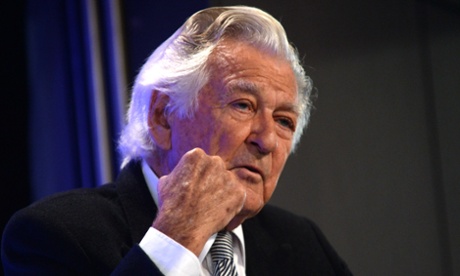
Bill Shorten has been the leader of the opposition for 12 months. One year on from assuming the Labor leadership, Shorten sat down with Guardian Australia for a conversation about what he has learned about being the person up front, Labor’s future policy direction, and some political hotspots – such as asylum boat turnbacks, and the recognition of Indigenous Australians in the constitution.
Here are five things we learned.
Unity or bust: learning to be a political leader, values are better than tactics
You’ve led a trade union, but you’ve never led the ALP before, presumably it’s a learning curve. What can you say about it? Shorten: “I learn something every day.” Specifically? “The Labor party being united is fundamental for us to be taken seriously by the Australian people. I think we’ve had an outbreak of pretty good unity in the past 12 months. When you see some of the book wars going on now, this reminds you that a year can be a long time in politics. I’ve also learned that if Labor takes principled positions – whether that’s Medicare, or opposing cuts to pensions – we do all right. Not everything has to be tactical and short term. I’m very grateful to my team. People are working hard and being positive.” Do you think Labor has recovered from the self-defeating and self-indulging tendencies which were so on display between 2010 and 2013 – or might we see a lapse? Is the current internal harmony circumstantial or durable? “What I think is if Labor wants to form a government we have no choice but to be united. Anything else is a betrayal of the millions of people who want a strong opposition and people who want a strong Labor party.”
Asylum boat turnbacks: watch this space
I point out to Shorten that his immigration spokesman, Richard Marles, has left wide open the prospect that Labor will change its stance on turning asylum boats back to Indonesia. Boat turnbacks used to be off-limits policy-wise for Labor, but not so much recently – there’s been some creative ambiguity. Shorten: “I’m from that tradition that immigrants are welcome and we should be taking our fair share of refugees. I think some of the deterrence stems from the decisions in the past few months of the previous Labor government when Papua New Guinea went on the table. We’ll have policies that get the balance right at the next election, but there is still a fair way to go. There’s plenty of moving parts here.” OK, so you are deliberately leaving open the possibility of Labor changing its policy to support boat turnbacks then? “We don’t have enough information on the turnbacks that have happened. It’s premature.” Then why not shut this issue down and say definitively that Labor won’t turn back asylum boats? “We don’t have information about [the turnbacks which have occurred]. I don’t accept turnbacks are the key element [in deterrence]. As far as I’m concerned this government is the issue, and we’ll work out our policies in time for the next election.”
‘Me too’ on national security
The shadow attorney general, Mark Dreyfus, said in July that Labor would not support legislation if it criminalised the publication of information about new “special intelligence operations”. Then Labor went on to support the Abbott government’s legislation criminalising publication. I asked Shorten why Labor declined to stand up for the principle of press freedom. He’s not thrilled with the question: “How did you go with the government when you asked that question?” I point out I have asked the government about its national security package, and now I’m asking him. “Because of Labor, there were measures put in to modify the operation of that legislation. Labor did speak up. We are very conscious about freedom of the press. It isn’t correct to say we didn’t raise any issues. We did.” (Labor did raise issues, but it didn’t amend the proposal, that’s the substantive point Shorten seems reluctant to accept.) But enough about journalists. How about consumers? What is Labor’s attitude to the next big national security cab off the rank: mandatory retention of everyone’s private communications data for two years? Shorten: “We don’t think it should be open-ended. We are not automatically against [data retention] for a year or two years, but the process hasn’t finished. I don’t want to be theoretical when we’ve got practical propositions to address. But this won’t be a blank cheque.” Shorten says Labor will be concerned about the security of people’s private information if the data retention scheme proceeds. “Absolutely, that almost goes without saying.”
Constitutional recognition: it has to mean something
Shorten has argued that recognising Indigenous Australians in the constitution should go beyond wafty symbolic gestures – and that a proposal should not be imposed on the first Australians but reflect what they actually want to see by way of reform. This should be a statement of the obvious in modern Australia, but it seemed a bit revolutionary for constitutional conservatives and editorial writers at the Australian. He copped some heat. Where are things up to now? Shorten says he’s had some preliminary discussions with Tony Abbott concerning how to proceed. “Hopefully we’ll have some more.” Shorten says constitutional recognition is “long overdue” but there has to be agreement on the fine print. He wants an inclusive conversation with a diversity of Indigenous leaders, and with next generation voices. This should be about what Indigenous people want, not about what politicians in Canberra think they need. “Change which doesn’t represent the wishes of Aboriginal and Torres Strait Islander people is not change worth having. What’s been missing in some of the debate and reportage is the views of Indigenous people. I’m open to having further discussions with Tony Abbott but I think the whole debate would benefit from national political leaders talking with Aboriginal and Torres Strait Islander people.”
‘Dumb-arse’ stepkids of Bob Hawke and Paul Keating
Michael Cooney, the head of Labor’s official thinktank, the Chifley Research Centre, recently issued a challenge to Labor parliamentarians to move beyond the Hawke/Keating model of reform to define new policies and new solutions. Cooney rather memorably said the party must shake off the temptation to be “Bob and Paul’s dumb-arse stepkids.” Shorten says he read the speech. His response to Cooney’s challenge is yes, and no. “In some ways I think we revive the Hawke-Keating mantle in terms of open economy and strong commitment to social justice. But new issues have emerged. The ageing of the population, the good and bad but absolutely disruptive changes from the digital economy, the onward march of women for equality, the rise of Asia in a way that could not have been foreseen in 1983 – we are a much more diverse economy. There are new issues. Some things are the same, some things are different.” Shorten says a Hawke-style approach to governing is sorely needed in a time of hyper-partisanship: “Consensus-building, bringing people into the centre of Australian politics is better than creating division. We should be reaching for higher ground, constantly.” He says the party is making progress on internal reform. “We can’t just be a faction-based party, we need to be a membership-based party. While unions are relevant to what we do, they are not the only economic actors.” Shorten says he wants transparency and funding disclosure back on the national agenda. “I wonder if the NSW Liberals would have run into trouble in the Icac if they’d adopted the [disclosure of donations] approaches Labor pursued federally?”













