Bill Shorten has acknowledged voter anger and declining political loyalty while placing housing affordability, jobs and political integrity measures at the centre of Labor’s agenda.
The federal opposition leader committed to establish a second parliamentary inquiry into a national integrity commission to restore voter confidence while claiming he did not believe corruption was widespread in politics.
Shorten also committed to a national skills summit, which he said had attracted support from business and industry groups, the Australian Council of Social Services (Acoss), seniors’ groups and the Australian Council of Trade Unions.
The opposition leader warned that while Australia had not suffered the hollowing out of the middle class yet that led to the rise of Donald Trump, the Coalition was pursuing policies that would lead the country down the US path.
In his first major speech of the year, Shorten told the National Press Club that safety nets were among the reasons why Australia did not have the same problems as the US.
“Superannuation, a strong Medicare and a strong minimum wage are [among] the reasons why the Australian middle class and working class isn’t quite in the dire straits of many parts of America but that doesn’t mean the problems we see there aren’t cropping up here,” Shorten said.
“There has always been a portion of inequality in our society but what concerns Australians is growing inequality.
“There is a sense in Australia that we’ve lost control of decision-making. It doesn’t just have to be on the big national issues. It can be the over-development of our suburbs, a sense that residents don’t have a say, a sense that everything is a done deal. So we are not America yet but we cannot be complacent.”
Shorten promised a second inquiry for a potential national integrity commission after the first Senate inquiry, set up by the former Palmer United party senator Dio Wang and the independent John Madigan, was dissolved at the last election.
“I’m not aware of corruption – on either side. if I was, I would report,” Shorten said. “I’m not advocating a Senate inquiry into a national integrity commission because I believe corruption is widespread.
“I do so it to lift public confidence because people’s trust in politics and public administration depends on the confidence and assurance that corruption will be met with the full force of the law.”
He reasserted a promise to ban on foreign donations and support for the independent body promised by Malcolm Turnbull after Sussan Ley’s expense scandal to oversee politicians’ expenses based on the UK model.
Shorten promised to impose stricter standards for gifts, greater accountability for public funding applying to declared expenditure and stronger rules with tougher penalties but provided no details.
Rather than outlining new policy items, his speech was a pitch to working and middle-class voters frustrated by politics and an acknowledgement that the political class – including the media – had failed.
“Too many Australians think the political system is broken and more than a few don’t trust us to fix it,” Shorten said.
“I say ‘us’ because virtually everyone in this room is considered part of the problem, part of the political class. Rightly or wrongly, we are seen as members of the same insider club, letting down the rest of Australia.
“This sense of alienation isn’t a local curiosity – it’s a global phenomenon.”
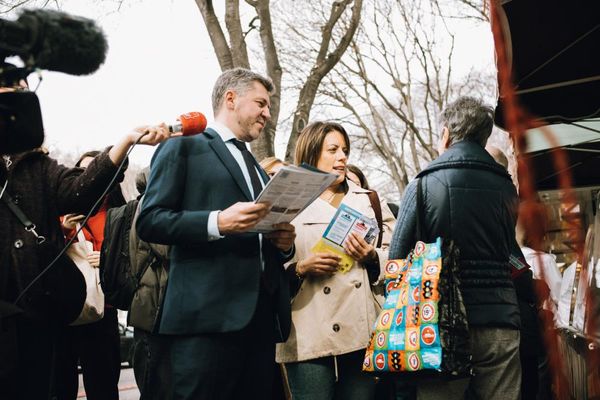
He said the threshold challenge for the political class was restoring faith in the system in a world in which people had disengaged with politics. The solution, he said, was for politicians to engage beyond media conferences and the “eight-second grab”. He described his town hall meetings in the past two years as an attempt to allow voters to have longer conversations.
“Any time you turn on the TV, you can see a politician talking, telling you what they think is right,” Shorten said. “Rarely do we explain why we hold that view. There’s a sense we have traded our status for eight seconds on the nightly news.”
Despite his strident criticism of Trump’s ban on people from some Muslim-majority countries, Shorten committed to the Anzus alliance and invoked the Labor wartime prime minister John Curtin to assert a belief to put “Australia first” – an echo of Trump’s “America first” slogan.
“When John Curtin in 1941 said we needed to look to America and not England, that was a remarkable call for his time,” Shorten said. “It showed that John Curtin was putting Australia first. I believe that the American alliance has been an absolute bulwark of our military and foreign policy and it should remain that way.
“But that never meant in an alliance and I just caution the government … you don’t have to say yes to everything the Americans ask.”
Shorten said the political landscape had changed since the July 2016 election, given that Trump was president “and Malcolm Turnbull has got worse”. He characterised the prime minister, a former barrister and banker, as a paid advocate who would take either side of the argument.
But he said the economic conditions remained unchanged, with low growth rates in wages and productivity combined with low interest rates.
“Twenty-five years ago, a typical home cost five times a young person’s average income,” Shorten said. “Today, it’s 15 times their average income. And what’s the Liberal-National answer? ‘Get rich parents. Pack up and leave town.’”