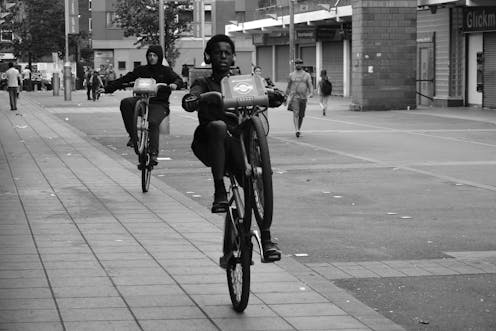
Streets in Central London were brought to a halt, when around 4,000 people – largely teenagers – got on their bikes to protest against London’s knife crime epidemic, as part of the #BikesUpKnivesDown campaign. Crime among young people has climbed up Britain’s political agenda; recent Home Office figures showed that 38 out of 44 police forces recorded a rise in knife crime.
Over the last few decades, young people have turned away from Westminster politics. They have either become disengaged, or leaned instead toward other forms of civic engagement ranging from demonstrations to consumer activism, online petitions or social action in their local communities. Political action has become less institutional and more issue-based; and looking at the topic of knife crime, it’s not hard to see why.
Both major political parties seem to be shifting the blame. Labour leader Jeremy Corbyn and London’s Labour mayor, Sadiq Khan, have argued that Conservative government cuts to police budgets are a major factor.
Meanwhile, the Conservative home secretary, Amber Rudd, suggested that the increase is just the result of police getting better at recording such crimes, and Conservative members of the London Assembly have demanded that the mayor takes charge of the situation.
A world apart
Against a backdrop of rising inequality, today’s young people live in two different worlds. In one world, are the well-resourced, highly-educated young people from middle-class backgrounds. These young people played a pivotal role in bolstering Labour’s popularity in the elections in June 2017. They tend to participate in many non-electoral forms of politics, such as signing petitions, consumer activism and engaging in social causes at a local level.
In the other world, there are young people from deprived backgrounds – many of whom feel detached from politics. Our research has also found that only a quarter of those who leave school with no qualifications vote, compared to three quarters of university students. And since young people from deprived backgrounds lack trust in key political and social institutions of modern Britain, they are also less likely to engage in any form of civic or political action.
Given the propensity of young people from disadvantaged backgrounds to disengage, the #Bikestormz protests are surprising. They illustrate the desperation that many such young people must be feeling about the crime scarring their neighbourhoods – and their determination to change things.
Losing support
Our research confirms that one of the most promising ways of reaching these young people is to engage them in local issues, for example by involving them in decision-making about transport issues, local parks and leisure facilities.
Unfortunately, big cuts to local government spending have reduced the support available for young people in poorer communities. Research from UNISON found that between 2012 and 2014 alone, 41,000 youth service places for young people were cut – that amounts to the removal of at least 35,000 hours worth of youth outreach work. And the Local Government Association has suggested that cuts to youth services are driving the increase in knife crime.
The areas most at risk of knife crime are deprived urban neighbourhoods with high rates of poverty, social exclusion and family breakdown. Residents of these areas are more likely to belong to an ethnic minority, do less well in education and have less access to social amenities such as youth clubs. The people who live in these places have been hit particularly hard by government austerity regimes, following the 2008 global financial crisis.
Because of this, Britain’s young people have suffered from austerity. Knife crime can be seen as a symptom of the austerity agenda, raising questions about intergenerational fairness, equality of opportunity across Britain’s ethnic groups and most importantly, how the nation’s resources is redistributed for the social good.
The “youthquake” of 2017 shows that although young people have turned towards more non-electoral forms of participation (such as the #bikestormz protest), they are more likely to engage with conventional politics if they see an opportunity for meaningful change. Labour’s anti-austerity, pro-youth agenda established under Corbyn may place the party at a distinct advantage among young people. With protests such as #Bikestormz, young people are sending a clear sign that they’re willing to take action on issues such as crime. The government would do well to take note.

Rakib Ehsan has received funding from the Economic and Social Research Council for his PhD.
James Sloam does not work for, consult, own shares in or receive funding from any company or organisation that would benefit from this article, and has disclosed no relevant affiliations beyond their academic appointment.
This article was originally published on The Conversation. Read the original article.