The novel coronavirus pandemic has triggered a rise in the use of bicycle-sharing services in urban areas, as they enable users to avoid closed spaces, crowded places and close-contact settings.
A 39-year-old business owner based in Nagoya started using shared bicycles for daytime trips in July when a second-wave of infections began. "Using buses and taxis increases the risk of infection. Shared bicycles are convenient and cost-effective, and they can be ridden at any time," he said.
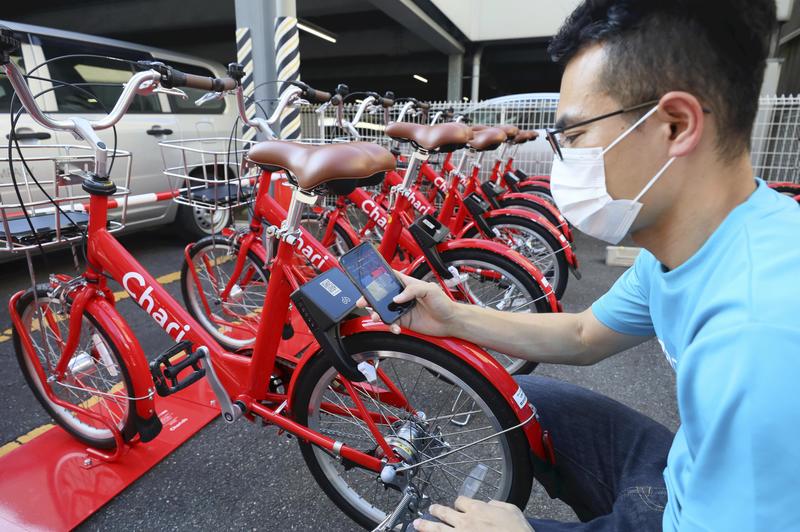
Operators of bicycle-sharing services have concentrated stations in urban areas, at which riders can rent and return bicycles at any station, using an app on a mobile device to unlock them.
The rental fee is about 100 yen per 10 minutes, and payment can be made using a smartphone. Each operator has a team of staff that regularly sterilize saddles and handlebars.
Since the outbreak of the coronavirus pandemic, many of the bicycles have been used by commuters, takeout delivery riders and people on their days off.
Consequently, there has also been an increase in the number of empty bays in city centers.
Industry leader Docomo Bikeshare Inc. saw the number of its newly registered members rise 20% in April and 60% in May compared to March figures.
Kyushu-based bike-sharing firm Charichari had about 220,000 users in Fukuoka in June, nearly double that of January. The operator of the company also launched a service in Nagoya in July.
Startup firm Luup launched a bicycle-sharing service ahead of schedule in May. Although it is aiming to promote the use of electric scooters in the future, deregulation of such vehicles has yet to be realized, and the company wanted to use this time to gain experience in the sharing industry through its new service.
-- Aiming to avoid trains
The spread of coronavirus infections has caused railway use to plummet since the start of the year. In April and May, when the state of emergency was declared, private railway operators in the Tokyo metropolitan area saw passenger numbers plunge to around half of what they were during the same months last year.
The number of passengers traveling on Central Japan Railway Co.'s conventional train lines in Nagoya and surrounding areas fell by 57% in April and 64% in May, from a year earlier. Private railway operators have since seen a slight recovery, but passengers are yet to reach the same levels as last year.
A surge in demand for parking lots in business districts indicates there has also been a rise in the use of cars and motorcycles, in addition to an increase in bicycle journeys.
According to Osaka-based Akippa Inc., which operates reservation services for approximately 37,000 parking spaces nationwide, the number of reservations by people "commuting to work or school" doubled from February to June.
Reservations for parking lots in business areas in central Tokyo rose markedly, with demand increasing more than fourfold in Shinjuku Ward. Looking at the 10 municipalities with the most reservations nationwide, the 23 wards of Tokyo have accounted for more than half of the reservations since April.
On the other hand, reservations at parking lots in areas near major event sites have been sluggish. "Many people may have been urged by their employers to drive to work," an Akkipa official said.
Opinions also appear to be changing concerning motorcycles, which are cheaper to park and maintain compared with cars.
According to the Japan Mini Vehicle Association, sales of small motorcycles over 125cc totaled 63,297 units between March and July, surpassing the levels posted during the same period last year.
When manufacturing capacity had returned to normal in June, motorcycle makers saw a 13.8% increase in sales from a year earlier. Double-digit year-on-year growth continued in July, when sales increased by 12%.
"During the state of emergency, the drop in motorcycle sales was limited, compared with that of four-wheeled vehicles," a motorbike manufacturer said.
Read more from The Japan News at https://japannews.yomiuri.co.jp/