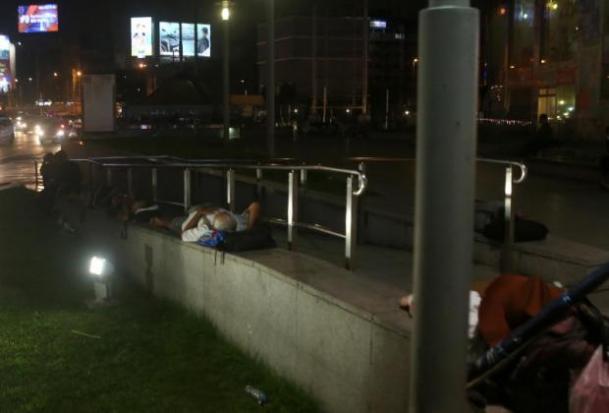
While the sight of downtrodden Bangkokians sleeping in the well-known "Big House" shelter for the homeless points towards efforts to address inequality, it does not necessarily herald their escape from such unfortunate circumstances.
Although years-long attempts to build decent shelters for those with no fixed address might be admirable, social advocates remain doubtful as to whether this "help" leads to many successful long-term outcomes.

Even the Big House does not always guide its residents to a brighter future.
Built in a corner of Bangkok Noi district on the western side of the Chao Phraya River, the shelter's doors are open to wanderers who want to settle in.
It also raises hope for some families who want to see their children spend time in classrooms.
By law, kids cannot be admitted to schools if they do not have a permanent residence.
The Big House currently accommodates 40 homeless people and can solve this problem, but the lives of those who sleep within its walls are still not a bed of roses.
"Nine children should go to school, but only two have managed to do so," said Somphon Hanphrom, who works for the housing development foundation.
Their major hindrance is poverty. It is true the government gives children free education, but their parents must still cover other additional costs, including some educational equipment and travelling expenses.
"This does not mean these parents have no jobs," Mr Somphon said.
"They work hard almost every day, but because they possess few skills, most dropped out of formal education after primary school, what they can do is limited to unimportant, low-paid jobs like scavenging."
It came as no surprise to Mr Somphon when he learned that many children decided not to study in order to help their family make a living.
But this only perpetuates a vicious cycle of poor incomes as, without an education, they too will end up working in the same low-end occupations as their parents.
Staff at the Big House are only too aware of this problem, so they encourage its two lucky students to work hard to open up other career avenues which will benefit their families in the future.
However, for other youngsters at the shelter, "their parents' dream of seeing their children in school uniform seems to be disappearing", Mr Somphon said.
He does not want homeless people to give up their hopes for a better life. The Big House is not only a shelter, but it also offers career training and even lends money and equipment to help residents set up small businesses, he said.
However, Wichian Thala, a member of Chiang Mai's homeless people network, urged all parties to be careful about the help they provide.
Assistance from charity organisations, social workers and individuals can pave the way for the homeless to leave their unpleasant conditions behind, but on the other hand, if this help is given continuously without a ceiling, "it will hinder attempts to completely rehabilitate them", he said.
At a shelter in Chiang Mai, the homeless are not given a free ride.
They are required to pay rent of 10 baht a night for their rooms. This encourages them to find jobs so that they will have enough money to meet this small expense.
"They, too, should contribute to making their own lives more valuable," Mr Wichian said.
Natthawut Kromphakdi, of Friends of the Homeless, a social advocacy group in Khon Kaen, said it is also important to monitor whether the number of homeless people is increasing. In his opinion, more people are finding themselves in this unwanted situation, at least in this northeastern province.
Usually, people become homeless due to economic problems, like unemployment, or family conflicts, which force them out of their homes.
"But the state's projects can be also a factor," Mr Natthawut said.
The double-track and high-speed railway projects in Khon Kaen are likely to affect poor communities located along the routes. Many do not have any kind of rights to their dwellings and will be forced out when the developments begin, he said.