One of the more odd things about the global financial crisis (GFC) is how it hasn’t turned out to be that bad for many financial companies. Here in Australia, the Big Four banks have done so well that now they account for four of the five biggest companies in Australia. A major reason for their success has been the actions of the government, but now with the Murray financial system inquiry about to hand its recommendations to Joe Hockey, the banks are circling their wagons to fight against any further actions which may make the system more secure, but reduce their profits.
The Big Four banks – Commonwealth, Westpac, ANZ and NAB – have performed rather better than the other major companies since the GFC. That’s not to say the banks would welcome another crisis but they have found a wonderful way to make lemonade while other companies – such as those in mining – have been sucking on GFC lemons:
The GFC actually played into the hands of the Big Four banks.
In the early 1990s, due to the deregulation of the financial system that saw new banks enter the market, up to 90% of all owner-occupier home loans were taken out with banks.
But by the mid-2000s, using cheap money from overseas, non-bank lenders began eating into the home loan pie. Lenders such as RAMS, Aussie Home Loans, and Wizard were able to cut into the banks’ share of the market to the extent that by June 2007, banks were getting only 77% of the home loan market.
Then the GFC happened:
The years of cheap foreign money were over. By the end of 2009 banks were accounting for more than 90% of the home loan market. And the big banks went shopping.
Westpac bought St George, BankSA as well as RAMS, the Commonwealth Bank bought BankWest and a third of Aussie Home Loans, NAB bought the mortgage broker Challenger.
Now the Big Four alone account for 84% of all home loans taken out by banks – about three quarters of all home loans:
But it’s not all joy. When the cheap overseas short-term money market went into meltdown, that affected the banks as well. At the time they were getting about 30% of their funding from such sources:
Their costs rose for a few years, but have now begun to return to normal (if still higher than pre-GFC) levels.
As a result of the short-term debt market explosion, banks turned to getting more of their funding from you and me. Deposits used to account for just 40% of their funding, but now account for about 53%.
The costs for that have also changed. The cash rate has fallen, but because the banks are all pretty desperate to get your money, the deposit rate rose relative to the cash rate:
But that’s only part of the story. At the same time, mortgage rates were going down.
A quick and dirty way to look at the cost of long-term funding is to compare the difference between the interest the banks pays you for a deposit, and the interest you pay it for a home loan:
During the GFC the difference between the two became very tight – meaning the profit for banks of taking money from one person and lending it to another decreased. But in the past 12-18 months the gap has opened up again to the point where the difference between the two is now where it was before the GFC:
So given the massive consolidation of the financial sector, and funding costs that are returning to normal levels, it should be no real surprise that the Big Four banks are churning out profits like they have a license to print money.
The Commonwealth Bank made an $8.68bn profit (up 12%), ANZ’s was $7.12bn (up 10%), and Westpac made $7.63bn (up 8%). Only NAB, which earned $5.18bn, saw a reduced profit from the year before (down 10%).
Just to ram home the point, yesterday Commonwealth Bank announced that in the first quarter of this financial year it made cash earnings of $2.3bn – up from $2.1bn the same time last year.
So you would think the banks would be pretty happy, and above all grateful about having not only survived, but thrived during the GFC. For they thrived not because of their own superior management, but primarily because of the government.
Firstly, our financial laws had not been watered down as was the case in the USA, which meant our banks were not as exposed to the risky funding that occurred there.
Secondly, our money was guaranteed by the government during the GFC (meaning no danger of a run on the bank). In 2008, the Rudd government guaranteed deposits up to $1m without risk, and then on a sliding scale for deposits over that amount. And just to make sure the banks were happy, they were charged a smaller fee for those deposits than other lending institutions were.
Then the government told the ACCC to not make too much of a fuss about all those buyouts, even though they have clearly reduced competition.
And to top it all off, as the Australian Financial Review’s Christopher Joye noted this week, the easy monetary policy around the world has ensured borrowing rates have remained low and have fuelled asset prices (such as the housing) which in turn boosts the profits of banks.
So all in all, banks should be bloody grateful.
And yet you wouldn’t know it from their response to suggestions that the Murray inquiry might recommend banks increase their capital ratios (ie the amount of equity they hold relative to their risk bearing assets) from the current level of 8% by 2016 to possibly 10%-12%. This would reduce bank profits, but make them more secure.
In response the ANZ’s head, Mike Smith suggested it would “come at a cost to customers who will pay more for home lending [ie higher mortgage rates]” and it would mean “lower growth, fewer jobs and lower tax revenue”.
Westpac’s chief, Gail Kelly backed him up saying the increased cost of holding more capital would either be passed on to customers (higher rates) or absorbed by the bank (lower profits and lower dividends, and lower taxes).
But let’s not be fooled into thinking the banks are suddenly all full of community spirit. The response is pure politics and all about the banks profits. Smith and Kelly are using the media to send a message to Joe Hockey that should he agree to any such recommendations they will blame him for any increases in interest rates, or reduction in profits.
The financial industry can campaign just as loudly as the mining industry did when it thinks its profits might be squeezed.
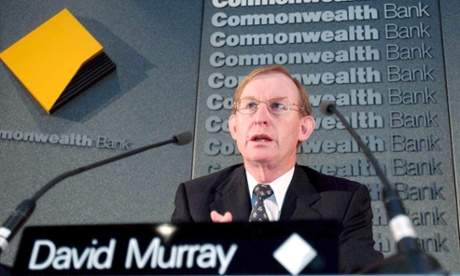
But the Murray financial inquiry is not being run by anti-bank folk. Murray himself was CEO of the Commonwealth Bank from 1992 to 2005. Any recommendations that may affect banks’ profit in order to improve the financial security of the whole system should not be dismissed as an attack on the free market.
Indeed, given that during the GFC we effectively socialised any losses and ensured the banks’ profits would be much bigger than had they been left to fend for themselves, a case could be made that it’s time the banks gave something back.
- This article was amended on 6 November 2014 to remove an inaccurate claim that ANZ had bought ING Direct.