Yes, you read that right. Six. Such was the quality of the 122 blogs we recieved this week that we've doubled the shortlist. In truth, we could have upped it to a dozen or more. For after one or two standouts, there was a very healthy batch of uniformly good and varied blogs just behind. In the end, though, we thought reading 8,400 words in one stretch would be too much, so six it had to be. Commiserations if you've missed out: we enjoyed reading every submission and, if it's any consolation, the whittling down process was slow, argumentative and painful.
Apologies also to all those whose entries did make the cut for the lack of hyperlinks below. Unfortunately we had to take them out this week due to technical problems.
Please vote for your favourite entry here. We'll announce the two winners (the top two in the voting) who will go through to the Big Blogger final on Monday afternoon.
Blogger A
It is rare that I ever back down in an argument, rarer still that I would contemplate abandoning my stance in favour of the opposite viewpoint. For years I have been vociferous – in pubs and on blogs only, but vociferous nonetheless – in my opposition to the introduction of video technology to assist the refereeing of football matches.
Over the last few years this has become something of a civil war within the game. There are the self-styled progressive thinkers who see this as the definitive no-brainer. Opposed to these are the traditionalists, in which number I've always counted myself, that find human error a compelling element and on a wider scale worry about the effect it would have on the ebb and flow of the game.
I'd stuck to my guns for years even if it meant being branded a luddite. However over this past weekend I saw something that made me think again.
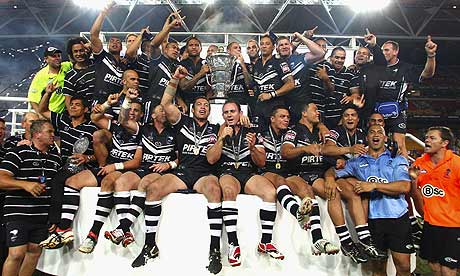
The sport of rugby league decided to embrace television replays to rule on contentious tries several years ago. Had it not done so we may have been deprived of the sporting upset of the century this weekend as New Zealand wrestled the World Cup away from Australia, ending their thirty-three year reign as world champions and making the death knell of international rugby league chime just that little bit quieter.
The video referee Steve Ganson was a busy man at the Suncorp Stadium, called upon to deny one try to each side and award three to New Zealand, some of which were undetectable to one glance with the naked eye. When he correctly denied Darren Lockyer what looked a certain try that would have made it 16-0 Australia he unwittingly caused the most important shift in momentum in the history of the game. The final New Zealand try of their stunning turnaround was given after what appeared to be multiple knock-ons but was actually a mass of legitimate ricochets off green and black shins. Justice served it seemed, and New Zealand had won their first World Cup.
Before I raise a glass and demand three cheers for video replay I should interject a cautionary note. Two of the tries awarded to New Zealand after video consultation have left the Australians absolutely seething. Jerome Ropati's try to put New Zealand 12-10 ahead in the first half was preceded by what appeared to be a knock-on but was ruled a strip tackle, yet this controversy pales besides the penalty try awarded against the Kangaroos with just ten minutes left.
Lance Hohaia raced towards a bouncing ball in the Australian in-goal area and was unceremoniously clotheslined by Joel Monaghan. Billy Slater was racing to the same ball from full-back. Who would get there first? The debate will rage as long as the game is played. I think Hohaia (just) but more importantly so did Steve Ganson. Penalty try to New Zealand and Australia needed two scores to win inside 600 seconds. Game over.
Perhaps that could pacify those who think human error will disappear from football with video replay. It could be reviewed on the biggest HD screen imaginable and the referee might hear it through an audio headset so sophisticated it would make a CIA phone-tapper blush, but the decision, borderline or otherwise, will still be made by a human being. My other concerns about the building momentum of a game have receded somewhat – even in a stop-start game like rugby league you couldn't have sucked the see-sawing drama out of Saturday morning if you'd tried.
So I've decided, tentatively, to climb on board the video replay bandwagon. A trial period at least is surely worth having, personally I'd want it for goals and penalty decisions only, not every offside, throw-in or corner and strictly no prostituting the time spent waiting for confirmation to corporate sponsors. Video replay is not perfect and never can be but arm the officials with the best tools to get closer to the truth and it could enhance the game, and in time we might wonder what all the fuss was for. As the saying goes, the benefit of hindsight is a wonderful thing.
Blogger B
About a decade ago, watching ice hockey's Toronto Maple Leafs coast inevitably to their annual playoffs exit, the conversation between periods turned to an old Montreal Canadiens net-minder by the name of Patrick Roy. The room, crowded with white and blue Leafs jerseys, was biased; there was a palpable sense of schadenfreude over the fact that Roy had left the Canadiens in late 1995 for the Colorado Avalanche, gone on to win a couple of Stanley Cups and a Conn Smythe trophy in Denver while rendering the Canadiens, once perennial Stanley Cup favourites, the National Hockey League's newest bottom-dwellers.
I didn't know much about Roy at the time except for his fierce low stance and fearlessness coming out of the net to stop attacking forwards on their way to goal. He was a shot-stopper who made goaltending look cool in a country where goalies are viewed as masterminding intellectuals, epitomised by former Habs goalie and now Member of Parliament, Ken Dryden. Roy was a maverick in the old fashioned sense – he had few friends in the dressing room, with a temper ranging from ice cold to white hot. Most of all, Roy had those crazy eyes. We joked that night that Roy must've primed himself for a long night in goal, not by calisthenics or tennis ball catches or any of the other oft-used methods of NHL keepers, but by chanting a mantra in a broken Quebecois accent: "I 'ATE da puck."
Patrick Roy's number 33 was retired this week at the Bell Centre in Montreal in a ceremony that side-stepped emotion in favour of blunt recognition – Patrick Roy was perhaps the best goaltender the Montreal Canadiens had ever produced. When his number went up to the rafters, many fans tried to remember their happiest moment with him: Roy hoisting the Stanley Cup in Montreal in 1993, the last time either the Habs or indeed any Canadian hockey team won hockey's premier trophy.
Understandably though, some Montreal fans couldn't help but remember his sudden departure two years later, in 1995. When Roy left for Colorado, he not only left Canada for the US – often a huge sore point here – he left for a hockey franchise that had itself moved from a Canadian locale, Quebec City, only a few years before. Even worse, the Quebec Nordiques were Montreal's biggest rivals, and Roy had been a boyhood fan. To top it off, the Montreal Canadiens have not won a Stanley Cup since.
What went wrong? While sport often hides the motives of players under a patina of deception – trades for more money are explained away as "the next step" in a career, bitter exchanges are pieced together afterward by a speculative press, forever discussing thrown shoes in the dressing room – Roy was different. His Montreal career ended in seconds, live on-air. A run-of-the-mill game against the Detroit Red Wings on December 2 1995 became an epic 11-1 shellacking – Detroit put nine past Roy before coach Mario Tremblay finally decided to pull him from goal. As Roy, humiliated, headed back to the Montreal bench, he, paused, turned back, and bent over to tell the Habs' president "I will never play for Montreal again."
Unlike so many other sporting divas, whose ill-advised words make it to press only for them to show up dutifully on the team bus with glowing words for the club and its board members, Roy meant what he said. Within a week he was on his way to play for the Avalanche. And, to his immense credit, Roy put the past behind him, winning two more Stanley Cups for his new American club and depriving Montreal of their favourite son.
As Roy watched his number make its way to the rafters, he didn't cry, he didn't give a choked speech, he said simply, "Merci, for the privilege and honour to defend our colors night after night." In a country that so often chooses caution over risk, team play over chaotic individualism, others over self, Roy was an exception. Even if only for one evening, Montrealers, and even some of us who wished him ill over in Toronto, were glad for the opportunity to say thanks.
Blogger C
They had a draw in the NFL last week. The Bengals and the Eagles drew 13 all. Unprecedented. Well, since 2002 anyway. Tellingly, Philadelphia quarterback Donovan McNabb didn't know a tie was possible. UK commentators will tell you that this is what makes our sports superior. US sports fans are all about instant gratification and black-and-white resolution. In the UK, we are mature enough to accept an honest deadlock, where both teams can leave it all on the field and walk off with their heads held high.
The only problem with this is that it's complete rubbish. The "honourable draw" is one of the most debased phrases in UK sport and the draw is nothing to be proud of. Sport is part of the entertainment business. The continuing existence of the draw is an archaic throwback to the days when organised sport was primarily a method of preparing young men for the challenges of adulthood.
In the 21st century, as opposed to the 19th, sports live or die on their ability to provide entertainment to massed ranks of spectators and in this respect, the draw all too often fails to deliver. The two main culprits, of course, are football and cricket. Significantly, our national sports.
Many cricket fans are inordinately proud of the fact that we invented a game that lasts five days and often fails to produce a victor. And yet, Test cricket was being comprehensively killed in the 60s, 70s and 80s by a combination of excessively cautious batting and lifeless batting tracks. During these decades, drawn matches accounted for nearly 50% of all matches played.
The existence of the draw meant that teams set out for a draw from day one hoping that the other side would make enough mistakes for them to sneak the game. It is only relatively recently, mainly thanks to the Australian distaste for the draw that test matches have livened up and begun to attract new spectators. Since 2000, however, it's still the case that 23% of Tests have been drawn.
During the same period football had its own problems with negative play. The English first division followed Jimmy Hill's suggestion and introduced three points for a win in 1981 in an attempt to encourage teams to attack more. It was a reaction to the perception that too many sides were being rewarded for negative and destructive play.
The effect has been limited, because in football, a draw is an achievable objective from the start. It is often the stated aim of relegation-threatened teams visiting Stamford Bridge or Old Trafford - pack 10 men behind the ball, stick the big man up front and settle down to 90 minutes of hard tackling and hoofed clearances. By any standard, such cynical play should not be rewarded and yet it so often is.
This pre-meditation is what makes the football draw so iniquitous. Ties can also occur in other sports, of course – rugby, athletics, swimming, limited overs cricket, skiing, cycling and other sports that compete over a fixed distance or time period – even the Boat Race has had one in its history. The difference is that in these events it is almost impossible to set out to achieve a draw from the beginning.
So what's the solution? Well, there are no easy answers. Football authorities have wrangled for years over how to settle deadlocked matches. The current favoured solution, the shoot-out, effectively encourages negative play as it gives the negative team a decent shot at actually winning. Cricket should have some equivalent to the tennis tie-break, but try selling that to the average Test match follower and you might as well try and sell them a pair of tickets to Manumission while you're at it.
Football and cricket have their draws and always will, but they are not something to be proud of. They are not a weapon with which we can assert our cultural superiority. Sport is about winning and should reward the team that dares to do so. The fact that our national sports so readily allow the stalemate and permit negativity to prosper is something we should be embarrassed by, not the stimulus for pompous unedifying conceit.
Blogger D
It will shortly be that time of year again. Mistletoe and wine. Children singing Christian rhyme. Logs on the fire, leaves on the tree, etc. Darts.
With two world championships on the horizon, we're about to be treated to a month of top quality darts. Darts all day long. And for those of us who are, in the mangled words of Robert Palmer, "addicted to Stubbs", we'll have Darts Extra in the early hours of the morning. Oh yeah.
"Darts Extra". There's a clue in the name: it's just more darts, in fact it's inferior darts. They know it, you know it and they know that you know. But who can say no to extra darts? Not me, that's for sure, but I have a terrible vision of waking up aged seventy to realise that I should have spent more time making love to my wife and less time watching Tony O'Shea making short work of Co Stompé. Or vice versa.
The PDC is where the serious action is nowadays, but for myself – and I refuse to believe I am alone - the BDO has an appeal that is both more elusive and evocative. It represents a land that time forgot for British sport. And is all the better for it.
Take the analysis. In welcome contrast to pretty much every other sport on television, there isn't any. It's just wall-to-wall drama. In Bobby George's universe (not somewhere any sane man wants to visit) there is nothing to say about the game, there is no bullshit insight into technique or tactics, and there's certainly no wibbling on about "understacking" or "overstacking".
Someone is either throwing "good darts" or they are throwing "bad darts".
And this refusal to dress up the spectacle extends to the players themselves. Only the most adventurous would even dare to make a distinction between "good scoring" and "getting his doubles". The only tactic ever discussed is "speeding it up" or "slowing it down".
After enough of this you can only conclude that as in darts, so in life. You're either throwing good darts or your throwing bad darts and if the latter all you can hope is that you turn things around sharpish (but time is precious - particularly in the first round) or at the very least slow things down, put the cruel hand of fate off his game and hope he starts fluffing his out shots.
But the appeal does not stop there. At the Lakeside Arena, there is no clear difference between the people on stage and the people in the crowd. All the celebrities, the pampered professionals, have disappeared to the PDC. And they leave behind a vision of sport as it used to be, magically uninventing all the tedious, "workmanlike" identikit professionals and leaving only the ones who can't be bothered putting too much effort in.
The pub players, the fat players, the thin players (they don't come in medium). Men with silly hair, beards, hats. Those that tick all the boxes. Humanity in all its glorious variety is up on that stage. Some of them are Dutch for God's sake.
So Phil Taylor can throw all the 180s he likes. Barney can defeat "The Power" in what was almost certainly the greatest sporting event yet witnessed this century. But until either of them dons a cape and throws a couple of plastic bats into the crowd, they are fighting a losing battle. At the Lakeside the audience and players are as one. Does anyone really care about how good the darts are?
A couple of years ago, whilst I checked on the progress of a young Jelle Klaasen (who stood to make me a small amount of money), the camera panned over a spectator wearing a Darth Vader suit. This caused great amusement amongst my children. Then one of them asked the question that nobody ever dares to ask. "WHY is he wearing a Darth Vader suit?" There is no answer. He just is. Just like Ted Hankey likes to dress up as a vampire and listen to trance in his loft.
You're either throwing good darts or you're throwing bad darts. The rest is window dressing.
Blogger E
How cool was Pilavullakandi Thekkeparambil (PT) Usha, really?
To a generation of Indian women coming of age after 1984, who witnessed her glorious, single-minded achievements, Usha, The Payyoli Express, was the pinnacle of sporting cool, the epitome of athletic excellence. Our mothers, unlike us, had no one to look up to and say, "See? Indian women can excel at sport, too". My generation found a role model in Usha, still the most successful Indian woman athlete ever.
Even her initials – PT – brought to mind muscle, sinew and physical activity. We had PT classes in our school system – Physical Training as opposed to Physical Education. For a long time, the PT in Usha's name was intertwined in my mind with the PT classes that were part of the academic calendar.
In the years that followed her exploits at the Los Angeles Olympics, I imagine most Indian schoolteachers, like mine, would have pointed to her with pride. She was in our school textbooks as well – the fairytale story of the girl from the tiny village on the Malabar Coast who ran like the wind on the biggest stage of all and just lost out on the bronze in the 400m hurdles by one hundredth of a second. India in the early 1980s was just 40 years into the post-independence era and had practically no sporting infrastructure to speak of. For a woman to reach the finals of a race at the Olympics and lose the bronze medal by such a close margin was not a tragedy, but a shining success. That fraction of time - one hundredth of a second - was repeated ad nauseam by misty-eyed sportswriters and fans who would think of how close she had come to winning an Olympic medal.
India however, is a country where sportsmen and women tend to be forgotten unless they are mentioned in Wisden. These toilers, who occupy the lowest levels of India's sporting eco-system, run on potholed tracks, wield hockey sticks and kick footballs on cratered fields. They eventually move away from the corners of sports pages, where their achievements are recorded for posterity in small type, and recede into obscurity. Some get low-paying jobs with inconsequential government departments. They run after politicians and appeal for help with certificates of their participation in tournaments and their medals. They want tiny parcels of land to build a house, a shop or a sports school. The last would be the desire of some, like Usha, whose sense of patriotism and desire to serve their country has not been destroyed by the fickle love of the masses.
As the Indian public watched its boxers and shooters at the Beijing Olympics, Usha appeared on a cable news channel appealing for help to fund better facilities for her athletics institute, USHA, located near Calicut, Kerala. This summer, unlike Los Angeles 24 year ago, no new Usha emerged from the paltry sporting contingent that was representing India at the games. As Usha herself had predicted, the Indian women gave mediocre performances in the athletics competitions. India had a record medal haul, yes, and for the first time an actual gold. But all the winners were male and none were for track and field events. There was no woman Olympian for the next generation to look up to. No one hundredths of seconds for teachers and physical education coaches to treasure as a glimmer of possibility.
Usha's charisma alone has been enough to draw aspiring female athletes to come to her for tutelage. Her institute at present lacks the facilities that would make it a truly world-class athletics school. It has no hostels and not enough running tracks of required lengths. Those who run longer than 100m go to the beach and train.
Usha and her fellow athletes are ignored at Olympic torch relays in favour of Bollywood stars. The media remembers them once every four years. The Indian medallists at Beijing were showered with monetary rewards for their achievements and the government ignored the valid claims for assistance by institutes such as Usha's. She has, however, persevered with the focus and ambition that got her to Los Angeles from Payyoli in deepest Kerala. She is well aware that India's emerging economy and the rise of private entrepreneurship might finally help turn her dream of future athletics glory into reality.
Until then, the Payyoli Express steams on.
Blogger F
I don't walk anywhere anymore, I race. Either to the chequered flag or to the goal line. I slipstream fellow pedestrians then pop out at the last minute to take the inside line into a corner, I slip through gaps - after a sidestep or swerve - while a stepover and change of direction lets me leave a bollard trailing in my wake as I race towards goal.
In short, I can't not think about sport. I breathe it, live it, revel in it and spend an unhealthy proportion of my waking hours with it on my mind.
I know, deep in my soul, that others don't share my obsession. But I can't not mention Greece winning Euro 2004 as an example of how people got used to the new world (zonal pressing and back fours) and forgot basics like man-marking when in a work discussion about complex financial structures leading to the downfall of the over-inflated credit markets.
But why does sport hold such power over me and millions of others? What is it about sport that makes us invest so much - emotionally and financially - into simple games?
Put simply, sport is both finite and infinite. Each game, match or race has an allotted time - there are clear rules in place and the players are defined. And that gives us the illusion we can understand it, comprehend it, analyse it and discuss it. It gives us a platform for our opinions, lets us talk to strangers in bars, at dinner parties and colleagues at work.
Sport is also infinite - there is always the next game, the next season to look to. Redemption is there waiting for just one more player to arrive or a new engine. It is also simple. It is impossible to either over- or under-think sport. But more than that, sport is a vehicle for our hopes, dreams and fantasies.
When things go wrong in your life it offers an escape. A way to forget about yourself and live through the men and women dressed in uniforms you – for whatever reason – identify with. It lets you live through the acts of others on the screen, grass or track.
This is a dangerous power though, because while offering us escape from our own lives, we let sport in. Sport is no longer an escape, it becomes part of us. There are horrible statistics about the incidents of domestic violence in Wales after the national team loses – especially to England. The actions of millionaires we have never met who kick balls for a living can cost us friends, relationships or even jobs.
There is something else though - something that is unquantifiable but as important as anything. Sport is a method of connecting people.
Humans are political animals. That quote that is often misused, you see it does not mean that we want to become - or that we act like - the inhabitants of Westminster, but that we live together in groups. We do not function alone, but as part of something bigger – collections of people.
We identify with something, and then act and align ourselves accordingly – anything from which side of a boiled egg we chop off to belief in an afterlife will see us form groups and identify with others like us.
In an increasingly atomised society, where your neighbours are strangers, sport holds us together. A team, club, town, or nation celebrates or grieves as one.
Sport offers identity and then layers shared memories, experiences and emotions on top. It offers the foundations of a community. Hugging people you've never met as Jonny's drop goal sails over. Standing in a park with thousands of strangers as Pietersen clubs 158 to win back the Ashes, finally believing again and knowing the people alongside you are sharing your experience.
And that's why sport matters: why we play it, watch it, read about it, write about it, talk about it and think about it. Not because it's a distraction or a frivolity, but because it lets us dream and binds us together.