Former Vice President Joe Biden emphatically asserted his political comeback with seven victories while Sen. Bernie Sanders notched a pair of wins in a Super Tuesday blitz of coast-to-coast balloting.
Biden, who had been all but written off after a stumbling start in early contests, swept across much of the South, posting victories in Alabama, Arkansas, North Carolina, Tennessee and North Carolina along with wins in Minnesota and Oklahoma.
Sanders carried his home state of Vermont and Colorado.
The two were in a close fight in Massachusetts, leading Sen. Elizabeth Warren, who was struggling to avoid embarrassment in her home state. They were also running neck and neck in Maine.
Biden's Southern state wins were powered in good part by massive support among black voters _ the bedrock of his campaign _ and late deciders evidently impressed by his crushing victory in Saturday's South Carolina primary.
In neighboring North Carolina, nearly 6 in 10 voters made up their minds in recent days and most backed the former vice president. In Alabama, nearly 4 in 10 voters were late deciders and more than 60% backed Biden.
His win in Minnesota came a day after the state's U.S. senator, Amy Klobuchar, quit the race and threw her support to Biden.
From the hamlets of New England to the beach communities of Southern California, voters in 14 states as well as American Samoa went to the polls to award about a third of the pledged delegates needed to win the Democratic nomination at the party's July convention in Milwaukee.
The competition amounted to a fight pitting muscle against momentum and money.
Sanders, who waged a strong bid for the 2016 nomination, was the candidate with muscle, a powerful turnout operation financed by an enormous fundraising base and a national army of devoted fans.
Ivan DePaz voted for the Vermont senator just as he did four years ago.
"I love what he's done. I love that he stands by what he says, and he's been doing that since he started," the 55-year-old talent manager said after casting his ballot in Los Angeles' Los Feliz neighborhood.
Biden was riding a huge wave of momentum from his South Carolina win, which forced three rivals from the race and drew many pillars of the party establishment to his side.
The strong showing was also enough to bring Frank Anderson around.
The 74-year-old retired hospital administrator in Birmingham, Ala., had long considered himself a Biden man. But he began to worry after the former vice president slumped in Iowa and New Hampshire, finishing in fourth and fifth place, respectively.
South Carolina alleviated Anderson's concerns. "Now I think he is the guy," he said.
The candidate with money _ in staggering sums _ is former New York Mayor Michael R. Bloomberg, who faced voters for the first time after skipping the race's early contests. After two uninspiring debate performances, he was braced for a poor showing despite lavishing more than $660 million on his candidacy, including more than $224 million on Super Tuesday advertising alone.
Speaking to reporters at a Miami field office, Bloomberg said he wasn't counting on winning a single state and suggested his hopes rested on Democrats turning to him in the event of a deadlocked convention _ the same scenario Warren clings to.
"You don't have to win states," Bloomberg said, "you have to win delegates."
He did manage to score a victory in American Samoa, good for five convention delegates. But even before Tuesday's first votes were counted, Bloomberg's campaign manager sounded as though his candidate was preparing a possible exit from the race.
"We will find out how well he does tonight and we'll find out whether Mike Bloomberg is on his way to becoming the candidate, or we will find out if Mike Bloomberg is going to be the most important person to whomever that candidate is," Kevin Sheekey told reporters ahead of a Florida campaign rally.
In Sacramento, Calif., one high-profile voter declined to reveal his pick.
Gov. Gavin Newsom , who originally supported California Sen. Kamala Harris until she quit the race in December, said it was better for him to keep mum for now.
"I felt like we're at a moment where I was hoping we might find some unity," Newsom told reporters as he cast his ballot Tuesday morning at the California Museum in Sacramento, "and I think my voice is better served in that space than asserting myself on an endorsement that at the end of the day might not amount to much."
Super Tuesday was so named because of the number of contests _ 16, including Democrats abroad, who have a week to make their preferences known _ and the 1,357 pledged delegates to be awarded. It takes 1,991 pledged delegates to win the nomination on the first round of balloting.
If the fight goes to a second round at the convention, it takes 2,375.5, or the majority of those eligible to vote, which includes superdelegates _ elected officials and other party leaders _ or, as they're being called this election, "automatic" delegates.
Sanders entered the day with a narrow lead over Biden in the delegate count, according to The Associated Press, after a small fraction was awarded in the four earliest-voting states: Iowa, New Hampshire, Nevada and South Carolina. Biden pulled ahead Tuesday night, but the two biggest prizes _ California and Texas _ had yet to be decided.
Under rules established by the Democratic Party, delegates were allotted on a percentage basis, based on a candidate's performance at both the statewide and congressional district levels. In each, candidates needed to meet a 15% threshold of support.
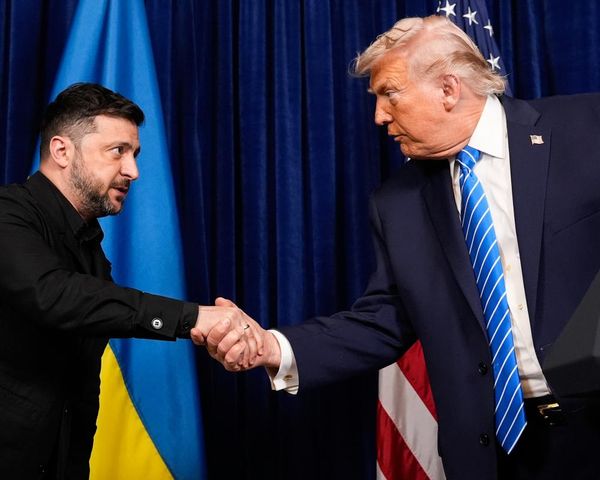
In Washington, President Donald Trump professed not to care whom Democrats choose.
Though he continued his effort to sow discord, claiming the Democratic establishment is trying to steal the nomination from Sanders, Trump insisted, "Whoever it is, we will take them on the job we've done."
"We've rebuilt the military, we have the strongest economy we've ever had, all of the things we've done," he told reporters as he left the White House to visit the National Institutes of Health, a lead agency in combating the novel coronavirus. "I will take on anybody."