Summary
- Joe Biden and Vladimir Putin held their summit in Geneva, Switzerland. The talks between the US and Russian presidents wrapped up after about three hours, and the two leaders then held solo press conferences before leaving the city.
- Putin described the talks as “quite constructive” with “no hostility” between the two sides. At his press conference, Putin said he and Biden agreed to “begin consultations” on cybersecurity, following a series of recent Russia-based cyberattacks against major corporations.
- Biden expressed satisfaction with the accomplishments of the summit, saying, “I did what I came to do.” However, Biden also disparaged Putin for comparing the jailing of critics, like Russian opposition leader Alexei Navalny, to charges filed against the rioters who carried out the Capitol insurrection on 6 January. “I think that’s a ridiculous comparison,” Biden told reporters in Geneva.
- Biden later said he believes Russia is in “a very, very difficult spot right now”. Answering a few reporters’ questions before boarding Air Force One to return to Washington, Biden said of Russia, “They are being squeezed by China. They want desperately to remain a major power.” He also argued the world has reached “a fundamental inflection point about what it’s going to look like 10 years from now”.
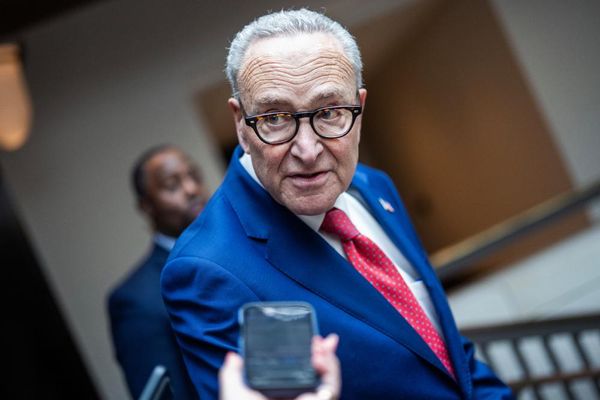
- Joe Manchin, a Democratic senator of West Virginia, said he was open to compromise on a federal voting bill. There’s a lot in Manchin’s compromise that his fellow Democrats will likely get behind, but even a bill incorporating the senators’ proposed changes is unlikely to get Republican votes.
- The House passed a measure to establish Juneteenth a federal holiday, commemorating the end of slavery in the US. The Senate unanimously passed the measure yesterday, and it is now headed to the White House where Joe Biden is expected to sign it. Fourteen House Republicans voted against it.
– Joan E Greve and Maanvi Singh
The House passed a measure to establish Juneteenth a federal holiday, commemorating the end of slavery in the US.
The Senate unanimously passed the measure yesterday, and it is now headed to the White House where Joe Biden is expected to sign it. Fourteen Republicans voted against it.
About 60% of Americans knew “nothing at all” or just “a little bit” about Juneteenth, according to a Gallup poll released Tuesday. And federal recognition of Juneteenth comes as Republican officials across the country move to ban schools from teaching students “critical race theory”, the history of slavery and the ongoing impacts of systemic racism.
Joe Manchin, a Democratic senator of West Virginia, said he was open to compromise on a federal voting bill.
The moderate senator has been a holdout, blocking Demoocrats’ efforts to pass the sweeping For the People Act voting rights bill. He has also resisted calls to change filibuster rules so that the narrower John Lewis Voting Rights Advancement Act – which he supports – can pass despite Republican opposition.
Manchin’s compromise proposal includes support for making Election Day a public holiday, offering automatic voter registration via state departments of motor vehicles, 15 days of early voting, and expansions to mail-in voting – all major Democratic priorities. Other provisions in Manchin’s plan scale back campaign finance reforms that other Democrats have backed.
There’s a lot in Manchin’s compromise that his fellow Democrats will likely get behind, but even a bill incorporating the senators’ proposed changes is unlikely to get Republican votes. With the current filibuster rules in place, Democrats would still need to win over 10 Republicans in order to get any voting rights measure passed.
During a Zoom event for supporters hosted by the centrist political group No Labels, Manchin said he needed Republicans to work with him and other Democrats on some measures – including the effort to establish a bipartisan commission on the 6 January capitol riots –to prove that cross-party collaboration was possible, the Intercept reports.
Updated
The Delta variant is spreading. What does it mean for the US?
Scientists in the United States are anxiously watching the Delta variant of Covid-19, as it spreads through an unevenly vaccinated American public and an economy that is rapidly reopening.
The Delta variant, first identified as B.1.617.2 in India, is believed to be more transmissible than both the original strain of Covid-19 and the Alpha strain, first identified in the United Kingdom.
“We’ve moved [Delta] to the top of our list of variants to study,” said Andrew Pekosz, a professor in Johns Hopkins University’s molecular microbiology and immunology department, and an expert in how viruses interact with the respiratory system.
“The data out of the UK showing how quickly the Delta variant became the dominant variant there is strong evidence that it is more transmissible than the Alpha variant, which we already thought was more transmissible than the original lineages,” said Pekosz.
The Delta variant is spreading at an uncertain time in the US. Covid-19 cases have fallen far below the winter peak, from an average of more than 250,000 new diagnoses a day in January to about 14,000 a day in June. Fewer cases have coincided with fewer hospitalizations and deaths.
This has led state after state to lift all social distancing guidelines, including in California, which gave the green light to large indoor gatherings such as sporting events. Now, social distancing and mask requirements are largely operating on the honor system.
But, even as pandemic guidelines recede, Delta has roughly doubled every two weeks in the US, a pattern once followed by Alpha, the variant first discovered in the UK, which eventually came to represent the vast majority of new US infections. The Delta variant has also delayed the UK’s planned reopening.
According to the CDC, at the end of May Alpha represented almost 70% of infections in the US. But in mid-March, it represented only 26% of cases. Similarly, Delta once represented only 2.5% of cases of Covid-19 by mid-May. But two weeks before that, it represented only 1.3% of cases. Again, two weeks before that in April, it represented just 0.6% of cases.
The doubling of cases has led some, such as the former Food and Drug Administration (FDA) commissioner Dr Scott Gottlieb, to predict that Delta may represent as much as 10% of US cases by mid-June.
The CDC officially elevated Delta to a “variant of concern” this week. A “variant of concern” designation puts Delta in the same category of increased surveillance as Alpha and Gamma (the variant first identified in Brazil).
Read more:
What we learned from the Biden-Putin summit in Geneva
1) The weird and unpredictable Trump era is over. In 2018 Donald Trump held a disastrous summit with Putin in the Finnish capital Helsinki. The then US president said he believed Putin’s assurances that Moscow did not interfere in the 2016 US election with a joint press conference that was so humiliating for America that Trump’s senior adviser Fiona Hill considered bringing it to a close by whacking a fire alarm or faking a medical emergency.
In Geneva, by contrast, cool normality was on display. Biden was well prepared for the US-Russia summit. He cut a relaxed figure, telling Putin he wanted a “predictable” relationship after a period defined by rogue Kremlin behaviour. The summit flowed along conventional diplomatic lines: a handshake, several hours of intensive talks and separate press conferences afterwards. The ghost of Helsinki was exorcised. There will be an agreed record of what was discussed, unlike in 2018 when Trump met Putin alone, without aides or even Trump’s own interpreter. We don’t know what was said.
2) Putin’s view of Washington is (still) negative. Over the last two decades he has met five serving American presidents. Throughout Putin has nursed a list of geopolitical grudges: Nato expansion, alleged US meddling in Russia’s internal affairs, and its “hypocritical” behaviour as shown in Iraq and elsewhere. On Wednesday Putin hit back at claims Moscow was behind cyber-hacking, and suggested Russia wasn’t even on a list of nations responsible. He also complained about the “bloody coup” in Ukraine in 2014, which he believes the US instigated.
As in cold war times, Putin sees America as an adversary and global rival. The Geneva summit allowed Putin to present himself at home as Biden’s equal on the international stage. Despite modest progress at the talks, Putin is unlikely to yield to US pressure. He will continue to repress opponents and made clear he has no sympathy with the jailed opposition leader Alexei Navalny. Nor will he make concessions over Ukraine, a country intrinsic to Russia’s “great power” ideology and which Putin sees as his back yard. In recent years the Kremlin has waged a deniable almost-war against the west, featuring cyber-attacks, political interference and flamboyant state murder. Expect these wrecking tactics to continue.
3) The summit achieved some concrete results. Expectations ahead of Wednesday’s meeting were low given the poor state of bilateral relations. In the end, the obvious and easy “deliverables” were achieved. One was to normalise the situation of Russia and America’s ambassadors. The Russian ambassador to Washington was recalled after Biden described Putin as a “killer”. The US envoy to Moscow, John Sullivan, also went back in April to the US. Both will now return to their respective embassies, allowing diplomatic life to resume.
There will also be consultations between the US state department and the Russian foreign ministry on a range of issues including the Start III nuclear treaty, due to expire in 2024, and cybersecurity. Seemingly there was no progress in the cases of former marines Trevor Reed and Paul Whelan, both sentenced to long jail terms in Moscow on dubious charges. The Kremlin has offered to swap the two Americans for Konstantin Yaroshenko, a Russian pilot charged by the US with drug smuggling.
Read more:
Governor signs law allowing Texans to carry handguns without a license
Texas governor Greg Abbott has signed a law allowing residents to carry handguns without a license or training starting in September.
My colleague Erum Salam wrote about the controversial law in April:
The law mirrors measures passed in 20 other states. It comes at the heels of several mass shootings around the country, and in Texas. In April, a man in Bryan, Texas opened fire at the cabinet company where he used to work, killing one person and injuring five people.
The justice department threw out a Trump-era ruling that made it virtually impossible for immigrants fleeing domestic violence to seek asylum in the US.
The former attorney general Jeff Sessions had overruled a previous court decision that people facing domestic violence in their home countries were eligible for asylum. Today, the justice department “vacated” that decision. Attorney general Merrick Garland wrote that questions about which groups be considered for asylum “should instead be left to the forthcoming rulemaking, where they can be resolved with the benefit of a full record and public comment.”
Garland’s move had been celebrated by immigrant rights advocates. “Around the world, in Central America and elsewhere, women struggle to have governments ensure, or in some cases recognize, their right to protection,” Human Rights Watch said in a statement.
Updated
Academics: Breyer must retire from supreme court
A group of 18 legal academics has issued an extraordinary joint letter urging US supreme court justice Stephen Breyer to retire so that Joe Biden can name his successor.

The intervention came after Mitch McConnell, the Republican minority leader in the Senate, warned that Biden will not get a supreme court nominee confirmed in 2024 if Republicans regain control of the chamber and a vacancy arises. McConnell also indicated that he would not confirm a justice in 2023.
With conservatives holding a 6-3 majority on the court, progressives have been calling for the liberal Breyer, who at 82 is the oldest member on the bench, to step down while Democrats narrowly control the Senate.
“It is time for supreme court justice Stephen Breyer to announce his intent to retire,” the legal scholars say in a statement. “Breyer is a remarkable jurist, but with future control of a closely divided Senate uncertain, it is best for the country that President Biden have the opportunity to nominate a successor without delay.”
The signatories include Niko Bowie of Harvard Law School, Erwin Chemerinsky and David Singh Grewal of the University of California Berkeley School of Law, Daniel Morales of the University of Houston Law Center, Samuel Moyn of Yale Law School, Zephyr Teachout of Fordham University and Miranda Yaver of Oberlin College.
The statement was released by Demand Justice, a progressive group mounting a concerted campaign to make Breyer consider his position, with everything from reproductive rights to voting rights and gun control potentially at stake.
This week it is among 13 liberal groups, including Black Lives Matter, the Sunrise Movement and Women’s March, publishing an advertisement in prominent media outlets. It says: “Supreme court justice Stephen Breyer should immediately announce his intent to retire from the bench.
“With future control of a closely divided Senate uncertain, President Biden must have the opportunity to nominate a successor without delay and fulfill his pledge to put the first Black woman on the supreme court.”
The ad concludes: “If Breyer were replaced by an additional ultra-conservative justice, an even further-right supreme court would leave our democracy and the rights of marginalised communities at even greater risk. For the good of the country, now is the time to step aside.”
Today so far
That’s it from me today. My west coast colleague, Maanvi Singh, will take over the blog for the next few hours.
Here’s where the day stands so far:
- Joe Biden and Vladimir Putin held their summit in Geneva, Switzerland. The talks between the US and Russian presidents wrapped up after about three hours, and the two leaders then held solo press conferences before leaving the city.
- Putin described the talks as “quite constructive” with “no hostility” between the two sides. At his press conference, Putin said he and Biden agreed to “begin consultations” on cybersecurity, following a series of recent Russia-based cyberattacks against major corporations.
- Biden expressed satisfaction with the accomplishments of the summit, saying, “I did what I came to do.” However, Biden also disparaged Putin for comparing the jailing of critics, like Russian opposition leader Alexei Navalny, to charges filed against the rioters who carried out the Capitol insurrection on 6 January. “I think that’s a ridiculous comparison,” Biden told reporters in Geneva.
- Biden later said he believes Russia is in “a very, very difficult spot right now”. Answering a few reporters’ questions before boarding Air Force One to return to Washington, Biden said of Russia, “They are being squeezed by China. They want desperately to remain a major power.” He also argued the world has reached “a fundamental inflection point about what it’s going to look like 10 years from now”.
Maanvi will have more coming up, so stay tuned.
Updated
DoJ moves to drop lawsuit over Bolton's tell-all book - reports
As Joe Biden returns to Washington, the justice department has reportedly decided to drop a lawsuit against Donald Trump’s former national security adviser, John Bolton.
The lawsuit, initiated by the Trump administration, accused Bolton of disclosing classified information in his tell-all book, which painted an unflattering picture of the former president.
The New York Times reports:
The Justice Department has closed its criminal investigation into whether a disparaging memoir by [Bolton] illegally disclosed classified information, and it is finalizing a deal to drop its lawsuit aimed at recouping profits from the book, according to two people briefed on the matter.
The agreement would end an effort that began under the Trump administration to silence Mr. Bolton and sue him over the book’s profits. Ending both the inquiry and the lawsuit is a clear rebuke by Attorney General Merrick B. Garland of the Trump Justice Department’s tactics in the matter.
The details of the agreement were unclear. A settlement by the Justice Department is likely to shield Trump administration officials from being forced to answer questions under oath about their time in office. A federal judge had given Mr. Bolton’s lawyer, Charles J. Cooper, approval to begin deposing those officials, but a settlement would end that litigation.
Bolton celebrated the news, telling Axios, “This is a complete vindication. ... They’re just giving up.”
For Joe Biden, the Geneva summit was designed as the anti-Helsinki, a chance to show that he would not be taken advantage of by Vladimir Putin like Donald Trump had in Finland in 2018.
That meeting went so poorly that Fiona Hill, a former Trump adviser, said she considered faking a medical emergency or pulling a fire alarm to end the press conference.
Biden and Putin’s summit went about as well as it could have. Speaking after the four-hour talks, Putin praised Biden’s “moral values” and called the talks “extremely constructive”, while calling their relationship a “pragmatic one”.
He still peppered his remarks with claims that the US was funding his opposition and appeared to sympathise with the Capitol Hill rioters (Biden called it “ridiculous” to compare them to Russia’s opposition). But there was hope, however ephemeral, for progress. “There is no happiness in life, only glimmers of it. Cherish them,” Putin said, paraphrasing Tolstoy. He looked rather upbeat.
Biden, who spoke second, said he believed that Putin “was not looking for a cold war”. “It was important to meet in person. I did what I came to do,” said Biden.
The CNBC camera crew in Geneva captured Vladimir Putin’s departure from the Swiss city after he met with Joe Biden today.
Vladimir Putin leaves Geneva. Here’s his motorcade rolling by our camera position a short time ago: pic.twitter.com/mvaehzM3Ox
— Eamon Javers (@EamonJavers) June 16, 2021
During his solo press conference today, Putin described the summit as “quite constructive” and praised Biden as an “experienced statesman”.
However, he also deflected criticism of his human rights record by unfairly comparing his jailing of political opponents to the charges filed against the rioters who carried out the January 6 insurrection.
CNN reporter Kaitlan Collins said she appreciated Joe Biden’s apology for his abrasive tone when answering her question about his summit with Vladimir Putin.
But Collins said she also considered the president’s apology to be “completely unnecessary”.
—@KaitlanCollins says she was just doing her job & Biden apologizing was "completely unnecessary."
— Oliver Darcy (@oliverdarcy) June 16, 2021
"He did not have to apologize, though I do appreciate he did."
Collins adds that "asking the president a question does not mean it has a negative slant or a positive slant." pic.twitter.com/PoN2uxzpxV
Collins emphasized that her question to Biden about why he was confident Putin would change his aggressive behavior on the world stage was part of “just doing my job”.
“Asking the president a question does not mean it has a negative slant or a positive slant,” Collins said. “It is simply a way to get into the president’s mindset of how he is viewing something.”
Updated
During his “jet talk,” Joe Biden also apologized for getting frustrated by a question asked by CNN reporter Kaitlan Collins at the end of his press conference in Geneva.
“Look, to be a good reporter, you’ve got to be negative. You’ve got to have a negative view of life, okay, it seems to me. The way you all, you never ask a positive question,” Biden said. He later added, “I apologize for having been short.”
"Look, to be a good reporter, you've gotta be negative. You've gotta have a negative view of life, it seems to me ... I apologize for having been short" -- Biden on Kaitlan Collins's question and his response to it pic.twitter.com/2mHvKkPz7X
— Aaron Rupar (@atrupar) June 16, 2021
Collins asked the US president why he seemed so confident that Vladimir Putin would change his behavior when he seems to have continued his aggressive actions since Biden took office.
“I’m not confident,” Biden said. “Where the hell -- what do you do all the time? When did I say I was confident?”
Biden went on to say that he believed the global response to Putin’s aggressive behavior would put pressure on him to alter his approach to foreign policy.
Q: "Why are you so confident he'll change his behavior, Mr. President?"
— CSPAN (@cspan) June 16, 2021
President Biden: "I'm not confident...Where he hell--what do you do all the time? When did I say I was confident? I said..." pic.twitter.com/5kKNx7Eull
Updated
Biden – 'Russia is in a very, very difficult spot right now'
More from Joe Biden’s jet talk just now – if talking to reporters before boarding Air Force One is his equivalent of Donald Trump’s preferred “chopper talk” tactic, which allowed him to blame the rotors of Marine One if he needed to not hear a question.

“Russia is in a very, very difficult spot right now,” Biden said, after his meeting with Vladimir Putin in Geneva, responding to questions about why Russia might now want to cooperate with the US. “They are being squeezed by China. They want desperately to remain a major power.”
Biden also told reporters he was “of the view that in the last three to five years the world has reached a fundamental inflection point about what it’s going to look like 10 years from now.
“I mean that literally, I think it’s a genuine reality, many countries around the world are wondering, ‘How do I maintain and sustain my leadership in the world? The US is doing it.”
He also spoke about domestic issues, saying of one subject that Putin brought up in his own remarks to the press earlier, the Capitol riot of 6 January, “I never thought we would have people breaking down the doors of the Capitol. It reinforced what I have always known, that every generation has to re-establish the fight for democracy.
“And I have never seen such an outward assault on voting rights. There’s a lot at stake … as long as I’m president we are going to stick to the notion that we are open, accountable and transparent.”
Speaking of voting rights and the politics to which Biden will now return:
Speaking to reporters by Air Force One in Geneva, Joe Biden has expressed regret for some sharp words to a reporter who questioned him about the success of his summit with Vladimir Putin.
Here’s the AP’s take:
The initial exchange came at the press conference after the meeting. When a reporter asked Biden how he could consider the summit a success when Putin came out of it still denying responsibility for cyberattacks or other alleged wrongdoing, Biden shot back, “If you can’t understand that you’re in the wrong business.”
But Biden came over to reporters before getting on Air Force One, telling them he had been a “wise guy” and expressing regret for being “short”.
Biden also spoke positively about the summit and his meetings with allies on his weeklong trip to Europe, which was meant in part to show the US engaging again after Donald Trump’s withdrawal from US allies.
“I think we, the country, has put a different face on where we’ve been and where we’re going,” Biden said.
Updated
Democrats ready to advance infrastructure plans on their own – report
In Washington, Democrats are reportedly ready to ditch attempts to work with Republicans on Joe Biden’s infrastructure proposals – even as Biden continues to work with GOP moderates on a scaled-back, $1tn plan.
The Associated Press reports that though “top White House adviser” Steve Richetti has attempted to keep Democrats in Congress onside, Senate majority leader Chuck Schumer is moving ahead with the budget committee to prepare for a July vote on Biden’s $1.7tn American Jobs Plan and $1.8tn American Families Plan. It will be under the rules of reconciliation – meaning just 50 votes plus Vice-President Kamala Harris as the tiebreaker will suffice for success.
Biden’s coronavirus rescue and stimulus package passed that way in March – without a single Republican vote and with Joe Manchin of West Virginia, who has emerged as a hate figure on the left of the Democratic party, enjoying immense influence in shaping its contents given his ability to sink legislation by siding with the GOP if he so chooses.
“We’ll see where we’re going to go after a week or 10 days [of] more dialogue and negotiation [with Republicans],” Ricchetti said on Tuesday, according to a transcript of a private caucus meeting obtained by the AP.
A bipartisan group of 10 senators has closed on a nearly $1tn deal covering traditional infrastructure projects, without the family-related investments in childcare and other needs that Ricchetti said remain a top priority. Republicans reject those investments as costly and unnecessary.
“Just ask a working mom if childcare is part of her family’s infrastructure,” Senator Debbie Stabenow, of Michigan, told the AP. “Ask a family with an aging parent who needs help to live at home safely if home care is infrastructure. We understand that it is.”
On Tuesday, the bipartisan group presented their proposal to colleagues at closed-door Senate lunches. According to the AP, they “met with mixed reviews”.
Back in Washington, a contender for headline of the day from MSNBC’s Maddowblog.
Trumpets please…
Defying irony, GOP alleges White House ‘weakness’ toward Russia
Blogger Steve Benen begins:
President Joe Biden sat down in Geneva this morning with Russian president Vladimir Putin … as the meeting got under way, the Republican National Committee issued a press statement, letting reporters know the party’s takeaway from the international gathering.
“Giving Putin a meeting is just the latest win that Joe Biden has handed Russia,” the RNC said.
I can appreciate ironic humor as much as the next blogger, but it’s a bit jarring to see Republicans decide that they’re actually the tough-on-Russia party – as if the last four years were little more than a pesky mirage that didn’t really count.
Where to start on those last four years, or how to even start to hint at the sheer chutzpah – the sheer balls, in the sense of both “courage” and “absolute nonsense” – of the RNC’s approach? This might do for starters:
Joe Biden chose not to answer a question about whether he has reconsidered his comment that Vladimir Putin doesn’t have a “soul,” as he claimed after a 2011 meeting with the Russian leader.
Instead, Biden just put on his aviator sunglasses and started walking away from the podium, telling reporters, “Thank you very much.”
Biden smiles, puts on his aviators, and responds "thank you very much" after being asked about his infamous Putin/eyes/soul comment and if he has a better understanding of the Russian pres. after today pic.twitter.com/xYfYT1oH2P
— Christian Datoc (@TocRadio) June 16, 2021
But as the president moved away from the podium, he took another couple questions. He seemed to grow agitated when a reporter asked why he is so confident that Putin will change his behavior.
Biden claimed that was a mischaracterization of his comments, saying, “I’m not confident he’ll change his behavior.” He instead argued that the global response to Russia’s actions would put pressure on Putin to change.
Biden’s press conference has now concluded after about 30 minutes.
Biden rejects Putin's 'ridiculous comparison' between Capitol rioters and Navalny
Joe Biden was asked to respond to Vladimir Putin comparing his jailing of political opponents, like Alexei Navalny, to the charges filed against those who carried out the January 6 insurrection.
“I think that’s a ridiculous comparison,” Biden told reporters in Geneva.
The US president emphasized there was a great difference between storming the Capitol with weapons and threatening law enforcement officers versus marching for the right to hold free and fair elections.
During his own press conference earlier today, Putin used that unfair comparison to deflect a question about why so many of his critics are either imprisoned or dead.
Joe Biden downplayed the fact that his summit with Vladimir Putin was shorter than the White House had initially anticipated.
The talks between Biden and Putin lasted for about three hours, while White House officials said they expected the summit to wrap up after four to five hours.
Biden emphasized it was a remarkable feat for the two world leaders to come together for any length of time, and they felt satisfied with the discussion after a couple hours.
Confirming Putin’s earlier remarks about the respectful tone of the meetings, Biden said, “There were no threats.”
A reporter asked Joe Biden if he outlined for Vladimir Putin how his administration would respond if there were a Russian cyberattack on critical US infrastructure.
“I pointed out to him that we have significant cyber capability, and he knows it,” Biden said. “I pointed out, if they violate basic norms, we will respond.”
Biden noted he gave the Russian president a list of 16 critical infrastructure entities that should be off limits for attacks, whether cyber or otherwise.
The US president seemed somewhat confident that Putin would adhere to his warnings, saying, “I think the last thing he wants now is a cold war.”
Joe Biden wrapped up his prepared remarks, and he started taking questions from reporters about his summit with Vladimir Putin.
An AP reporter asked Biden how it would impact US-Russian relations if opposition leader Alexei Navalny died in prison. Putin has refused to guarantee Navalny’s safety in prison.
“I made it clear to him the consequences would be devastating for Russia,” Biden said of Navalny’s potential death.
'I did what I came to do,' Biden says of Putin summit
Joe Biden said he and Vladimir Putin had achieved a great deal during their summit today in Geneva, Switzerland.
Specifically, Biden said he raised specific human rights concerns that his administration has, including the treatment of Russian opposition leader Alexei Navalny.
The two leaders also discussed working together in dealing with Iran, and they addressed the withdrawal of US troops from Afghanistan.
On the issue of Ukraine, Biden said he expressed his administration’s “unwavering commitment to the sovereignty and territorial integrity of Ukraine”.
Biden described the tone of the summit as “positive.” He added, “I did what I came to do.”
Our agenda is 'for the American people,' Biden says after Putin summit
Joe Biden is now holding his solo press conference after his summit with Russian president Vladimir Putin in Geneva, Switzerland.
“I told Putin our agenda is not against Russia or anyone else. It is for the American people,” Biden told reporters.
The US president noted he emphasized the importance of human rights in his meetings with Putin. He also raised the issue of potentially releasing Paul Whelan and Trevor Reed, two former US Marines who are currently imprisoned in Russia.
“Human rights is going to always be on the table, I told him,” Biden said.
Joe Biden gave Vladimir Putin two gifts representing American culture as part of their summit in Geneva, the White House said.
According to the latest White House press pool report, Biden gave the Russian president “a pair of custom Aviators made by Randolph USA” and a “crystal sculpture of an American Bison”.
The American president is frequently photographed wearing his own aviator sunglasses while he is traveling.

The EU should prepare for “a further downturn” in its relations with Vladimir Putin’s Russia, the bloc’s top diplomat has warned.
As Joe Biden and Putin talked at a lakeside mansion in Geneva, the EU’s foreign policy chief, Josep Borrell, unveiled a strategy aimed at charting a course for EU-Russia relations. Ties between the two sides have hit a post-cold war low following Kremlin-orchestrated cyber-attacks and election interference, the frozen conflict in eastern Ukraine, and the poisoning and jailing of opposition politician Alexei Navalny.
“We believe that a renewed partnership allowing us to realise the full potential of a close cooperation with Russia is a distant prospect,” Borrell told reporters. “The EU therefore needs to be realistic and prepare for a further downturn of our relations with Russia, which are right now at the lowest level. And this further downturn is the most likely outlook for the time being.”
While Brussels has faced calls to tighten sanctions on Putin’s inner circle, Borrell said he hoped to avoid further restrictive measures, because it would signal a continuing deterioration of relations. “I would try to do my best in order to avoid it, showing at the same time the necessary strength to push back and constrain and the will to engage when necessary.”
Today so far
Here’s where the day stands so far:
- Joe Biden and Vladimir Putin held their summit in Geneva, Switzerland. The talks between the US and Russian presidents wrapped up after about three hours, even though the White House had predicted the summit would last for four to five hours.
- Putin described the talks as “quite constructive” with “no hostility” between the two sides. At his solo press conference after the summit concluded, Putin said he and Biden agreed to “begin consultations” on cybersecurity, following a series of recent Russia-based cyberattacks against major corporations.
- Biden will soon hold his own solo press conference to take questions about the summit. The US president will likely be asked to respond to Putin’s criticism of the US in his press conference, during which the Russian president engaged in whataboutism to deflect criticism of his human rights record.
Biden will soon begin his press conference, and the live blog will have updates and analysis once it starts, so stay tuned.
Vladimir Putin concluded his press conference after about an hour, taking a number of questions from Russian and international reporters.
Joe Biden will soon hold his own solo press conference just down the street from where Putin was speaking in Geneva. Stay tuned.
No surprise here: Vladimir Putin said Joe Biden did not invite him to the White House, and the Russian president did not extend any invitation of his own.
Elaborating a bit on Biden’s negotiating style, Putin described the US president as a “very constructive” and “balanced” politician.
Putin said he believed he and Biden were speaking “the same language” in their meeting, but he added that they didn’t form any kind of lasting friendship either.
Putin unfairly equates his jailing of political opponents to charges filed against Capitol rioters
An American reporter, Rachel Scott of ABC News, asked Vladimir Putin about how he has responded to political opposition in Russia.
Scott said to Putin, “The list of your political opponents who are dead, imprisoned or jailed is long. ... My question is, Mr President, what are you so afraid of?”
.@ABC News' @rachelvscott to Russian Pres. Putin: "The list of your political opponents who are dead, imprisoned or jailed is long...and you have now prevented anyone who supports [Alexey Navalny] to run for office.
— ABC News (@ABC) June 16, 2021
"So my question is, Mr. President: what are you so afraid of?" pic.twitter.com/EMNnaRLLbO
Putin responded by equating his jailing of critics like Alexei Navalny to the charges filed against the rioters who participated in the Capitol insurrection, which resulted in five deaths.
The Russian president claimed the insurrectionists had gone to the Capitol with “political demands” and were subsequently jailed for being so.
That is, of course, a gross mischaracterization. Navalny and his supporters are fighting for free and fair elections in Russia, while the Capitol insurrectionists were attempting to overturn the results of a free and fair election in the US.
Updated
Vladimir Putin described Joe Biden as an “experienced statesman,” and he contrasted the current US president from his predecessor, Donald Trump.
“He is very different from President Trump,” Putin said.
Vladimir Putin: "President Biden is an experienced statesmen … He is very different from President Trump." pic.twitter.com/dDgWFhgM2w
— The Recount (@therecount) June 16, 2021
Trump met with Putin in Helsinki in 2018, and afterwards, the US president sided with the Russian leader over his own intelligence community on the issue on interference in the 2016 election.
Trump’s performance at the Helsinki press conference sparked international criticism and widespread embarrassment in the US.
Vladimir Putin pushed back against criticism of his human rights record by condemning the US for gun violence and drone strikes.
Consistent with his defensive nature, the Russian president argued the US had much to answer for when it comes to respecting human rights, specifically pointing to Guantanamo Bay as an example.
Joe Biden has previously described Putin as a “killer,” but the Russian leader emphasized that people are shot to death every day in major US cities.
“Who is the killer?” Putin asked, according to a translation of his remarks.
Vladimir Putin bristled against a question about Alexei Navalny, the imprisoned opposition leader who was previously poisoned with a nerve agent.
Putin refused to even say Navalny’s name, instead referring to him simply as “this man”. The Russian president also accused Navalny of “deliberately” breaking the law.
In an interview this week, Putin refused to guarantee Navalny’s safety in prison, and Joe Biden warned the opposition leader’s death would be very detrimental to US-Russian relations.
Putin describes talks with Biden as 'quite constructive'
Taking a question from CNN, Vladimir Putin was asked whether the talks between him and Joe Biden were hostile in nature.
“I think there was no hostility. Quite the contrary,” Putin said, according to the translation of his comments.
The Russian president insisted the talks were in fact “quite constructive,” with both sides showing a “willingness to understand one another”.
Putin added that he and Biden agreed to “begin consultations” on cybersecurity. The White House had indicated Biden would raise the issue of recent cyberattacks against major corporations during his meeting with Putin.
Vladimir Putin says "we agreed that we would begin consultations" with the U.S. over cyber security, following multiple attacks on U.S. firms by Russian-linked hackers. pic.twitter.com/0VjhTiGODf
— CBS Evening News (@CBSEveningNews) June 16, 2021
Updated
Putin says he and Biden agreed ambassadors should return to posts
Vladimir Putin is now holding his solo press conference in Geneva, taking questions from Russian reporters after his summit with Joe Biden.
The Russian president told the media that he and Biden had agreed their ambassadors should return to their respective posts and resume their diplomatic duties.
The Russian ambassador to the US, Anatoly Antonov, and the US ambassador to Russia, John Sullivan, had been in their home countries for the past several months because of heightened tensions between the two nations.
The White House had initially said that the expanded bilateral meeting, the second session of Joe Biden and Vladimir Putin’s summit, would be broken into two parts.
However, it seems that did not happen, as the expanded bilateral meeting only lasted about an hour. That shorter meeting is why the talks wrapped up in about three hours, rather than the four to five hours that the White House had anticipated.
Biden and Putin will soon hold separate press conferences, and they will almost certainly be asked why the summit wrapped up so quickly.
Joe Biden has left Villa la Grange in Geneva, after his summit with Vladimir Putin concluded about 30 minutes ago.
JUST IN: Pres. Biden departs after high-stakes summit with Russian Pres. Vladimir Putin; press conference expected to follow.
— ABC News (@ABC) June 16, 2021
LIVE UPDATES: https://t.co/oU2NdPiY8k pic.twitter.com/SHUWkmhJug
The US president will soon be holding a press conference down the street, while Putin will speak to reporters first. Putin’s presser should start at any moment, so stay tuned.
Biden-Putin summit concludes after about three hours
Joe Biden and Vladimir Putin’s summit has now concluded in Geneva, after about three hours of talks between the US and Russian presidents.
The expanded bilateral meeting, which several of the presidents’ aides participated in, wrapped up after a little over an hour. The smaller first session of talks lasted about an hour and a half.
The White House had initially said the talks would last between four to five hours, so the summit was actually shorter than what Biden’s team was expecting.
Biden and Putin will now hold separate press conferences to take questions about the summit, so stay tuned.
A former longtime White House correspondent said today’s chaotic media scrum at the beginning of Joe Biden and Vladimir Putin’s summit reminded him of Ronald Reagan and Mikhail Gorbachev’s Geneva meeting in 1985.
Photo-op was also jammed and chaotic at first Reagan-Gorbachev Summit in Geneva in 1985. pic.twitter.com/5dA4YPLcsN
— Mark Knoller (@markknoller) June 16, 2021
The media was let in at the start of the summit today, and the room was so jam-packed that some reporters ended up clashing with Russian security officers.
According to the White House press pool report, “Journalists pushed and shoved, yelling at each other to move but no one did. After just a minute or two, Russian security pulled the red rope separating the media from the leaders back to try to keep them away from the presidents.
“Russian security yelled at journalists to get out and began pushing journalists. Journalists and White House officials screamed back that the Russian security should stop touching us. Your pooler was pushed multiple times, nearly to the ground, as many poolers tripped over the red rope, which was now almost to the ground.”
A Russian state-owned media agency has shared a photo of Joe Biden and Vladimir Putin’s expanded bilateral meeting, which started about an hour ago.
Первые кадры с расширенных переговоров Президентов России и США Владимира Путина и Джозефа Байдена
— МИД России 🇷🇺 (@MID_RF) June 16, 2021
📸 @rian_ru pic.twitter.com/y5nwV4Uu3s
National security adviser Jake Sullivan and Victoria Nuland, the undersecretary of state for political affairs, are among the US officials participating in the second session of the summit.
Away from Geneva, the Guardian’s Sam Levine reports on the rise in threats against election officials:
One in three election officials feel unsafe in their jobs, according to a new report released Wednesday by the Brennan Center for Justice. One in five election workers said threats to their lives were a concern related to their job.
Nearly 8 in 10 of the election officials surveyed said social media, a hotbed of disinformation about elections, made it harder to to do their jobs. More than half said they believed social media had made their jobs more dangerous. The findings were based on a survey of 233 election officials with an overall margin of error of 6.4%.
The report underscores the enormous pressure election officials across the country came under both during the 2020 election and in its aftermath. As Donald Trump and allies fueled baseless conspiracy theories about the election, the officials responsible for overseeing election administration often became the target of supporters’ rage. Workers were followed, faced death threats, and were harassed at home.
The Brennan Center report recommends that the Justice Department set up a task force specifically focused on protecting election workers. Attorney General Merrick Garland signaled the department was paying attention to the issue during a speech last week.
“We have not been blind to the dramatic increase in menacing and violent threats against all manner of state and local election workers, ranging from the highest administrators to volunteer poll workers,” he said. “Such threats undermine our electoral process and violate a myriad of federal laws.”
The Brennan Center report also recommends states pass new laws and allocate funding towards protecting election workers. States should also prioritize investigating threats against election officials and pass new laws that protect officials from undue partisan interference, the report says.
Second session of Biden-Putin summit begins
The second session of Joe Biden and Vladimir Putin’s summit in Geneva has now started after a 45-minute break, a White House official confirmed to the press pool.
This expanded bilateral meeting will include more of the two leaders’ senior aides in comparison to the first session.
Only Biden, Putin, US secretary of state Antony Blinken, Russian foreign minister Sergey Lavrov and interpreters participated in the first round of talks.
The second session is expected to last a few hours, and Biden will then hold a solo press conference after the summit concludes. Stay tuned.
Updated
House minority leader Kevin McCarthy called on Joe Biden to demand the release of former Marine Trevor Reed during the president’s summit with Vladimir Putin.
“This morning, President Biden has the opportunity to demand Trevor Reed’s release from Putin himself. I stand in solidarity with Trevor’s parents, his family and friends, and my fellow Members of Congress in calling for his safe return,” the Republican leader said in Twitter. “It’s time to bring Trevor home safely.”
This morning, President Biden has the opportunity to demand Trevor Reed's release from Putin himself. I stand in solidarity with Trevor's parents, his family and friends, and my fellow Members of Congress in calling for his safe return.
— Kevin McCarthy (@GOPLeader) June 16, 2021
It's time to bring Trevor home safely.
Last year, Russian court sentenced Reed to nine years in prison on charges of assaulting a police officer while drunk.
The Guardian’s Andrew Roth reported last July:
Reed, 29, was convicted of endangering the lives of police officers during an incident last August that he says he cannot remember.
After being detained for public drunkenness following a party, he was accused of hitting one police officer and pulling at the arm of another who was driving a police car, potentially causing an accident.
Most of the evidence in the trial has been disputed. Reed was alone with the police officers when the alleged incident took place.
Reed is the second former US marine to be sentenced to a lengthy prison term in Russia this summer. In June, a court convicted Paul Whelan of espionage and sentenced him to 16 years in a high-security prison.
Whelan is seen as a likely bargaining chip in a trade for several Russian nationals serving prison terms in the US. His Russian lawyer, Vladimir Zherebenkov, said he could be exchanged for Viktor Bout, a Russian arms dealer serving 25 years in a US prison.
Biden and Putin's first session concludes
The first session of Joe Biden and Vladimir Putin’s summit has concluded after about an hour and a half, the White House told the press pool.
The first session was a very small meeting, with just the two leaders, US secretary of state Antony Blinken, Russian foreign minister Sergey Lavrov and interpreters in attendance.
The next session will be somewhat larger, with more advisers joining Biden and Putin as they continue their talks in Geneva.
The summit is supposed to last about four to five hours in total, so stay tuned.
Here is the pool report from Anita Kumar, a Politico White House correspondent, about the chaos at the beginning of Joe Biden and Vladimir Putin’s summit:
The media scuffle was the most chaotic your pooler has seen at a presidential event in nine years. Journalists pushed and shoved, yelling at each other to move but no one did. After just a minute or two, Russian security pulled the red rope separating the media from the leaders back to try to keep them away from the presidents. Russian security yelled at journalists to get out and began pushing journalists. Journalists and White House officials screamed back that the Russian security should stop touching us. Your pooler was pushed multiple times, nearly to the ground, as many poolers tripped over the red rope, which was now almost to the ground.
Both presidents watched and listened to the media scuffle in front of them. They appeared amused by the scene. At one point, Biden leaned over and spoke to the interpreter and smiled.
Kumar shared a photo on Twitter of the two leaders looking on with bemusement as reporters and White House staffers clashed with Russian security officers:
Biden and Putin watch the media scuffle pic.twitter.com/8YB69A3Yvc
— Anita Kumar (@anitakumar01) June 16, 2021
The White House press secretary, Jen Psaki, echoed her colleague, saying Joe Biden was not responding to a reporter’s question when he nodded to the press at the start of his summit with Vladimir Putin.
“During a chaotic free for all with members of the press shouting questions over each other, the President gave a general head nod in the direction of the media. He wasn’t responding to any question or anything other than the chaos,” Psaki said in a statement.
Media chaos at the start of Biden-Putin summit
This is Joan Greve in Washington, taking over for Martin Belam.
Joe Biden’s summit with Vladimir Putin began with what one senior White House official called a “chaotic scrum with reporters shouting over each other” to throw questions at the two leaders.
The press pool’s chaotic jostling forced the White House communications director, Kate Bedingfield, to clarify one of Biden’s responses to a reporter’s question.
It was a chaotic scrum with reporters shouting over each other. @POTUS was very clearly not responding to any one question, but nodding in acknowledgment to the press generally. He said just two days ago in his presser: “verify, then trust.” https://t.co/5C9gP4XTtO
— Kate Bedingfield (@WHCommsDir) June 16, 2021
At one point during the scuffle, Biden appeared to nod when a reporter asked whether he trusted Putin. But Bedingfield said the nod was not in response to that specific question.
“It was a chaotic scrum with reporters shouting over each other. @POTUS was very clearly not responding to any one question, but nodding in acknowledgment to the press generally,” Bedingfield said on Twitter. “He said just two days ago in his presser: ‘verify, then trust.’”
Indeed, speaking to reporters on Monday, Biden said of Putin, “I’d verify first and then trust. In other words: Everything would have to be shown to be actually occurring. It’s not about, you know, trusting; it’s about agreeing.”
Today so far…
US president Joe Biden and Russian president Vladimir Putin are having what is expected to be a tense set of talks in Geneva.
- The two presidents arrived separately, and were each greeted by Swiss President Guy Parmelin before the three men appeared briefly together outside the venue, the Villa La Grange.
- Parmelin welcomed them to “the city of peace” and wished them “fruitful dialogue” in the best interests of both their countries and the world.
- The two leaders didn’t say much in front of the press, but Putin told Biden “Mr President, I’d like to thank you for your initiative to meet today,” and Biden replied “It is always better to meet face to face.”
- Talks are now expected to last four to five hours. Initially Biden and Putin will hold a relatively intimate meeting joined by US Secretary of State Antony Blinken and Russian Foreign Minister Sergey Lavrov. This will then be expanded to include more senior aides on each side.
- Topics will include strategic stability, cyber security, climate change and Covid. Putin and Biden also are expected to cover regional crises in Ukraine, Syria and Libya, as well as the Iranian nuclear program and Afghanistan. The treatment of Alexei Navalny, and detained former US marines Paul Whelan and Trevor Reed are also sure to be mentioned.
- Following talks there will be separate press appearances by Biden and Putin – scheduled not before noon New York time, 5pm London time, 6pm Geneva time. It is likely we may end the day with two contrasting narratives of how the talks went.
That’s it from me, Martin Belam. I’m handing over to Joan Greve now, and unlike Vladimir Putin, trapped in an international summit with the US president, I’m going to be able to watch Russia take on Finland at soccer in Euro 2020 which is just kicking off. I’ll see you soon.
Kevin Liptak and Phil Mattingly have been doing the online coverage duties at CNN, and they’ve had this to say:
Depending on its outcome, the meeting could shadow Biden as he returns home to help revive his domestic agenda. He arrived to the villa bolstered by support from western allies he spent the past week consulting ahead of his face-to-face with the Russian President, who arrived in Geneva Wednesday morning ahead of the summit.
In Biden’s telling, those leaders all backed him in his decision to meet Putin now, in the first six months of his presidency, before he’s had a chance to fully formulate a Russia strategy.
Still, skepticism abounds that anything can be accomplished. Instead, Biden is looking to open lines of communication with the notoriously shrewd Putin in the hopes of stalling further deterioration in relations between the United States and Moscow.
There are some areas Biden thinks he can work in harmony with Putin, including cooperation on nuclear arms, climate change and shared interest in renewing the Iran nuclear deal. And one outcome officials said was possible was an agreement to return their ambassadors back to Washington and Moscow after months with no senior diplomat in place in either country.
With the two leaders planning to do separate press events after the talks, it is also clear that we might get two very different narratives of how things went by the end of the day.
On more serious matters, there’s been a lot of noise in advance about what Joe Biden might say to Vladimir Putin about the treatment of Alexei Navalny, but there are also two former US Marines whose names are likely to crop up in the talks: Paul Whelan and Trevor Reed. As CBS News put it:
Last year, Paul Whelan was convicted by a Russian court of espionage and sentenced to 16 years in prison. Whelan, who also holds British, Irish and Canadian passports, was arrested in Moscow in December 2018. Prosecutors alleged he was working for American intelligence and was caught receiving a USB drive containing classified information. Whelan has denied he was a spy and said he was set up.
Trevor Reed also made a plea for freedom on Monday in audio obtained by CBS News. “I’ve spent my whole life in the service of my country and I would appreciate it if my country would bring me home,” he said. Reed was arrested in 2019 and charged with assaulting police officers after a drunken birthday party in Moscow. He was sentenced to nine years in prison.
It was recently reported that Reed has been suffering from Covid while in jail in Russia, and US consular access or contact with his family had been restricted.
My sympathies with whoever is running the Washington Post’s emails today, because they’ve just had to send out a corrected version which starts:
Correction: An earlier version of this newsletter had an error in the subject line. Russian President Vladimir Putin is meeting with President Biden, not with former president Donald Trump. The error has been corrected.
We’ve all done it.
The two leaders didn’t say much in front of the press, but Putin told Biden upon first meeting him “Mr President, I’d like to thank you for your initiative to meet today,” as he knew the US president “had a long trip and lots of work.”
But the Russian president emphasized that there are “lots of questions accumulated in Russia-US relations that require discussion on the highest level.”
Biden said the two leaders would try to determine areas of cooperation and mutual interest. “It is always better to meet face to face.”
Here’s a couple more of the pictures from inside the room.


Biden and Putin reappeared together inside the mansion’s book-lined library. The Russian president said he hoped for a “productive” dialogue. In comments part drowned out by journalists, Biden said he wanted “predictable” relations with Moscow, and to cooperate where the two great powers had “mutual interests”.

Biden appeared relaxed. In what has become a familiar pose Putin leaned back into his chair, legs sprawled. He seemed faintly bored. Aides then evicted a large press pack. The historic summit talks began in two by two format, with Biden flanked by US secretary of state Antony Blinken and Putin accompanied by his veteran foreign minister Sergei Lavrov.
Larger US-Russian delegations are scheduled to join later this afternoon. The Geneva talks are likely to last four or five hours.
Just a note for those of you interested in Covid precautions at the meeting, the acting chief of protocol for the Geneva region says staff members at the villa will keep face masks on during the summit even if the two leaders don’t.
Geneva authorities require the wearing of masks in public, though there are exceptions. The requirement holds particularly in places with a lot of pedestrian traffic, such as shopping areas.
Marion Bordier Bueschi, who is managing the grand lakeside mansion that will serve as the summit site, told the Associated Press that staffers inside Villa La Grange were already wearing masks.
She said Putin and Biden would likely not wear masks during their talks – as we’ve seen. She noted that both leaders have been vaccinated against the coronavirus.
Confirmed cases and deaths from Covid-19 have dropped across Switzerland, and authorities are planning steps to ease the mask requirement later this month.
Here’s a picture of the two men shaking hands inside the venue that has just dropped on the wires.

The Reuters live feed is having a bit of a hot mic moment, and I can hear people outside the venue complain about there being pushing and shoving inside between press and Russian security while the leaders were posing for those photographs.
Joe Biden and Vladimir Putin have begun talks in Geneva at a highly anticipated summit meant to prevent the two countries’ rivalry from descending into open conflict.
The Russian president’s plane flew in over a quiet Lake Geneva, touching down at 12.27pm. He travelled by motorcade to the summit venue, the 18th century Villa La Grange. Uncharacteristically Putin was on time.
Biden followed minutes later and was greeted by Swiss president Guy Parmelin, surrounded by Russian, American and Swiss flags. Biden and Putin posted for a brief photo-call in front of the mansion and shook hands. There was a glimmer of a smile from both before they vanished inside.
Welcoming his guests Parmelin said he hoped the pair would have a “fruitful and productive dialogue, for the benefit of both their countries and the entire world”. The historic summit talks are due to last four or five hours.
Ahead of Wednesday’s meeting Biden said he is seeking “stable, predictable” relations with Russia despite claims that Putin has interfered in American elections, provoked wars with his neighbours, and sought to crush dissent by jailing opposition leaders.
Putin brings his own list of grievances to Geneva in his first trip abroad since the outbreak of the coronavirus in 2020. He has expressed anger about US support for Ukraine’s government and claims of opposition backing in Russia and neighbouring Belarus, as well as the expansion of Nato into eastern Europe.
While the two sides may seek common ground on issues such as nuclear arms control, there are numerous tripwires that could derail the conversation, prompting expectations of a careful summit that both sides attempt to navigate without causing a scandal. One analyst described the upcoming meeting as “housekeeping” after a long period of paralysing disfunction between Russia and the US.
The two leaders are currently posing for photos ahead of the meeting, but there’s been quite the hoo-ha moving press people into and out of position. Neither has spoken out to the audience yet.

The two leaders didn’t take any questions as they were outside the venue, which didn’t stop the gathered press shouting them out.
I yelled to Putin why do you fear navalny so much. Putin heard me and didn’t answer. Biden flashed me a big toothy grin. pic.twitter.com/Z8pFbPDgtO
— Jennifer Jacobs (@JenniferJJacobs) June 16, 2021
Jennifer Jacobs is the senior White House reporter for Bloomberg News
Biden and Putin have both arrived at the Geneva venue for the US-Russia summit
US president Joe Biden and Russian president Vladimir Putin have both arrived at Villa La Grange in Geneva for what is anticipated to be a tense set of talks in their first meeting since Biden was elected.
- Putin landed at 12.27pm local time and was first to arrive, being greeted by Swiss President Guy Parmelin.
- Biden had arrived in Geneva last night, and was second to the venue. The order was precisely choreographed, to avoid previous scenes where Putin has left US presidents waiting.
- Swiss president Guy Parmelin wished them “fruitful dialogue” in the best interests of both their countries and the world.
- Talks are now expected to last four to five hours. Initially Biden and Putin will hold a relatively intimate meeting joined by US Secretary of State Antony Blinken and Russian Foreign Minister Sergey Lavrov. Each side will have a translator. This will then be expanded to include five more senior aides on each side.
- Topics on the summit agenda include strategic stability, cyber security, climate change, the coronavirus pandemic and the Arctic. Putin and Biden also are expected to cover regional crises in Ukraine, Syria and Libya, as well as the Iranian nuclear program and Afghanistan. The treatment of Alexei Navalny is also sure to be mentioned.
- Following talks there will be separate press appearances by the two leaders – scheduled for around noon New York time, 5pm London time, 6pm Geneva time.
Updated
Swiss president wishes Putin and Biden 'fruitful dialogue' in the best interests of the world
Guy Parmelin is now speaking outside the venue, flanked by Vladimir Putin and Joe Biden. He offered both presidents “best wishes” in their native tongues, having wlecomed them to Geneva, “the city of peace” on behalf of the Swiss government. He wished them a “fruitful dialogue” in the best interests of their countries and the world.

Joe Biden’s motorcade has arrived with the US president. He was greeted first by Swiss President Guy Parmelin, and they then went indoors together.
Here’s Vladimir Putin waving to the press as he is greeted at the Villa La Grange by Swiss President Guy Parmelin.

We’re just getting live pictures of Joe Biden’s motorcade on its way to the venue.
A reminder that topics on the summit agenda include strategic stability, cyber security, climate change, the coronavirus pandemic and the Arctic. Putin and Biden also are expected to cover regional crises in Ukraine, Syria and Libya, as well as the Iranian nuclear program and Afghanistan.
Associated Press remind us that Putin’s foreign affairs adviser, Yuri Ushakov, sought to moderate expectations for the summit but strongly emphasized the meeting’s importance amid the strained ties between Moscow and Washington.
“It’s the first such meeting that takes place at a time when the bilateral relations are extremely bad,” Ushakov told reporters this week. “Both parties realize it’s time to start dealing with the issues that have piled up.”
Here’s what the Russian president’s car looked like as it sped through Geneva.

The vehicles were delivered to Switzerland via Russian military transport in advance.
Vladimir Putin has just been greeted by Swiss President Guy Parmelin outside the venue. Both men posed briefly shaking hands at the door and then headed straight inside. We now are waiting for Joe Biden. We expect we’ll see the three of them together outside briefly.
Here’s a picture of Putin emerging from his plane at Geneva.

We are currently waiting for his motorcade to arrive at the venue.
That agenda, by the way, doesn’t leave any time when Joe Biden and Vladimir Putin are alone. That’s a contrast to the last US-Russia summit in Helsinki in 2018, where Donald Trump met Putin accompanied only be translators. That led to a lot of speculation as to what was discussed, especially as afterwards in a joint appearance, Trump refused to blame the Russian leader for meddling in the 2016 US election, and cast doubt in public on the findings of his own US intelligence agencies.
Here’s what we expect next, by the way. Putin and his entourage will arrive first at the summit site: Villa La Grange, a grand lakeside mansion set in Geneva’s biggest park. Next come Biden and his team. Swiss President Guy Parmelin will greet the two leaders.
The three will spend a moment together in front of the cameras, but only Parmelin is expected to make remarks, according to a senior administration official who briefed reporters on the condition of anonymity.
Associated Press state that Biden and Putin first will hold a relatively intimate meeting joined by US Secretary of State Antony Blinken and Russian Foreign Minister Sergey Lavrov. Each side will have a translator.
The meeting will then expand to include five senior aides on each side.
After the meeting concludes, Putin is scheduled to hold a solo news conference, with Biden following suit. The White House opted against a joint news conference, deciding it did not want to appear to elevate Putin at a moment when the president is urging European allies to pressure Putin to cut out myriad provocations.
So, no joint press conference, and no meals together, that’s what we anticipate.
Putin’s plane landed at 12.27pm local time, he’s just exited the plane at 12.41pm. As my colleague Luke Harding noted earlier, there’s quite some choreography involved in this, because the US are anxious to avoid images of Biden being left hanging around waiting for the Russian president to arrive [see 11.01am].
Putin's plane arrives at Geneva's airport
Here’s Russia’s president Vladimir Putin’s plane arriving at Geneva’s airport.

He’s unlikely to be exposed to the protests that have already been set up to greet him.
Protest banner in support of Alexei @navalny up on the Pont de Coulouvreniere in Geneva before Biden-Putin summit. “Navalny poisoned with novichok. And still no investigation? How come, President Putin?” pic.twitter.com/nEfU86AApT
— Andrew Roth (@Andrew__Roth) June 16, 2021
David Sanger writes for the New York Times about one noticeable difference with this summit – cyberweapons being elevated to the top of the agenda above nuclear weapons. He notes:
The shift has been brewing for a decade, as Russia and the United States, the two most skilled adversaries in the cyberarena, have each turned to a growing arsenal of techniques in what has become a daily, low-level conflict. But at summit meetings, that sort of jousting was usually treated as a sideshow to the main superpower competition.
No more. The rising tempo and sophistication of recent attacks on American infrastructure — from gasoline pipelines running up the East Coast, to plants providing a quarter of America’s beef, to the operations of hospitals and the internet itself — has revealed a set of vulnerabilities no US president can ignore.
For Biden, nuclear weapons still matter, and his aides say the two men will spend a good amount of time debating “strategic stability,” shorthand for containing nuclear escalation. But the more immediate task, Biden told his allies at G7 summit meeting in Cornwall, England, last week and then at a Nato meeting in Brussels, is to convince Putin he will pay a high price for playing the master of digital disruption.
It will not be easy. If a decade of intensifying cyberconflict has taught anything, it is that the traditional tools of deterrence have largely failed.
Read more here: New York Times – Once, superpower summits were about nukes. Now, it’s cyberweapons
We’ve just been shown some live pictures of what is believed to be Vladimir Putin’s plane landing in Geneva. So far, he’s on time.
For more than a year, people who have wanted to get within breathing distance of Vladimir Putin have performed a ritual, two-week quarantine in Russian hotels and sanatoriums to protect the 68-year-old president from falling ill with coronavirus.
Since March 2020, powerful business people, regional governors, his pilots and medical staff, volunteers at an economic conference, and even second world war veterans have shut themselves away to meet the Kremlin leader or even stand in his general vicinity.
So it will be a rare sit-down when Putin jets into Geneva to meet Joe Biden. Putin has not publicly travelled abroad since the outbreak of coronavirus in early 2020, hosting foreign leaders in Moscow or Sochi and holding most of his meetings with government ministers and regional governors over videoconference.
Critics have chided Putin for sheltering in a “bunker” during the coronavirus outbreak, reportedly protected by medical tunnels of dubious efficacy that sprayed visitors with a cloud of disinfectant.
The Proekt investigative website later claimed the Kremlin had built an identical windowless office in Sochi, a resort city on the Black Sea, where Putin was reportedly holding meetings while he was believed to be in Moscow.
It is a little while yet until we will get a glimpse of either president Biden or Putin arriving for the summit, but in the meantime there are already some pictures coming through the wires of what it looks like in Geneva ahead of the US-Russia summit.


Ishaan Tharoor has written an analysis piece for the Washington Post ahead of todays’s summit, saying:
There are no great expectations for the meeting with Putin. The United States pushed for it to take place not to herald a “reset” with Russia — as Biden and the Obama administration once did more than a decade ago — but, in the words of White House press secretary Jen Psaki, to “restore predictability and stability to the U.S.-Russia relationship.” Some experts contend that even that may be a tall order given the current atmosphere between Washington and Moscow.
The optics matter, too. Biden and Putin are not expected to hold a joint news conference after their meeting. Biden famously called Putin a “killer” and once mused that he had no soul. The U.S. president may want to come away from Wednesday’s meeting having scored a few points, rather than having found common ground.
In his first months in office, Biden already leveled new sanctions on Putin’s regime for a range of alleged actions, including the cyber hacking of U.S. agencies and the poisoning of prominent (and now imprisoned) Russian dissident Alexei Navalny. Russian state media has cast Putin as confident and blasé in the buildup to a summit where he has little to lose or to gain.
Read more here: Washington Post – Ishaan Tharoor – An emboldened Biden meets an unbothered Putin
Expectations for today’s Joe Biden-Vladimir Putin summit are exceedingly low. One early test: will Putin turn up on time? Russia’s president has a long history of keeping world leaders waiting, in what appears to be deliberate KGB-style oneupmanship.
First, Putin will arrive first. Biden second. Putin has a habit of showing up late for meetings (He made Obama wait 40 minutes in Los Cabos in 2012.) If Putin is late tomorrow, Biden won't be standing around awkwardly waiting. 2/
— Michael McFaul (@McFaul) June 15, 2021
Senior US officials, acutely aware of Putin’s tardy record, have drawn up a protocol under which the Russian leader is supposed to arrive first at the summit venue, an 18th century villa in Geneva’s Parc de La Grange. The Kremlin has seemingly signed off on this.

Taking to Twitter on Tuesday, Michael McFaul – a former US ambassador to Moscow – said this ensured Biden “won’t be standing around awkwardly waiting” for the other guy. McFaul also praised US officials for avoiding a joint press conference after the talks, which would give Putin a platform to peddle propaganda and “disinformation”.
And yet. In 2012 Putin kept President Obama waiting for 40 minutes at a G20 summit in Los Calobos, Mexico. Three years later he was an hour late for an audience with Pope Francis in the Vatican. He even kept the Queen hanging on for 14 minutes during a state visit to Britain in 2003. It would be remarkable if Biden doesn’t experience similar treatment.
Biden to meet Putin at highly anticipated summit in Geneva
Andrew Roth, our Moscow correspondent, is in Geneva too, and sets the scene for us this morning:
Biden has said he is seeking “stable, predictable” relations with Russia despite claims that Putin has interfered in American elections, provoked wars with his neighbours, and sought to crush dissent by jailing opposition leaders.
Putin brings his own list of grievances to Geneva in his first trip abroad since the outbreak of the coronavirus in 2020. He has expressed anger about US support for Ukraine’s government and claims of opposition backing in Russia and neighbouring Belarus, as well as the expansion of Nato into eastern Europe.
While the two sides may seek common ground on issues such as nuclear arms control, there are numerous tripwires that could derail the conversation, prompting expectations of a careful summit that both sides attempt to navigate without causing a scandal. One analyst described the upcoming meeting as “housekeeping” after a long period of paralysing disfunction between Russia and the US.
Biden is under pressure for agreeing to meet Putin without any preconditions, gifting the Russian leader the prestige of a presidential summit with little expectation of any concessions or even progress in the relationship. His advisers reportedly told him not to appear with Putin after the talks.
“This is not a contest about who can do better in front of a press conference or try to embarrass each other,” Biden said last week, explaining the decision.
Putin appeared defiant in a US television interview last week, refusing to give guarantees that the opposition leader Alexei Navalny will get out of prison alive and comparing his movement to the US protesters who stormed the US Capitol on 6 January. “We have a saying: ‘Don’t be mad at the mirror if you are ugly,’” Putin told an NBC journalist, accusing the US of hypocrisy.
Read more of Andrew Roth’s report from Geneva here: Biden to meet Putin at highly anticipated summit in Geneva
Good morning. All eyes are on Geneva this morning, as we await the first summit between US president Joe Biden and his Russian counterpart, Vladimir Putin. Negotiations to even get the meeting on were strained, and we expect talks today to be more about the US setting red lines rather than huge progress being made on co-operation. Putin himself has said the relationship is at its “lowest point”.
The leaders are expected to meet at 7am New York time (that’s noon in London, 1pm in Geneva).
Talks are scheduled to last for four to five hours, and then there will be press appearances by the two leaders – separately, rather than together it seems. That should come around noon in New York, 5pm in London. However, we would not be surprised if that overran.
This is Martin Belam in London, and I’ll be bringing you live coverage of the build-up, as well as other key stories from US politics during the morning.
Updated