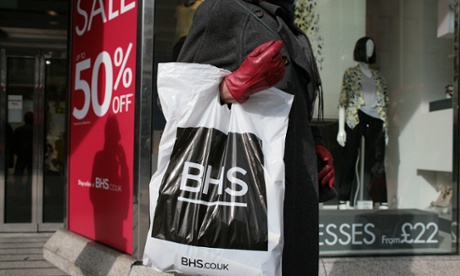
“I don’t know why anybody shops there. The buildings are always awful, the clothes, the layout, it’s all awful. I have bought something for my mum, though,” says Carol Haigh, a 62-year-old shopper, as she steps out of BHS’s flagship store on London’s Oxford Street.
As dozens of middle-aged women scan the store’s sales rails on a sunny spring afternoon, most are unaware that the whole business has just been bought for the bargain price of £1. But shoppers and retail watchers believe the new owners, a little-known group of investors, will have to invest a lot more than a pound if they are to have any hope of staging a high-street comeback.
Sir Philip Green, the man who finally offloaded BHS this week after 15 years of ownership, promised to “battle it out on the high streets” with Marks & Spencer after his attempt to buy that chain were rebuffed in 2004. “We’re going to be a contender,” he pledged.
A decade on, the Oxford Street store has the well-cared-for appearance of any flagship site but it still looks like a cut-price, cheerful version of the M&S outlet down the road.
Shoppers at the BHS store sum up its problems. “I’m not really a regular shopper,” says Faith, 49. “I think its merchandise looks a bit old. I usually shop in Debenhams. I like the fashions there and it’s got good concessions.”
Mai Seida, 32, says she’s a regular visitor to BHS as it has good prices and nice fabrics but it is mainly her mother who shops there. “I prefer H&M, Gap or Primark,” she says. Dionne Benjamin, 28, also likes Primark, H&M and New Look but visits BHS to pick up bargains on footwear or lingerie. “They do have some great bargains but my favourite shop is H&M. They have better fashion and change their stock constantly. Even if you don’t know anything about fashion you can see what’s in for the season there,” she says.
While Green’s Topshop chain continues to do well and is expanding internationally, BHS has struggled to increase sales and made a £70m loss in 2013 and a £116m loss a year before that. The company is also saddled with a pension deficit valued at about £100m in 2013 according to accounts at Companies House.
Stephen Springham at analysis firm Planet Retail said: “BHS was a very good deal for Philip Green. It enabled him to buy Arcadia and make an attempt to buy Marks & Spencer. He has taken a lot of money out of it and a lot of costs out but he has not made it fit for the future.”
BHS shareholders, led by Green’s wife, Tina, who lives in Monaco, have enjoyed dividends of at least £400m over the years.
While Green, who celebrates his birthday this weekend, enjoys the benefit of that deal and the relief of offloading a loss-making business, Springham says BHS’s stores look tired. The chain hasn’t modernised its image while competition across the high street has only become stronger.
“You’ve got to question whether things have ever been right with BHS. It’s difficult to see how it is going to break the spiral,” Springham said.
BHS’s new owner, Retail Acquisitions, headed by former racing driver and bankrupt Dominic Chappell, has said it wants to expand the group’s homewares and food sales and potentially bring in new clothing concessions alongside Green’s Wallis and Evans brands.
Retail watchers believe BHS will continue to struggle to differentiate itself in a tough market and is likely to be broken up. Primark has bought a number of BHS stores in the past and is thought to be keen to buy more, if the price is right.
“BHS has fallen foul of the middle-market malaise,” says Terry Green, who previously ran BHS, Debenhams and the clothing division at Tesco. “Primark and the supermarkets are the new middle market. If you’re positioned where BHS and Marks & Spencer are you are vulnerable, almost niche. You are not appealing to the broad market.”
Green, who headed BHS for a brief period after Philip Green’s family took control, was able to boost profits by more than £100m within 18 months at the business. He said: “We did that by putting in proper buying and merchandising practices. By looking at the supply chain and the way the stores looked. With the help of Allan Leighton [the group’s former chairman] we raised staff morale. But every 10 years you need to revitalise a store again and I’m not sure that’s happened.”
On Friday it emerged that while Green sold BHS for just a token sum, he and the group’s new owners, Retail Acquisitions, shared the proceeds of a £30m to £40m sale of BHS’s London headquarters, North West House in Marylebone. The building was sold last week to Alexander Dellal, brother of the model Alice and grandson of legendary property investor “Black Jack” Dellal.