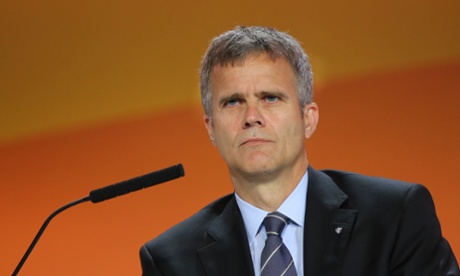
Helge Lund is one lucky man. The new chief executive of BG only arrived in February, and within a month its chairman received a call from Royal Dutch Shell. The message was that Shell wanted BG, so were they interested?
They certainly were. And the good news for Lund was that his pay package is linked to how well BG’s share price performs. It is up 40% thanks to the Shell bid. Lund is likely to pick up £25m for being in the right place at the right time. Kerching!
There is more than a little irony in this. BG faced a huge shareholder backlash when it first appointed Lund and offered a £25m pay package. The Institute of Directors slammed it as “excessive, inflammatory and contrary to the principles of good corporate governance”. Such was the anger, the deal was scaled back and more stretching targets applied. But now he could get the full original payout, faster than anyone anticipated. He will simply have to stay at the helm of the business for about a year, until the merger is complete.
BG says Lund knew nothing of the likely Shell approach before joining from the Norwegian oil company Statoil, but it should not have come as a complete surprise that the company would be sought out by one of the sector’s big boys. In the late 1990s and early 2000s – the last time the oil price was in the doldrums – there was a rash of mergers and acquisitions: ExxonMobil, BP-Amoco, and then Chevron and Total-Elf. And BG has been touted as a potential bid target ever since a series of profit warnings and the departure of Lund’s predecessor, Chris Finlayson, a year ago.
Those mega-deal days are now back, with the halving of the price of crude explaining why BG is attractive to Shell. Exploration and extraction in inhospitable parts of the world looks a lot less attractive after the price of oil halved to below $60 (£40) a barrel. Far better, Shell believes, to splash out £47bn so that it can get its hands on BG’s Brazilian reserves and its liquefied natural gas assets.
Pascal Menges, who manages the Lombard Odier global energy fund, is almost certainly right when he says the Shell-BG deal will be the first of many. Other companies, he says, will be looking to improve the quality of their portfolios by picking up smaller rivals made vulnerable either by underperformance, the falling oil price or, in the case of BG, both. Further consolidation of the industry looks inevitable.