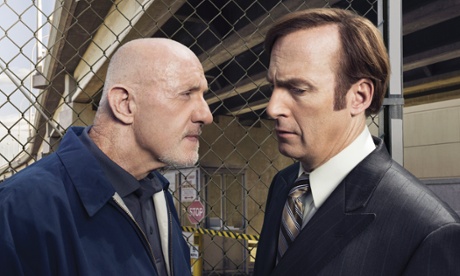
The headlines on Monday afternoon were big and bold declaring that Better Call Saul, the Breaking Bad prequel that debuted Sunday night on AMC, broke a record for the biggest cable premiere of all time. While its 6.9 million premiere is a record, we have to look at in context to see what it really means.
Almost 7 million people is huge for cable (and twice the size of some network mainstays), but to get the full picture of Better Call Saul, you have to look at The Walking Dead. That show, the highest rated on television, scored 15.6 million viewers on Sunday night. That means that Saul lost more than half the audience provided by its zombie-smashing lead-in. If that happened on network television, Saul would be on the chopping block right away. But this is cable, and Saul has already been renewed for a second season.
The other thing that a lot of those articles didn’t really examine is what would happen when Saul moved to its normal time slot on Monday night, with no lead-in at all. AMC (and HBO, and Showtime, and others) has only been able to hit it big on Sunday nights. In trying to move Saul to Monday, it hopes to establish an anchor on which it can grow more shows with less competition from the other prestige heavyweights. HBO tried this with Six Feet Under about a decade ago, but sent it back to Sundays when ratings sagged.
And indeed, the numbers for Monday’s premiere, without The Walking Dead and perhaps after people decided they don’t want to invest more time in the series, did almost half (to 3.4 million). But the real success of Saul will be gauged both when we see how many viewers it consistently drags to Monday and also how many people tune in via DVR and downloads, something that cable networks prize more than networks.
Like I said, Saul is already lined up for another season, because cable has a different way of looking at ratings. Breaking Bad, which we all think of as a huge hit, only drew 1.4 million viewers for its premiere. By the time people caught up thanks to strong interest on Netflix, the final season averaged north of 5 million viewers and the finale scored slightly over 10 million.
Saul could have the same trajectory, with more people piling on and driving its average up. But Saul had both Breaking Bad and The Walking Dead to draft off of and it still got 7 million viewers. They could disappear within a few weeks, so it might not be the sure-fire blockbuster that AMC really needs it to be.
AMC is a publicly traded company. In order to drive up its stock prices for investors, it needs to have big hits. It especially needs to show it can generate more success with Breaking Bad off the air and Mad Men ready to end this year. That’s why we’re hearing so much about Better Call Saul’s record-breaking performance – AMC wants to cultivate the perception that it has a huge success on its hands.
And they very well might. We just have to wait for the curiosity factor of Breaking Bad fans and the leftover viewers of The Walking Dead to go away and see how well Saul does standing on his own. I’m not saying it’s all gloom and doom, but let’s wait a little bit before busting out the champagne.