
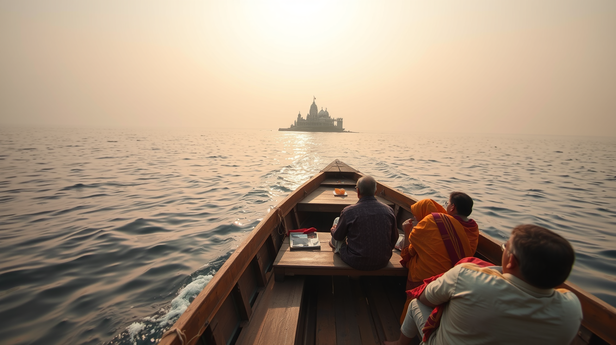
The boat ride that frames everything
The ferry from Okha to Bet Dwarka takes about fifteen minutes. You sit on a wooden bench, salt air coming at you sideways, and the island resolves out of the haze as something smaller than you expected. Pilgrims around you are already holding marigold garlands. Some have travelled from Rajasthan or Maharashtra, weeks of planning compressed into this crossing. The island is formally called Beyt Dwarka, beyt meaning island in Gujarati, and it sits about five kilometres off the coast of Okha in Gujarat's Devbhoomi Dwarka district. Tradition holds that this was Krishna's personal residence, separate from the administrative capital of Dwarka on the mainland. That distinction matters when you are trying to understand what people come here for, and why the archaeology has complicated the story without quite resolving it.
What the pilgrimage actually is
The main shrine on the island is the Dwarkadhish temple, dedicated to Krishna as lord of Dwarka. It is not ancient in the archaeological sense, the current structure dates to relatively recent centuries, though the site's sanctity is claimed to be far older. Pilgrims do a parikrama of the island, visit smaller shrines including one associated with Rukmini and another with Hanuman, and take a ritual dip at Shankhodhara ghat. The experience is physically demanding in the heat, logistically crowded during peak season, and spiritually intense in the way that only places with concentrated collective belief manage to be. What the pilgrimage offers is not evidence. It offers continuity, the sense of participating in something that has been done, in this place, for a very long time. That is not a lesser offering. It is simply a different category of truth than the one archaeology deals in.
What the underwater archaeology has found, and what it hasn't
The Archaeological Survey of India conducted underwater excavations off the coast of Dwarka, primarily in the 1980s and 1990s under the direction of Dr. S. R. Rao. The team recovered a significant number of artefacts from the seabed: stone anchors, pottery fragments, a seal bearing an animal motif, and structural remains that suggested a submerged settlement. Rao dated some of these finds to around 1500 BCE or earlier, and argued that they corroborated the account in the Mahabharata of Dwarka being submerged by the sea after Krishna's death. The finds were real. The dating was contested. Marine archaeologists and geologists pointed out that the Gulf of Khambhat region has experienced sea-level changes over millennia, and that submerged structures in this area do not automatically connect to any specific historical or mythological city. The ASI's own published reports are careful in their language, they speak of a submerged settlement, not of Krishna's Dwarka confirmed. The leap from ancient submerged ruins off Gujarat to the specific city described in the Mahabharata is one that the physical evidence does not support on its own. That doesn't make the ruins unimportant. A submerged Bronze Age settlement in these waters is genuinely significant as archaeology. It just isn't proof of the thing people most want it to prove.
The city the Mahabharata describes
The Mahabharata's account of Dwarka is elaborate. The text describes a city of extraordinary scale, gold and jewel-encrusted structures, wide roads, a port of international commerce, built by Vishwakarma, the divine architect, on land reclaimed from the sea at Krishna's request. After Krishna's death and the fratricidal war among the Yadavas, the sea reclaimed the city. The Mausala Parva, the book of the clubs, describes this submersion with the specificity of an eyewitness account and the register of elegy. Reading it, you understand why the discovery of any submerged structure off this coast would feel like confirmation. The text created the expectation. The sea provided something. Whether those two things are the same thing is the question that remains open. What is historically established is that Dwarka as a sacred site has been a centre of pilgrimage for well over a thousand years. The Dwarkadhish temple on the mainland, one of the four dhams of Hinduism, has continuous documentary history going back many centuries. The faith is old. The city of faith is old. Whether the physical Dwarka of Krishna's era lies beneath the Arabian Sea in the precise form the epic describes is a different question, and an honest answer is: probably not in that form, and we do not yet know.
What you carry back from the crossing
The pilgrims on the ferry going back to Okha look different from the ones going out. Quieter, mostly. A woman near me on one crossing was holding a small brass idol she had bought at a stall near the temple, turning it in her hands without looking at it. The island had given her something the archaeology cannot measure and cannot invalidate. This is the thing about Bet Dwarka that no amount of excavation report settles: the place functions. It functions as a site of memory, of longing, of the particular kind of presence that sacred geography creates in people who come to it with intention. The ruins under the water, whatever they are, belong to a different conversation, one about Bronze Age trade networks and sea-level change and the limits of radiocarbon dating in marine environments. Both conversations are serious. Neither cancels the other.
The submerged city and the living pilgrimage have coexisted for decades without resolution, and that coexistence is the most accurate description of what Bet Dwarka actually is. The archaeology gave the myth a shadow in the water. The pilgrimage gave the shadow a name. What lies beneath has not been fully mapped, and what lies in the heart of every person who makes that fifteen-minute crossing was never going to show up on a sonar scan.